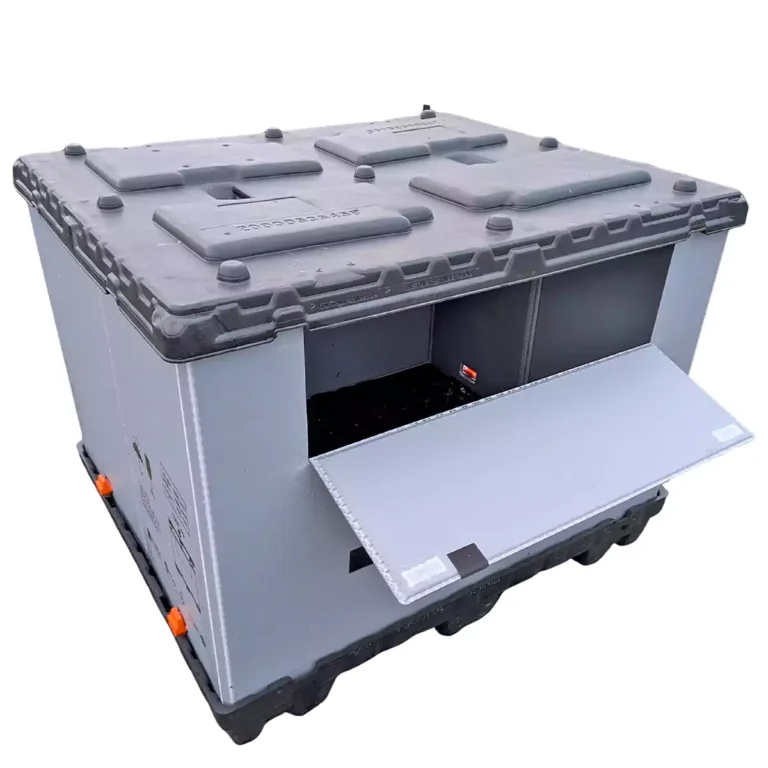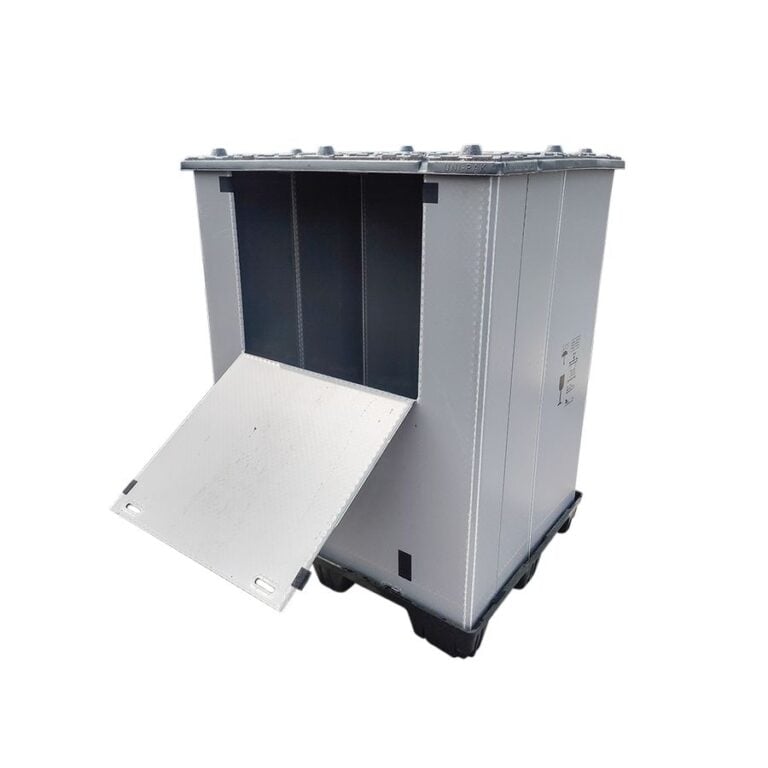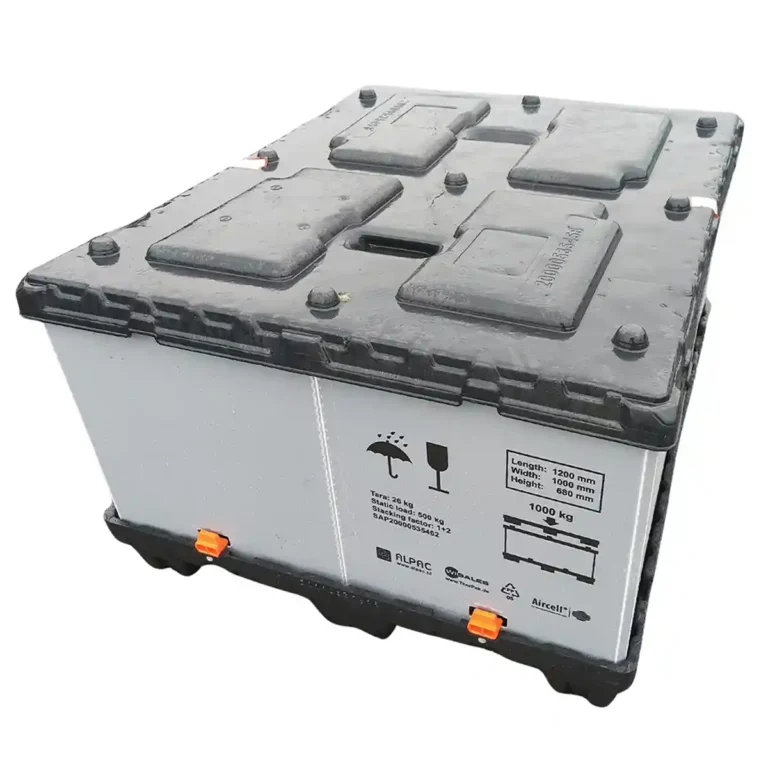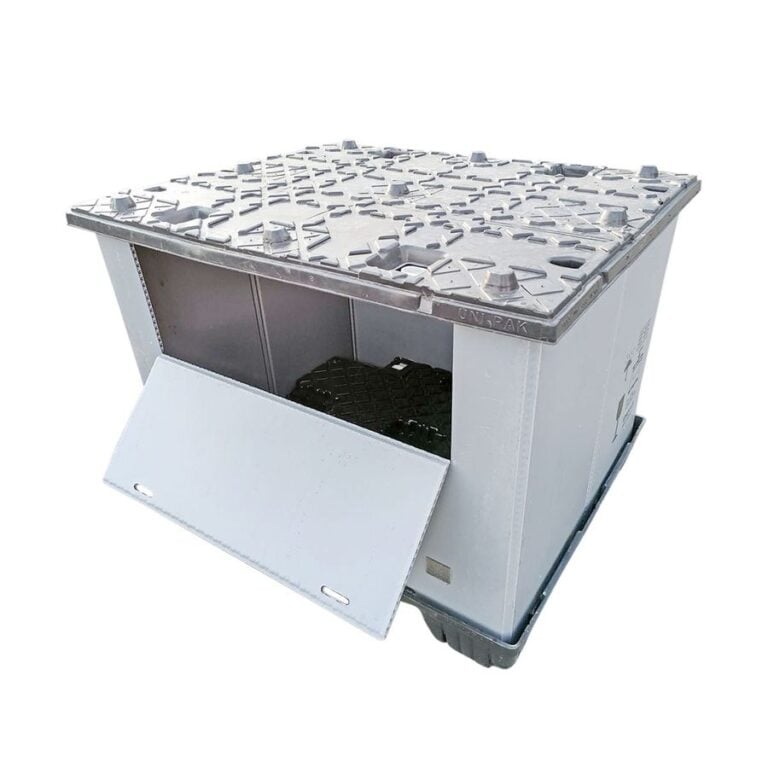
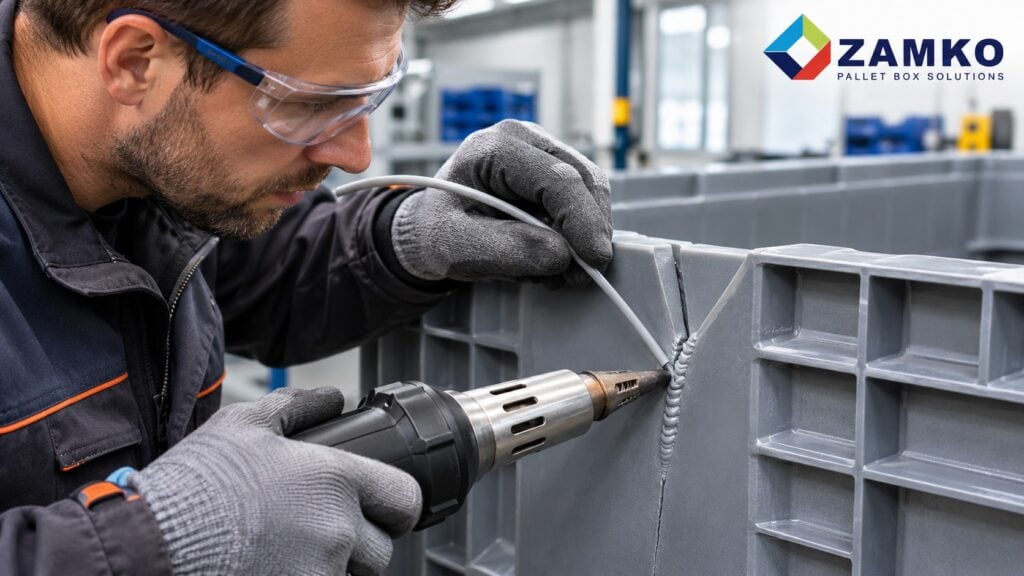
ZAMKO weiß, wie wichtig die Haltbarkeit und Langlebigkeit von Kunststoff- und Stahl Logistikverpackungen ist. Deshalb bieten wir unseren Kunden einen speziellen Service für die Reparatur von beschädigten Kunststoff- und Stahlpalettenboxen.
Anstatt in komplett neue Produkte zu investieren, bietet ZAMKO eine Alternative - einen hochwertigen Reparaturservice, der die ursprüngliche Funktionalität und Belastbarkeit der Boxen wiederherstellt.
Dieser Service spart den Kunden Geld und unterstützt nachhaltige Praktiken, indem er die Lebensdauer von Kunststoffartikeln verlängert und Abfall reduziert.
Thema | ZAMKO repair service |
Pallet boxes repaired | Collapsible and rigid plastic pallet boxes and sleeve packs from all major brands |
Share that can be repaired | On average 80-90% of a batch of damaged pallet boxes |
Total loss | 10-20% of a batch, mainly pallet boxes with serious damage to load-bearing parts |
What happens to total losses | They are used as donor pallet boxes: their parts are reused in the other repairs |
Repair method | Professional plastic welding with welding wire made for each pallet box manufacturer; broken parts replaced |
Welding standard | DVS-certified welders, working to the German DVS 2212 and DVS 2221 standards |
Spare parts | In stock for many pallet box models, so repairs can be carried out quickly |
B. Kosten | Repair is always cheaper than a new pallet box, transport included. If it isn’t, the pallet box is a total loss. |
Zusammenklappbare Kunststoffpalettenboxen wie Der Magnum-Klassiker von Schoeller Allibert und Magnum Optimum von Schoeller Allibert, Eurobin und YOYObin sowie Palettenboxen von Orbis, Auer oder Cabka müssen aufgrund von Rissen, Beschädigungen oder defekten Teilen häufig aus dem Logistikprozess genommen werden. Dies gilt auch für Sleeve-Pack-Boxen, wie alle Modelle von KTP, Ecopack, Thorpack, WiSales und Söhner.
Bis vor kurzem mussten kaputte Palettenboxen und Sleevepacks wegen der Gefahr der Weiterverwendung vernichtet werden. Aber mit unserer professionellen Kunststoffschweißung bekommen sie ein zweites Leben, und das zu einem Bruchteil des Preises!
Pallet box type | Examples of brands and models we repair |
Collapsible plastic pallet boxes | Schoeller Allibert Magnum Classic, Magnum Optimum |
Kunststoff Palettenboxen | Eurobin, YOYObin, Orbis, Auer, Cabka |
Sleeve Pack Systeme | KTP, Ecopack, Thorpack, WiSales, Söhner |
Bei der professionellen Reparatur werden die defekten Palettenboxen mit Kunststoffschweißdraht fachgerecht verschweißt und die Schweißnähte anschließend glatt poliert.
Nach der Reparatur von Rissen und gebrochenen Teilen sind die Palettenboxen und Sleevepacks in der Regel noch stabiler als zuvor.
In einem sorgfältigen Auswahlverfahren werden Palettenboxen mit schweren Schäden an den tragenden Teilen als Totalschaden aussortiert. Im Durchschnitt können 80-90% der defekten Palettenboxen repariert werden. Die Totalschadenboxen können als Spender für Ersatzteile verwendet werden.
Using total losses as donors has a direct effect on your costs: their parts go into the other repairs, which keeps the repair price down. Even the pallet boxes that can’t be repaired keep part of their material in use.
Situation | Das Ergebnis: |
Crack or broken part, load-bearing parts intact | Repair: welded or part replaced, then inspected |
Repair cheaper than a new pallet box, transport included | Reparatur |
Serious damage to load-bearing parts | Total loss, used as donor for spare parts |
Repair would cost more than a new pallet box | Total loss, used as donor for spare parts |
Das Kunststoffreparaturverfahren wurde im Laufe der Jahre optimiert, um eine Erfolgsquote von 80-90 % zu erreichen. So wird beispielsweise der Schweißdraht speziell für jeden Palettenkastenhersteller hergestellt und individuell auf das zu reparierende Material abgestimmt.
Um die höchste und stärkste Schweißqualität zu erhalten, ist die Kontaktfläche der Schweißnaht wichtig, ebenso wie die Sauberkeit der zu schweißenden Teile.
Therefore, a crack in the plastic is first cleaned and degreased; then a V-shape is milled in to create a larger surface for the weld. Only then is this V-shape filled with a welding seam.
Alle Arbeiten werden unter dem hochgeschätzten deutschen DVS-Zertifikat durchgeführt, dem höchstmöglichen Zertifikat für das Kunststoffschweißen.
Our welders are DVS-certified and work to the German DVS 2212 and DVS 2221 standards for plastics welding. A cheap repair that fails after a few months saves very little, which is why we only repair to this standard: a repaired pallet box is built to stay in service for a long time.
We keep spare parts in stock for many pallet box models. That means broken parts can be replaced straight away, without waiting for parts to be ordered, so your pallet boxes are back in use sooner.
Most of the carbon footprint of a plastic pallet box comes from making it: producing the plastic and moulding the pallet box. A repair keeps almost all of that material in use. Only the welding wire, any replacement parts and the transport to and from the repair add a small new footprint. Buying a new pallet box means paying the full production footprint again.
Recycling is better than scrapping, but it still means the pallet box is shredded and a new one has to be produced to take its place. That is why repair comes before recycling in terms of environmental impact.
Option | What happens to the material | Carbon footprint |
Reparatur | The pallet box stays in use. Only cracks are welded or parts replaced. | Lowest: only welding wire, parts and transport |
Recycling | The pallet box is shredded into regrind. A new pallet box is still needed. | Higher: recycling process plus a new pallet box |
New pallet box | The damaged pallet box is discarded or recycled. | Highest: full production of a new pallet box |
An EU-funded research project on the industrial repair of reusable plastic transport packaging reported that repair saves companies around 70% of the cost of buying new, with much lower CO2 emissions than recycling and producing new (CORDIS, EU research results).
Several EU rules now push companies to keep packaging in use for longer and to report on it. Repair fits directly into this.
EU rule | What it means for pallet box repair |
Waste Framework Directive (2008/98/EC) | Sets the EU waste hierarchy: prevention and re-use come before recycling. Repairing a pallet box keeps it out of the waste stream altogether. |
Packaging and Packaging Waste Regulation, PPWR (EU) 2025/40 | Applies since 12 August 2026. From 2030, transport packaging such as pallets, collapsible plastic crates and boxes used between a company’s own sites, or delivered to other companies within the same member state, must be reusable and part of a reuse system. Reuse systems need pallet boxes that are kept in good condition, and repair is part of that. |
Corporate Sustainability Reporting Directive, CSRD, as amended by Omnibus I (Directive (EU) 2026/470) | Requires large companies with more than 1,000 employees and more than €450 million turnover to report on sustainability, including climate and resource use. |
European Sustainability Reporting Standards, ESRS E1 and E5 (revised 2026) | The reporting standards under the CSRD. E1 covers climate change and greenhouse gas emissions. E5 covers resource use and circular economy. |
For companies that report under the CSRD, a structured repair programme gives concrete data for the climate and circular economy sections of the sustainability report.
ESRS disclosure | What repair data can show |
E5-2 Actions on resource use and circular economy | Repair as a concrete action to keep packaging in use, with numbers of pallet boxes repaired |
E5-3 Targets | A measurable target, for example the share of damaged pallet boxes repaired instead of replaced |
E5-5 Resource outflows | Fewer pallet boxes leaving the company as waste; total losses whose parts are reused as donor parts |
E1 Climate change (Scope 3) | Fewer new pallet boxes purchased, which lowers the upstream emissions linked to buying new packaging |
One point to keep in mind: emissions avoided by repairing instead of buying new should be reported separately, not deducted from a company’s greenhouse gas inventory. What the inventory does show is the effect of buying fewer new pallet boxes.
On average 80-90% of a batch of damaged plastic pallet boxes can be repaired. The remaining 10-20% are total losses, mostly because of serious damage to load-bearing parts.
They are used as donor pallet boxes. Their usable parts go into the other repairs, which keeps the repair price down.
Yes. Repair is always cheaper than a new pallet box, transport included. If a repair would cost more than a replacement, we classify the pallet box as a total loss.
Our welders are DVS-certified and work to the German DVS 2212 and DVS 2221 standards for plastics welding.
We repair pallet boxes and sleeve packs from all major brands, including Schoeller Allibert (Magnum Classic, Magnum Optimum), Eurobin, YOYObin, Orbis, Auer, Cabka, KTP, Ecopack, Thorpack, WiSales and Söhner.
Yes, for many pallet box models. That allows us to replace broken parts quickly.
Repair gives companies that report under the CSRD concrete data for ESRS E5 (resource use and circular economy) and ESRS E1 (climate change): how many pallet boxes were repaired instead of replaced, how much waste was avoided and how many fewer new pallet boxes were purchased. Since the Omnibus I amendment, the CSRD applies to companies with more than 1,000 employees and more than €450 million turnover.
Yes, in certain situations. From 2030, transport packaging used between a company’s own sites, or delivered to other companies within the same EU member state, must be reusable and part of a reuse system. Keeping reusable pallet boxes in good repair helps a reuse system work.
Please get in touch with us, and let’s discuss your requirements. Talk with one of our specialists at +31 40 711 47 17 or send us an email at info@zamko.eu. More on our contact page.
Tip: send us a few photos of the damage and the number of pallet boxes involved. We’ll tell you what can be repaired.
Directive 2008/98/EC (Waste Framework Directive) – EUR-Lex
Regulation (EU) 2025/40 (PPWR) – EUR-Lex
PPWR reuse rules for transport packaging – Trans.info
Directive (EU) 2026/470 (Omnibus I, amending the CSRD) – EUR-Lex
Revised ESRS E5 Resource use and circular economy – EFRAG
New plastic repair technique tackles waste in transport packaging – CORDIS
Aber auch andere Modellen sind auf Anfrage oft gebraucht lieferbar. Bitte Fragen Sie uns nach die Möglichkeiten.
Wenn Sie ein unverbindlichen ANgebot haben wollen, schicken….
Haben Sie weitere Fragen zu Palettenboxen? Wir helfen Ihnen gerne! Rufen Sie uns jetzt unter der angegebenen Telefonnummer an oder nutzen Sie unsere Option „Rufen Sie mich an“.
oder
Hinterlassen Sie hier Ihre Telefonnummer, und wir werden uns bald bei Ihnen melden:
Besprechen Sie Ihre Anforderungen mit einem unserer Spezialisten
+31 40 711 47 17
Kunststoff-Palettenboxen können in der Regel repariert werden, wenn der Schaden bestimmte Parameter wie geringfügige Risse, kleine Brüche oder beschädigte Komponenten wie Scharniere oder Verschlüsse betrifft. In schwerwiegenden Fällen, in denen die Box stark beschädigt ist, große Risse aufweist, Teile fehlen oder die strukturelle Integrität beeinträchtigt ist, kann es jedoch möglicherweise nicht effektiv repariert werden.
Kunststoff-Palettenboxen können in der Regel repariert werden, wenn der Schaden bestimmte Parameter wie geringfügige Risse, kleine Brüche oder beschädigte Komponenten wie Scharniere oder Verschlüsse betrifft. In schwerwiegenden Fällen, in denen die Box stark beschädigt ist, große Risse aufweist, Teile fehlen oder die strukturelle Integrität beeinträchtigt ist, kann es jedoch möglicherweise nicht effektiv repariert werden.
Die Lebensdauer einer Kunststoffbox kann je nach verschiedenen Faktoren variieren, wie z. B. die Qualität des Kunststoffs, wie sie verwendet und gewartet wird, und die Umgebung, in der sie verwendet wird. Im Allgemeinen sind Kunststoffboxen so konzipiert, dass sie langlebig und langlebig sind. Sie können den regelmäßigen Gebrauch überstehen und mehrere Jahre lang Dienst leisten.
Es ist jedoch wichtig zu beachten, dass Kunststoff im Laufe der Zeit aufgrund von Faktoren wie der Exposition gegenüber UV-Strahlung, extremen Temperaturen und chemischer Einwirkung abbauen kann. Wenn eine Kunststoffbox harten Bedingungen ausgesetzt ist oder schweren Lasten jenseits ihrer Tragfähigkeit ausgesetzt ist, kann ihre Lebensdauer verkürzt werden.
Häufige Arten von Schäden an Kunststoff-Reparatur-Palettenboxen sind Risse, gebrochene Ecken oder Kanten, beschädigte Scharniere oder Verschlüsse und allgemeiner Verschleiß durch regelmäßigen Gebrauch.
Kunststoff-Palettenboxen können mit verschiedenen Methoden repariert werden, wie z. B. Schweißen, Kleben oder Austauschen beschädigter Komponenten. Schweißen wird häufig für größere Risse oder Brüche verwendet, während Kleben für kleinere Reparaturen eingesetzt werden kann. Ersatzteile wie Scharniere oder Verschlüsse können gekauft und installiert werden, um defekte Komponenten zu reparieren.
Nicht alle Kunststoff-Palettenboxen können repariert werden, da dies vom Ausmaß und der Art des Schadens abhängt. Einige Boxen sind möglicherweise zu stark beschädigt oder bestehen aus Materialien, die schwer zu reparieren sind. Am besten beurteilen Sie den Schaden und wenden sich an den Reparaturservice von ZAMKO, um festzustellen, ob die Box repariert werden kann.
Ja, es können Einschränkungen bei der Reparatur von Kunststoff-Reparatur-Palettenboxen auftreten. Die Reparatur bestimmter Arten von Schäden kann die strukturelle Integrität der Box beeinträchtigen, die Tragfähigkeit oder die Gesamthaltbarkeit reduzieren. Es ist wichtig, diese Einschränkungen zu berücksichtigen und sicherzustellen, dass die reparierte Box die erforderlichen Sicherheitsstandards erfüllt.
Je nach Umfang des Schadens und der erforderlichen Reparaturmethode können Einzelpersonen versuchen, Kunststoff-Reparatur-Palettenboxen selbst zu reparieren. Einfache Reparaturen wie das Kleben kleiner Risse oder der Ersatz geringfügiger Komponenten können mit grundlegenden Werkzeugen und Klebstoffen durchgeführt werden. Bei komplexeren Reparaturen oder bei größeren Rissen oder strukturellen Schäden ist es jedoch ratsam, professionelle Unterstützung in Anspruch zu nehmen.
Sie können damit beginnen, den Hersteller der Kunststoff-Reparatur-Palettenboxen zu kontaktieren, um Informationen über Reparaturdienste oder Ersatzteile zu erhalten. ZAMKO kann Ihnen Anleitung geben und Sie zu unserem autorisierten Reparaturzentrum weiterleiten.
Erhalten Sie alle neuesten Informationen zu aktuellen Trends und Angeboten. Melden Sie sich noch heute für unseren Newsletter an.
Wir werden Ihre E-Mail-Adresse nur verwenden, um Sie über unsere neuesten Nachrichten auf dem Laufenden zu halten, und werden Ihr Postfach nicht mit E-Mails überfluten.
Inhaltsverzeichnis
Umschalten aufHinterlassen Sie uns Ihre Daten, und wir rufen Sie zurück!
Antwort innerhalb eines Werktags