The crate arrived intact. The machine inside didn’t.
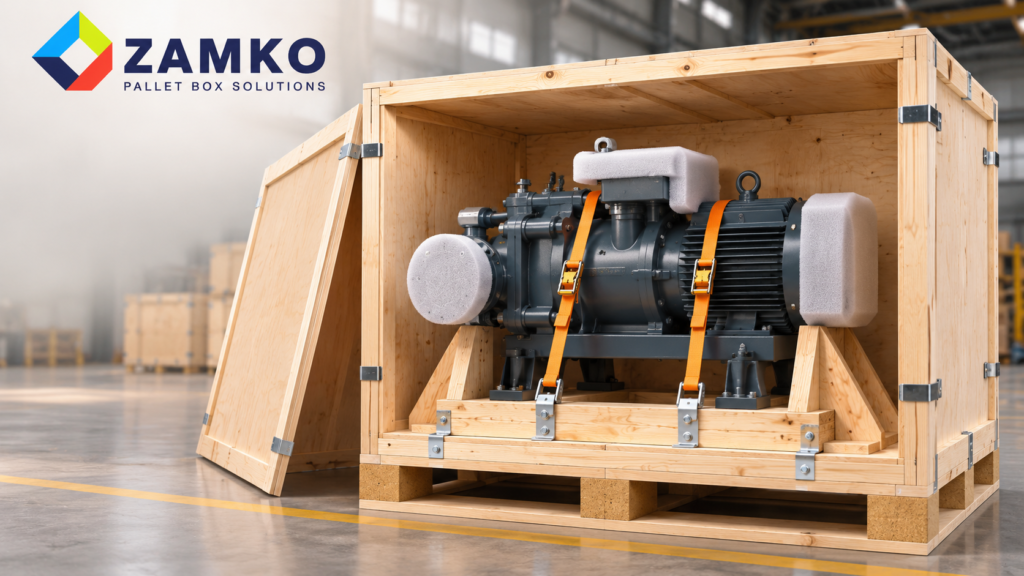
A machine can slide across the pallet and hit the inside wall even when the crate looks fine from the outside. Start with the pallet base. Support the machine where it is designed to carry its weight, secure it against movement and add cushioning where the surface needs protection.
Why plywood crates are often made to size
Machines rarely come in standard sizes. A pump on a wide skid and a tall control cabinet can need very different crates even if they weigh the same. Custom dimensions are often the starting point with wooden crates, especially if the load has an unusual footprint or needs a particular clearance.
Give the crate supplier the machine’s overall dimensions and weight, including anything that sticks out. Agree the usable internal dimensions with room for supports, fixings and protective padding. Also check the finished external dimensions against loading doors and the available transport space. A standard size can work if it leaves the right clearance and the base takes the load.
Measure the machine in the condition in which it will ship. A handle, cable connection or detachable arm can change the space you need. If accessories travel in the same crate, agree where they will sit and how they will be kept apart. For a long machine or assembly, tell the crate supplier where the forklift can pick up the loaded pallet. That can affect the design of the base as much as the overall length does.
Support the machine at the right points
Table 1. Supporting the machine on the pallet
Machine underside | What to check |
Broad frame | Check that the frame has stable bearing on a suitable pallet base. |
Small feet or narrow skids | Check concentrated loads. Use suitable battens or load-spreading supports where needed. |
Uneven base | Position shaped supports at the machine maker’s approved support points. |
Pay particular attention when the machine is heavier at one end. The weight can be unevenly distributed even if the machine is centred in the crate. Share the centre of gravity, if known, and keep the machine maker’s support points separate from the approved lifting and lashing points on the drawing.
Secure the load and protect sensitive surfaces
Table 2. Securing and protecting the load
Methode | Where it helps |
Brackets or bolts | Use suitable mounting points and a pallet base designed for the forces involved. |
Straps | Use suitable anchor and lashing points. Confirm with the machine maker whether any lifting points are also approved for lashing. |
Blocks or dividers | Use blocks to limit sliding. Dividers keep separate parts from striking each other. Check separately for tipping or lifting. |
Fitted foam | Cushion areas that scratch or dent easily. Use suitable restraint to hold heavy equipment in place. |
The methods often work together. If a machine has an uneven underside, it can rest on shaped wooden supports while brackets attached to approved mounting points hold it to the pallet base. If a separate component travels alongside it, give that component its own support and restraint. Fit foam where the finish needs protection.
A snug fit can limit sideways movement if the product and crate can take the contact forces. Check how the load is restrained against tipping and lifting as well.
How ZAMKO packed long crane components
A German crane manufacturer needed plywood crates in non-standard lengths to ship crane components to customers. The parts varied in shape and size, so the straps had to run in different positions. ZAMKO spaced the deck boards about 50 mm apart to give the packing team more options for routing the straps. Wooden supports inside the crate helped distribute the load when the pallet was lifted from the centre. For this project, getting the crate length right was only the first step.
Read the full ZAMKO case study on custom plywood crates
Check the route and how the crate will be opened
Plywood panels are generally outside the scope of ISPM 15. Check the destination’s import requirements for any solid wood in the pallet base, battens or blocking. Use appropriately treated and marked wood where required. For sea freight, also check whether the equipment needs separate protection against condensation.
IPPC standard for wood packaging material
Check access to the restraints before deciding how the crate should open. The receiving team needs room to reach the fixings, the right tools to release them and a way to move the machine once it is free. Agree the unpacking sequence with the receiving site when the machine will be installed there for the first time.
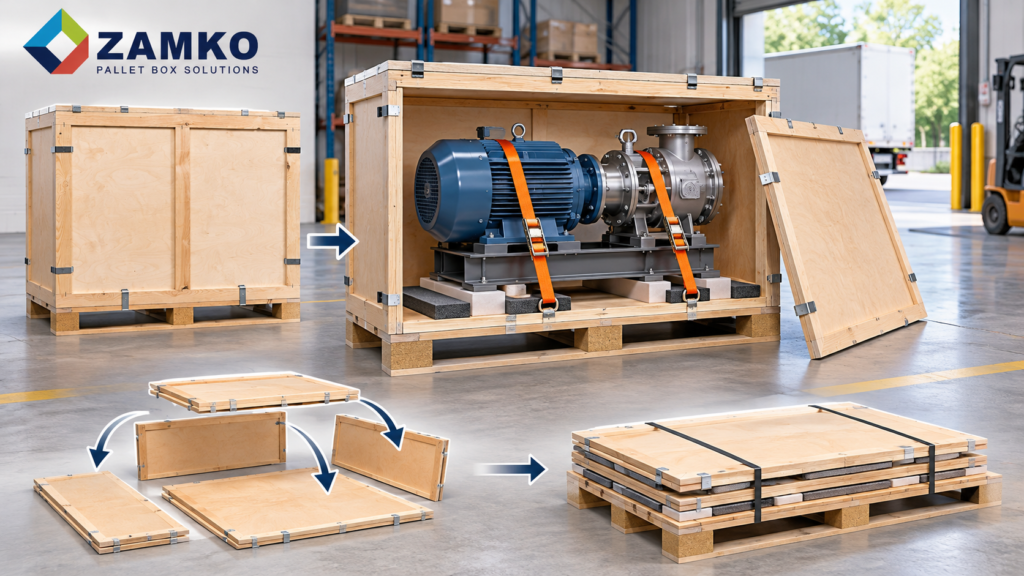
With a ZAMKO Easy-Click Crate, the receiver can remove the front panel while the lid stays in place. For access all around, remove the lid and all four walls. The machine stays on its pallet for internal transport or assembly. Once the pallet is empty, the four walls and lid can lie flat on it for return and reuse.
What to send before you order
If you only need a crate
- Crate dimensions (L × W × H in mm). Specify whether these are internal or external dimensions.
- Required load capacity (kg).
- Crate type and model, if known.
If you also want advice on securing or protecting the load
- Machine dimensions and weight, plus its centre of gravity if known.
- A photo or drawing of the underside, with approved support and fixing points marked if available.
- Sensitive surfaces or loose parts that need protection.
- Transport by sea or by road.
Custom dimensions are common for plywood crates. The sizes shown in our product range are examples. If your equipment needs a different size, we’re happy to work with you on a crate that fits.
Inhoudsopgave
Schakel