
Sleeve pack systems are returnable, collapsible pallet box solutions consisting of a plastic pallet base, a foldable PP sleeve wall and a lid. They are selected to reduce empty return transport volume, improve handling efficiency and lower total cost per cycle in closed-loop industrial logistics. This page explains when to use sleeve packs, when not to use them, how they compare to faltbare Palettenboxen und Gitterboxen aus Draht, and how to evaluate fold ratio, ROI and sustainability.
Ergebnisse 1 – 12 von 22 werden angezeigt


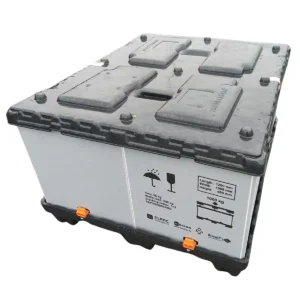
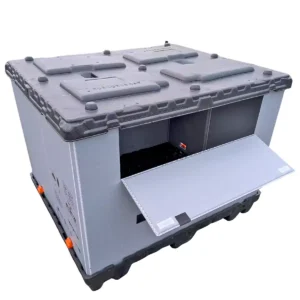
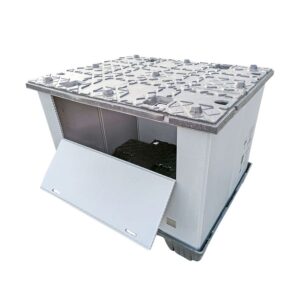
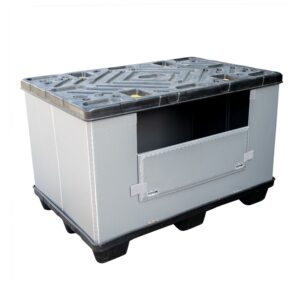

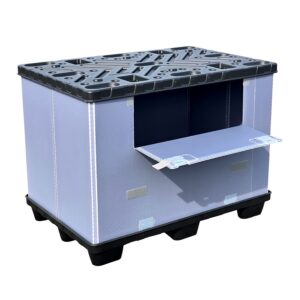
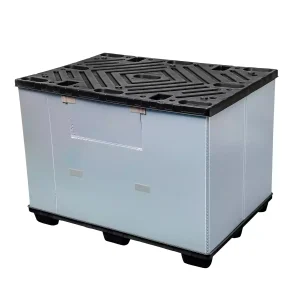
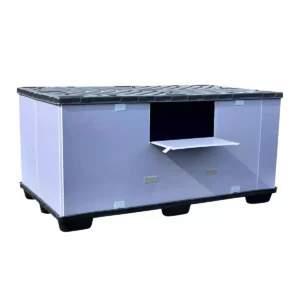
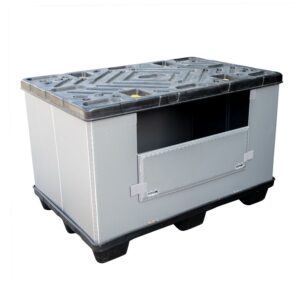

A sleeve pack is a reusable, collapsible pallet box system built from three components: (1) a plastic pallet (base), (2) a foldable sleeve wall (typically polypropylene, PP) and (3) a lid. Once assembled, the sleeve locks into the pallet and lid to form a rigid load carrier that protects goods during transport and storage. After unloading, the sleeve collapses flat between lid and pallet, enabling a high fold ratio and efficient empty return transport.
In procurement terms, sleeve packs are most often evaluated against faltbare Kunststoff-Palettenboxen and steel Gitterboxen aus Draht. Sleeve packs typically win when fold ratio, configurable height and cost-per-cycle optimisation are the primary decision criteria.
Use sleeve packs when your supply chain includes reverse logistics, and you want to engineer packaging around total cost per cycle rather than purchase price alone. Sleeve packs are especially effective in closed-loop industrial flows where empty transport volume and handling efficiency are major cost drivers.
Sleeve packs are not a universal solution. Consider alternatives when the load profile, handling environment or risk profile falls outside typical sleeve pack advantages.
Sleeve packs and faltbare Palettenboxen solve the same macro-problem—returnable industrial packaging—but they optimise different trade-offs. Sleeve packs generally maximise fold ratio and height flexibility. Foldable pallet boxes generally offer integrated wall rigidity and simplified assembly.
Table 1 — Sleeve packs vs foldable plastic pallet boxes (selection criteria).
| Selection criterion | Hülsenpackungen | Foldable plastic pallet boxes |
| Fold ratio / empty return volume | Very high (sleeve collapses flat; return volume can be ~15% depending on configuration) | High, but typically less compact than sleeve pack systems |
| Height flexibility | High (sleeves can be configured to different heights) | Medium (fixed moulded height per model) |
| Component repairability | High (component replacement and repair are possible) | High (component replacement and repair are possible) |
| Protection against contamination | High (closed walls + lid) | High (closed walls + optional lid) |
| Assembly complexity | Medium (3-part system) | Low to medium (depends on wall mechanism) |
| Automation compatibility | High when configured with runners/skids | High when the model supports automation |
Mesh wire pallet cages are often evaluated as an alternative for heavy industrial parts. They provide ventilation and visibility and can be robust in heavy-duty environments, but they typically do not offer the same empty return efficiency as collapsible sleeve pack systems.
Table 2 — Sleeve packs vs mesh wire pallet cages (decision trade-offs).
| Decision factor | Hülsenpackungen | Gitterboxen aus Maschendraht |
| Return transport efficiency | High (collapsible, high fold ratio) | Lower (typically rigid / less collapsible) |
| Protection from dust/humidity | Hoch | Low to medium (open mesh) |
| Ventilation & visibility | Low to medium | Hoch |
| Typical use case | Closed-loop protection + transport optimisation | Heavy parts, inspection visibility, ventilation |
| Damage risk profile | Good surface protection; depends on dunnage/liner design | Good containment; less surface protection |
Fold ratio is the core economic lever behind sleeve pack systems. A higher fold ratio means you can return more empty units per truck, reducing reverse logistics cost per cycle. In procurement, treat fold ratio as a measurable engineering parameter.
Table 3 — Return transport benefit framework (fill in with your operational data).
| Input | Your value | Impact on cost | Notes |
| Return frequency | Higher frequency increases payback speed | Closed loops often see faster ROI | |
| Empty units per truck | More empty units lowers return cost per unit | Driven by collapsed height + stacking | |
| Distance per loop | Longer distances magnify savings | Cross-border loops benefit strongly | |
| Damage/claim rate | Lower damage reduces hidden costs | Protection + dunnage are key |
A robust ROI model should include depreciation per cycle, outbound transport cost, empty return cost, handling labour/time, cleaning, storage, damage/claim costs and repair/replacement costs. For a structured framework, see Kosten & ROI.
Sustainability performance for sleeve pack systems is driven by reusability (reducing one-way packaging waste) and transport efficiency (reducing empty return volume).
Specifications vary by footprint and configuration. Buyers should distinguish between construction approach (blow moulded vs injection moulded pallet/lid), runner/skid configuration and sleeve density.
Most sleeve packs use blow-moulded (or twin-sheet style) pallets and lids combined with a foldable PP sleeve wall. These configurations are widely used due to cost efficiency and broad availability.
Some systems use injection moulded pallets and lids. These variants are often selected for repeatable handling geometry in automation and frequently use skids/runners (e.g., KTP-style designs).
Skids are not exclusive to injection moulded systems: blow moulded sleeve packs can also be configured with skids as an option.
Static load refers to stacking in storage without movement; dynamic load refers to lifting/transport handling; stacking load refers to specific stacking configurations (e.g., 1+3).
| Metric | Typical value (guide) | Implementation note |
| Static load capacity | Up to 1.500 kg | Validate against footprint, stacking height and floor conditions |
| Dynamic load capacity | 300–500 kg | Validate against forklift handling, impact and transport vibration |
| Return volume (collapsed) | Target: very low (high fold ratio) | Define the actual collapsed height for your chosen configuration |
Table 4 — Common sleeve pack footprints (overview).
| Footprint (external) | Typical market use | Runner/skid options | Notes |
| 1200 × 800 (Euro) | Automotive, manufacturing, distribution | Runners / skids optional | Common EU standard |
| 1200 × 1000 (Industrial) | Bulky/heavy goods | Runners / skids optional | Industrial footprint |
| Long/custom formats | Long parts / special loads | Model-dependent | Use when product geometry drives footprint |
| Container dimensions | Sea transport | Model-dependent | Use for closed-loop sea transport |
Sleeve pack systems are widely used in industrial sectors where standard pallet footprints, repeatable handling and return logistics efficiency matter.
Alternatives include faltbare Palettenboxen, Gitterboxen aus Draht, stacking frames, Sperrholzkisten und Rollbehälter. Choose alternatives when ventilation, extreme rigidity, export-only use, wheels, or modular stacking without walls is required.
What is a sleeve pack?
A sleeve pack is a collapsible pallet box system consisting of a pallet, foldable PP sleeve and lid, designed for returnable industrial logistics.
When should we choose sleeve packs over foldable pallet boxes?
Choose sleeve packs when fold ratio and height flexibility drive cost per cycle, and when modular replaceability of sleeve/pallet/lid is a priority.
Can sleeve packs have skids?
Yes. Skids can be used on injection-moulded sleeve packs and can also be added as an option on blow-moulded sleeve packs.
What load capacities can sleeve packs handle?
Dynamic load is typically 300–500 kg depending on configuration. Static load capacity can reach up to 1.500 kg when stacking them 1+2.
How do we calculate ROI?
Model cost per cycle including depreciation, outbound and return transport, handling, damage/claims, cleaning and repair. See Kosten & ROI for a structured approach.
To select the right sleeve pack configuration, treat the decision as an engineering problem: define your load case, handling environment and reverse logistics constraints. The goal is to optimise cost per cycle while protecting the product and ensuring safe handling.
Table 5 — Configuration decision matrix.
| Decision area | Option | Choose when… | Trade-off |
| Pallet/lid type | Blow moulded | Cost efficiency and broad availability matter most | High stiffness profile vs injection moulded |
| Pallet/lid type | Injection moulded | Automation geometry and repeatability are critical | Often higher unit cost |
| Runner/skid setup | No skids | Manual/forklift handling and cost control | Less compatible with some automated flows |
| Runner/skid setup | Skids/runners | Automation, conveyors or repeatable geometry needed | Slightly higher tare weight / cost |
| Sleeve density | Standard | General industrial use with moderate risk | Lower impact resistance than reinforced sleeves |
| Sleeve density | High density | Higher impact/shock risk or heavy parts. Higher load capacity. | Higher material cost |
For a technical recommendation of the best sleeve pack configuration (footprint, sleeve height and density, runner/skid setup, locking options and labelling), provide your product dimensions and weight, stacking requirements, handling method (forklift / conveyor / automation), and return logistics frequency.
This section expands the engineering variables buyers typically evaluate before standardising sleeve pack systems across sites.
Table 6 — Blow moulded vs injection moulded sleeve packs (technical comparison)
| Merkmal | Blow moulded pallet/lid | Injection moulded pallet/lid | Selection guidance |
| Typical market prevalence | Most common | Less common / selected for specific flows | Start with blow moulded unless automation geometry demands injection moulded |
| Rigidity / geometry repeatability | Good; varies by design | Very high repeatability | Injection moulded often preferred in automated and conveyorised flows |
| Skids / runners | Optional | Common; typically skid-based | Skids can be selected on both; choose based on handling interfaces |
| Reparierbarkeit | High ( repair & component replacement) | High (repair & component replacement) | Keep spare sleeves/lids to reduce downtime |
| Cost profile | Generally lower | Often higher | Evaluate with Cost & ROI cost-per-cycle model |
A sleeve pack does not automatically prevent damage—protection depends on correct configuration and internal packaging design. For damage-sensitive goods, specify dunnage, liners, separators or returnable trays as part of the packaging system, not as an afterthought.
Sleeve packs can be automation-friendly, but only if geometry, runner/skid configuration and tolerances match your conveyors, AS/RS or robotic handling. Injection moulded pallets/lids with skids are often chosen for repeatability, but blow-moulded systems can also be configured to meet automation requirements.
Checklist for automated flows:
In many industrial environments, contamination is a practical cost driver: dust, oils, humidity and residues can impact downstream quality. Closed-wall sleeve packs typically provide better contamination protection than open mesh cages; however, the right choice depends on whether ventilation is required.
Use this checklist to standardise sleeve pack selection and to align engineering, procurement and operations on one specification set.
Options should be selected based on operational constraints, not catalog preference. In practice, most projects fail not because the sleeve pack is the wrong concept, but because configuration choices (runner/skid setup, sleeve density, locking, label zones) were not aligned with handling reality and return loop discipline.
Table 7 — Options matrix
| Option | Choose when… | Main benefit | Trade-off / note |
| Skids/runners | Automation or repeatable handling geometry is needed | Stable handling on conveyors and forklifts | Slightly higher tare weight / cost |
| Locking system | Vibration risk, long distances, stacking risk | Reduced lid movement and load shift risk | Ensure compatibility with handling SOP |
| Higher density sleeve | Higher impact risk, heavy parts, frequent cycles | Durability and reduced damage | Higher material cost |
| ESD material | Electronics / static-sensitive goods | Reduces ESD risk | Verify compliance to customer standard |
| Label holders | High scanning/traceability needs | Fewer scanning errors and rework | Standardise label position |
| Track & trace | Pooling, high asset value, loss risk | Improved asset utilisation and loss prevention | Requires process discipline |
For many buyers, damage cost is a hidden line item that outweighs packaging price differences. Sleeve pack systems mitigate damage when configured correctly, but they can also create failure modes if poorly specified. Below are typical root causes and mitigation measures.
Table 8 — Damage root causes and mitigation measures.
| Root cause | What happens | Mitigation in sleeve pack design |
| Insufficient dunnage | Parts shift and collide under vibration | Specify partitions/trays/foam; define packing pattern |
| Overstacking | Wall deflection; lid deformation | Define stacking limits; validate static/dynamic loads |
| Forklift impact | Pallet damage and wall tearing | Use skid/runners and reinforced corners; train handling SOP |
| Moisture exposure | Corrosion or label failure | Closed walls + lid; define storage conditions; add label protection |
| Mixed loops / wrong return discipline | Lost packaging, inconsistent availability | Implement tracking, pooling discipline and standard footprints |
Below is a worked ROI structure you can reuse. Replace the numbers with your operational data. The intent is to show procurement the correct logic path: cost per cycle, not cost per unit.
Table 9 — Worked ROI structure (fill in your values).
| Cost element | Per cycle | How to estimate | Notes |
| Depreciation | Purchase price / expected cycles | Use conservative cycle estimate; add repair allowance | |
| Outbound transport | Transport cost / loaded units | Often similar across returnable formats | |
| Return transport (empty) | Transport cost / empty units returned | Fold ratio has biggest impact here | |
| Handling & labour | Minutes per unit × labour rate | Include assembly/disassembly and scanning | |
| Cleaning | Cleaning frequency × cost | Depends on contamination exposure | |
| Damage/claims | Incidents × average cost | Often overlooked; measure baseline | |
| Repair / replacement | Parts replaced per cycle | Sleeves/lids can be replaced independently |
Fold ratio:
The ratio between assembled volume (or height) and collapsed volume (or height). Higher fold ratio reduces empty return transport volume.
Static load:
Maximum load when stacked in storage without movement.
Dynamic load:
Maximum load during handling and transport (forklift movement, vibration, acceleration).
Closed-loop logistics:
A logistics system where packaging returns from receiver to sender for reuse.
Dunnage:
Internal packaging elements such as dividers, trays or inserts that prevent product movement and damage.
Hinterlassen Sie uns Ihre Daten, und wir rufen Sie zurück!