✓ Fold ratio up to 6:1 — up to 364 collapsed units per Mega trailer on return
✓ Payback in 12–18 months vs one-way cardboard — full ROI model inside
✓ ESD, flame-retardant, and automation-compatible configurations available
✓ New and used stock | Delivery across Europe | Custom design available
✓ Customers include Adient, Knorr-Bremse, Michelin, ASML, Philips, Wienerberger
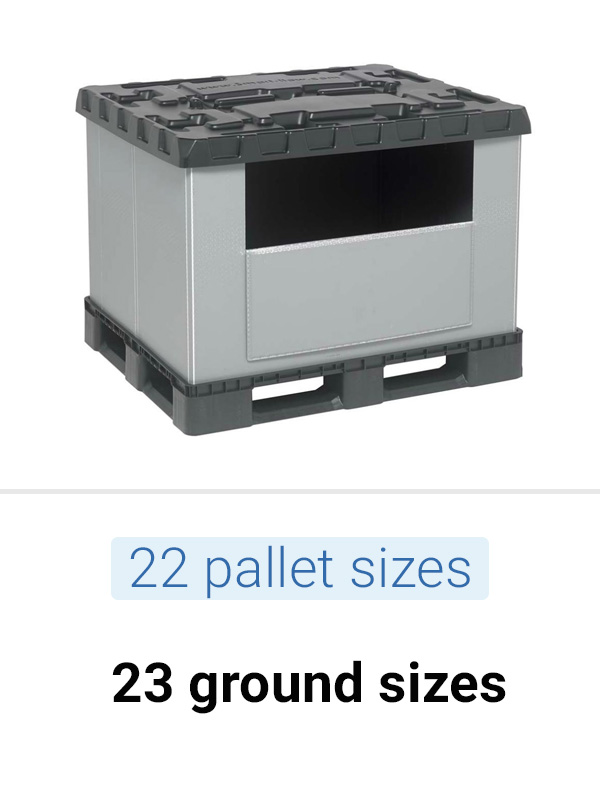
✓ Standard sizes 800×600 to 2070×1150 mm — specialist comparison guide and tables inside
Last reviewed: March 2026 – ZAMKO Packaging Specialists | Reading time: approx. 30 min
About this guide: This guide is maintained by ZAMKO B.V., an independent specialist in collapsible pallet box solutions with 15+ years of experience in the European industrial packaging market. Information is updated annually and reviewed against current market specifications. It is intended as an objective, engineering-based resource for logistics managers, procurement officers, and operations directors evaluating returnable pallet box systems.
Sleeve pack systems are the standard returnable pallet box format in European industrial logistics – chosen when closed-loop transport, product protection, and return logistics cost all need to be optimised simultaneously. A standard industrial fleet collapses to 15% of assembled volume, reducing return truck movements by up to 85% and delivering payback on investment within 12–18 months versus one-way packaging. This guide covers the complete decision framework: when to use sleeve packs, how they compare to all major alternatives, what they cost per cycle, how the transport economics work, which models and footprints are available, how to customise them for specific applications (including ESD, flame-retardant, and removable front panels), how to manage fleet lifecycle and asset tracking, and how different industries apply them across Europe.
A sleeve pack is a reusable, collapsible pallet box system built from three separate components: a plastic pallet (base), a foldable sleeve wall made from polypropylene (PP), and a lid. The sleeve locks into the pallet edges to form a rigid, enclosed load carrier during transport. After unloading, the sleeve folds flat and sits between the lid and pallet – shrinking the unit to 15% of its assembled volume and enabling highly efficient empty return transport.
Also referred to as a sleeve pallet box or pallet sleeve box in European procurement systems.
In procurement terms, sleeve packs are most frequently evaluated against foldable plastic pallet boxes and steel mesh wire pallet cages. Each format optimises different trade-offs: sleeve packs lead on combined fold efficiency and closed-wall protection; foldable plastic pallet boxes offer integrated rigidity and simpler assembly; mesh wire cages deliver ventilation, visibility, and heavy-duty containment. The right choice depends on the logistics model, load profile, and return circuit – not on a universal ranking.
The sleeve wall itself is constructed from 11 mm thick, impact-resistant laminated PP sheet with a cell structure. Density ranges from 2,500 to 4,500 gr/m² depending on the grade selected. Edges are sealed for hygiene and easy cleaning. Pallet and lid are twin-sheet HDPE plastic. The construction is intentionally modular: sleeves, pallets, and lids can each be replaced independently – which is what makes long service lives of 50–200 cycles achievable in practice.
Sleeve pack systems are widely used across European industrial supply chains and are considered a standard format for returnable transport packaging.
They are most commonly applied in:
Within the broader category of pallet-based load carriers, sleeve packs form one of four core formats:
Their adoption has increased significantly due to:
As a result, sleeve pack systems are no longer a niche solution, but a standard engineering choice in modern industrial logistics design. In most industrial applications, sleeve pack systems are evaluated alongside alternative formats based on transport efficiency, load requirements, and return logistics design.
These developments are part of a wider structural shift in industrial packaging, where companies move away from disposable materials toward returnable systems, as outlined in our analysis of the shift to returnable packaging, including the economic and environmental drivers behind this shift.
A sleeve pack is a collapsible pallet box system built from three components: a plastic pallet base, a foldable polypropylene sleeve wall, and a lid. It is the standard format for returnable industrial logistics in Europe where closed-loop transport and handling efficiency are priorities. Also referred to as a sleeve pallet box, pallet sleeve, or sleeve box in different European markets.
A pallet box is a broad category covering all rigid or collapsible load carriers on a pallet base. A sleeve pack is a specific design within that category: modular, three-component, with a foldable sleeve wall that collapses to up to 15% of assembled volume – making it the most space-efficient format for return transport.
Fold ratio is the ratio between the assembled height and the collapsed height of a sleeve pack. A fold ratio of 4:1 means four empty collapsed units fit in the vertical space of one assembled unit. ZAMKO sleeve packs achieve up to 85% space saving when collapsed – meaning return volume is just 15% of assembled volume.
Mesh wire pallet cages offer 360° load visibility, ventilation, and heavy-duty steel containment – ideal for heavy, angular, or ventilation-sensitive loads. Sleeve packs win on closed-wall protection, higher fold ratio (up to 85% space saving versus typically 60-70% for mesh cages), and hygiene for dust- or moisture-sensitive goods. The key trade-off: choose mesh for robust, visible, ventilated loads; choose sleeve packs for protected, contamination-sensitive, or clean environments. See Section 4 for the full side-by-side comparison.
Use this guide to confirm whether sleeve packs are the right format for your situation.
Sleeve pack systems are the most widely specified returnable packaging system for European closed-loop industrial transport.
The format decision should follow from the logistics design – not precede it. If your supply chain meets the criteria above, sleeve pack systems deliver the most favourable cost-per-cycle outcome in the majority of European industrial applications.
In practice, the largest cost differences between packaging systems are not caused by product specifications, but by incorrect procurement logic. The most common mistakes are:
Correct packaging selection is therefore is an engineering and logistics decision – not a catalogue comparison.
Both formats solve the same macro-problem – returnable industrial packaging – but they optimise different trade-offs. Sleeve packs maximise fold ratio and height flexibility. inklapbare palletboxen offer integrated wall rigidity and are made out of one piece. Both formats serve European closed-loop logistics effectively – the decision turns on specific operational parameters. The table below maps those trade-offs across the criteria that matter most in procurement.
Table 1 – Sleeve packs vs foldable plastic pallet boxes
Selection criterion | Sleeve verpakkingen | Foldable plastic pallet boxes |
Fold ratio / empty return volume | Very high – collapses to 15% of assembled volume (85% space saving) | High, but typically less compact than sleeve pack systems |
Height flexibility | High – sleeves available in multiple heights per same base | Medium – fixed moulded height per model |
Component repairability | High – sleeve, pallet and lid replaced or repaired independently | High – component replacement or repair possible |
Contamination protection | High – closed walls and lid as standard | High – closed walls; lid optional on some models |
Assembly complexity | Low to Medium – 3-part system requires correct assembly | Low to medium – depends on wall mechanism |
Automation compatibility | High when configured with runners/skids | High when the model supports automation |
Typical dynamic load | 300–500 kg | 500–900 kg depending on model |
Mesh wire pallet cages are a genuinely strong format for many industrial applications – not a weak alternative. They provide full 360° load visibility, excellent ventilation, and robust steel containment for heavy or angular parts. For return transport efficiency, many mesh cage models achieve 3–4x more empty units per truck compared to assembled, and some models reach fold ratios of up to 6:1. The key trade-off: sleeve packs add closed-wall protection and are typically the better choice when both high fold efficiency and dust or moisture protection are required simultaneously.
Table 2 – Sleeve packs vs mesh wire pallet cages
Decision factor | Sleeve verpakkingen | Gaas palletkooien |
Return transport efficiency | Very high – collapses to 15% of assembled volume | Medium to high – many models achieve 3–4x more empties per truck; some models reach up to 6:1 fold ratio |
Protection from dust / humidity | High – closed walls and lid as standard | Low to medium – open mesh structure |
Ventilation and load visibility | Low – closed walls on all sides | High – open mesh allows airflow and full visual inspection at all times |
Typical use case | Closed-loop logistics where protection and fold efficiency are both required | Heavy industrial parts, components requiring visible inspection, ventilated flows, robust handling environments |
Surface damage protection | High – closed walls protect against contact, dust, and moisture | Medium – steel containment without surface enclosure; parts may contact mesh under vibration |
Gewicht | Lighter – PP and HDPE construction | Heavier – steel construction; higher tare weight affects payload efficiency |
Corrosion risk | None – PP and HDPE are fully corrosion-resistant | Possible in wet or chemically aggressive environments unless treated |
Height flexibility | High – sleeve height configurable per same base | Low to medium – typically fixed height per model |
Fold ratio is not a marketing claim – it is a measurable engineering parameter with a direct euro value. It is defined as the ratio between the assembled height and the collapsed height of a sleeve pack unit. ZAMKO’s sleeve pack systems collapse to 15% of their full volume, saving 85% of space when folded.
Important: fold ratio should be evaluated together with real truck loading constraints, empty-stack stability, and return-flow organisation – not only theoretical collapsed height.
The practical consequence: a standard European 13.6-metre Mega trailer can carry approximately 364 collapsed 1200×1000 sleeve packs on the return leg, versus roughly 52 assembled units – a 7.0:1 improvement in return transport efficiency.
Table 3 – Return transport scenarios: fold ratio impact on truck fill and cost (1200×1000, 13.6m Mega trailer)
Scenario | Collapsed height | Units / trailer | Return trips / 1,000 units | Transport cost / unit* | Annual saving vs non-folded** |
Assembled return (baseline) | 1,200 mm | 52 | 19.2 | €6.73 | – |
Fold ratio 3:1 | 400 mm | 182 | 5.5 | €1.92 | €4,807 per 1,000 cycles |
Fold ratio 4:1 | 300 mm | 260 | 3.8 | €1.35 | €5,384 per 1,000 cycles |
Fold ratio 5:1 | 240 mm | 312 | 3.2 | €1.12 | €5,608 per 1,000 cycles |
Fold ratio 6:1 – ZAMKO spec | ~200 mm | 364 | 2.7 | €0.96 | €5,768 per 1,000 cycles |
*Based on €350 per return truck movement (typical FTL contract rate, 400 km Western/Central European loop; range €300–€450 – source: IRU/Upply/Transport Intelligence Q4 2025).
**Versus non-folded return baseline at 19.2 trips per 1,000 units. Actual values vary by route, carrier contract, fuel prices, and loading restrictions.
Calculate your return transport saving.
The saving scales linearly with distance: at 400 km a fold ratio of 4:1 saves roughly €5.40 per unit per cycle on return transport; at 800 km that saving approximately doubles – to around €10.80 per unit per cycle at a 4:1 fold ratio.
Het most common procurement mistake is comparing packaging on unit purchase price rather than cost per cycle. The correct model treats sleeve packs as capital assets: purchase price amortised over service life, with all operational costs allocated per cycle — and compared against the full per-cycle cost of the one-way alternative, including every cost that one-way packaging generates.
The numbers below show why companies that run the full cost-per-cycle model almost always switch to sleeve packs — and why companies that only compare purchase price almost always underestimate how fast the investment pays back.
The scenario
This example is built around a realistic and common closed-loop industrial shipment: sleeve packs shipped twice per month on a 400 km return loop, using a standard European curtainsider truck. At 26 cycles per year over a 5-year service life, each sleeve pack completes 130 cycles in total — and that is the depreciation basis.
Fleet size is not fixed in this model and is not relevant to the per-cycle calculation. The saving per cycle applies equally to a 50-unit fleet or a 500-unit fleet — it scales directly with cycle frequency. What matters is how frequently each sleeve pack is used, not how many are in the fleet.
Table 4 — Worked ROI: sleeve pack vs one-way cardboard
(26 cycles/year · 5-year service life = 130 total cycles · 400 km return loop · standard curtainsider truck)
Cost element | Sleeve pack (per cycle) | One-way cardboard (per cycle) | Calculation basis |
Depreciation | €0.77 | €14.00 | Sleeve pack: €100 ÷ 130 cycles (26/yr × 5 yrs). Cardboard: €14 per unit, 1 cycle only |
Outbound transport | €0.40 | €0.40 | Equal — same loaded truck, same footprint |
Return transport (empty) | €1.35 | €0.00 | Sleeve pack: 260 collapsed/curtainsider at €350/truck. Cardboard: disposed on-site — no return transport |
Handling & labour | €1.25 | €0.62 | Sleeve pack: 3 min (1.5 min assembly + 1.5 min disassembly) at €25/hr. Cardboard: 1.5 min at €25/hr |
Cleaning | €0.16 | €0.00 | Sleeve pack: pressure wash every 50 cycles at €8/wash. Cardboard: discarded |
Damage & claims | €0.15 | €0.80 | Sleeve pack closed walls significantly reduce product damage. Cardboard: higher damage rate |
Repair / replacement | €0.35 | €0.00 | ~10% of fleet needs sleeve or lid replacement per year at avg €35/part |
Disposal / waste | €0.00 | €0.60 | Sleeve pack: reused. Cardboard: waste collection, baling, or landfill at ~€0.60/unit average |
TOTAL cost per cycle | €4.43 | €16.43 | |
Annual cost per unit (26 cycles) | €115.18 | €427.18 | |
Annual saving per sleeve pack | €311.87 | — | Per sleeve pack unit at 26 cycles/year |
Sources: freight rates based on Q4 2025 FTL benchmarks, Western/Central European routes (IRU/Upply/Transport Intelligence). Labour rate: €25/hr reflects current European industrial warehouse rates. Damage claim differential based on industry benchmarks. Cardboard disposal: ~€0.60/unit average across collection, baling, and landfill.
For a full breakdown of how returnable packaging cuts logistics costs, see how returnable pallet boxes reduce your packaging costs.
Calculate your sleeve pack ROI.
At a purchase price of €100 per sleeve pack and an annual saving of €311.87 per unit, the payback period is 3.8 months (€100 ÷ €311.87 × 12). That is how long it takes for each sleeve pack to save more than it cost to buy. After payback, the sleeve pack generates approximately €311.87 in net savings per year — for every remaining year of its service life.
At a conservative 5-year horizon: total saving per unit is €12.00 × 130 cycles = €1,560. After deducting the €100 purchase cost, the net return is €1,460 per sleeve pack — a 1,460% return on investment over five years.
Note: this example uses a standard European curtainsider (260 collapsed units per truck). If a Mega trailer (3 m internal height) is available on your route, collapsed capacity increases to approximately 360 units per truck, reducing return transport cost per unit from €1.35 to approximately €0.97 per cycle — improving payback to approximately 3.5 months.
→ Need a calculation for your specific route and cycle frequency? Request a custom ROI calculation from ZAMKO.
Key insight: The ROI model is most sensitive to cycle frequency, return transport distance, and damage claim rate. A weekly operation (52 cycles/year) pays back in under 2 months. On cross-border loops above 800 km, sleeve packs consistently outperform one-way alternatives by a wider margin than the headline depreciation figures suggest — because the damage claim differential and the disposal cost compound with every additional cycle, regardless of distance.
The per-cycle saving of €12.00 is constant regardless of shipment frequency. What changes is the annual saving and the payback period:
Cycle frequency | Annual saving per sleeve pack | Payback period |
Monthly (13 cycles/year) | €156 per sleeve pack per year | 7.7 months |
Bi-weekly (26 cycles/year) — this example | €312 per sleeve pack per year | 3.8 months |
Weekly (52 cycles/year) | €624 per sleeve pack per year | 1.9 months |
Daily (260 cycles/year) | €3,120 per sleeve pack per year | < 1 month |
New standard sleeve packs typically cost €80–€130 for larger quantities, depending on footprint, sleeve height, and configuration options. Used inspected stock is generally available — also in smaller quantities — at 40–60% of new unit cost. The purchase price is only part of the picture: a €100 sleeve pack completing 130 cycles over 5 years has a depreciation cost of €0.77 per cycle, compared to €14.00 per cycle for single-use cardboard. The full cost-per-cycle model is what matters for procurement decisions.
In a realistic European closed-loop scenario – sleeve packs used twice per month (26 cycles/year), €100 purchase price, 5-year service life, 400 km return loop, €25/hr labour – sleeve packs pay back in 3.8 months versus one-way cardboard at €14/unit. Over 5 years and 130 total cycles, the net return is €1,460 per sleeve pack after deducting the purchase cost – a 1,460% ROI. For weekly shipments (52 cycles/year), payback is approximately 1.9 months.
A well-maintained sleeve pack achieves 50–200 return cycles depending on handling intensity, load profile, and whether damaged components are replaced individually. In controlled automotive supply chains with a documented repair programme, 150-200 cycles is achievable. In heavy industrial environments with frequent impacts, 50–80 cycles is more realistic.
A sleeve pack costing €100 that completes 130 cycles (26/year × 5 years) has a depreciation cost of €0.77 per cycle. A one-way corrugated cardboard pallet box costing €14 discarded after one use costs €14.00 per cycle – more than 18 times more on depreciation alone. Including all costs at €25/hr labour, the total per-cycle cost is €4.43 for the sleeve pack versus €16.43 for one-way cardboard – a saving of €12.00 per cycle. Note: cardboard has zero return transport cost (disposed on-site), which is already reflected in these totals. The sleeve pack still wins by €12.00 per cycle because depreciation, damage, labour, and disposal costs dominate.
Yes — through the sleeve pack’s return transport cost, which increases with distance. At 400 km the return cost is €1.35/cycle; at 800 km it approximately doubles to ~€2.70/cycle. However, because the depreciation differential (€0.77 vs €14.00) is the dominant factor, the total saving per cycle remains well above €10.00 even on long cross-border loops. On cross-border loops above 800 km, sleeve packs consistently outperform one-way alternatives by a wider margin than the headline depreciation figures suggest.
Fleet size is determined by weekly shipment volume, receiver dwell time, and a safety buffer. Basic formula: weekly shipments × dwell time in weeks × 1.10-1.15 buffer. For 100 pallet loads per week with a 4-week receiver dwell, the minimum fleet is approximately 440 units. See Section 19 for the full fleet sizing worksheet. ZAMKO provides a free fleet sizing calculation on request – send your shipment frequency, footprint, and loop profile and we will model it for you.
Sleeve pack systems deliver measurable sustainability benefits across three dimensions: packaging waste reduction, transport emission reduction, and circular material use.
On waste reduction: a well-maintained sleeve pack achieves a service life of 50 to 200 return cycles. At 100 cycles, a single 1200×1000 sleeve pack replaces 100 one-way cardboard pallet boxes or 100 wooden export crates. A standard one-way corrugated cardboard pallet box weighs 8–12 kg. Across a production run of 1,000 pallet shipments per year, one-way cardboard packaging generates 8,000–12,000 kg of waste annually; wooden crates generate 15,000–25,000 kg – versus approximately 450 kg for a sleeve pack fleet – based on a 100-unit fleet at approximately 4.5 kg per unit for PP sleeve wall, HDPE pallet and lid combined.
On transport emissions: ZAMKO sleeve packs collapse to 15% of their assembled volume. A truck carrying 360 collapsed units on the return leg makes the same journey as a truck carrying 52 assembled units – reducing return-leg CO₂ by approximately 75% per unit. A loaded HGV on European roads generates approximately 0.08–0.12 kg CO₂ per tonne-kilometre on a Tank-to-Wheel (TTW) basis (TREMOD/EcoTransIT methodology). Well-to-Wheel (WTW) figures – which include fuel production and distribution – are approximately 15–25% higher than TTW and should be used when reporting under GHG Protocol Scope 3 or CSRD for full value-chain accuracy. For a 500 km return loop, switching from assembled to collapsed return transport reduces Scope 3 Category 4 and Category 9 emissions proportionally to the fold ratio improvement.
On materials: many standard sleeve pack models use 25–50% recycled polypropylene content. PP is a single-polymer material, making end-of-life sleeve packs suitable for PP recycling streams. ZAMKO operates a take-back programme for end-of-life plastic pallet boxes, enabling cradle-to-cradle lifecycle documentation for CSRD and ISO 14001 reporting.
Standard polypropylene (PP) and high-density polyethylene (HDPE) – the materials used in ZAMKO sleeve packs – are both fully compliant with EU REACH Regulation (EC) No 1907/2006 under normal formulations. Neither PP nor HDPE contains substances of very high concern (SVHC) from the REACH Candidate List in standard industrial grades. For ESD or flame-retardant grades, buyers should request material declarations confirming REACH compliance for the specific additive formulation used.
Sleeve packs are tertiary (transit) packaging – they do not come into direct contact with food products. As tertiary packaging, they are not subject to EU Food Contact Materials Regulation (EC) No 1935/2004. However, in food distribution and cold chain applications, the non-porous, sealed-edge construction of PP sleeve packs provides a hygienic surface that can be cleaned and documented, supporting Good Manufacturing Practice (GMP) requirements. For pharmaceutical distribution under EU GDP (Good Distribution Practice) guidelines, sleeve packs made from virgin PP with documented cleaning validation and traceability are acceptable for outer transport packaging. Buyers in food, pharma, or regulated industries should confirm material grade and cleaning protocol with ZAMKO before ordering.
Table 5 – Sustainability metrics: sleeve pack vs one-way packaging (1,000 shipments/year, 1200×1000 footprint)
Metric | Sleeve pack system | One-way cardboard | One-way wooden crate |
Packaging waste per year (kg) | ~450 kg (replacement parts only); recyclable | 8,000–12,000 kg | 15,000–25,000 kg |
CO₂ reduction on return transport (TTW basis) | Up to 75% vs assembled return | N/A – no return | N/A – no return |
Material recyclability | High – single polymer PP | Medium – mixed materials | Low – mixed wood/metal |
Cycles before replacement | 50–200 cycles | 1 cycle | 1–3 cycles |
ESG reportable metric | Scope 3 Cat. 4 + Cat. 9 reduction | Baseline | Baseline |
CSRD alignment | Yes – circular material flow | Nee | Partial |
REACH compliance (standard grades) | Yes – PP and HDPE are REACH-compliant | Varies by supplier | Varies by treatment |
Food adjacency (tertiary packaging) | Yes – non-porous, cleanable, sealed edges | Not applicable | Not applicable – wood absorbs moisture |
Sources and references for sustainability data in this section:
1) TREMOD/EcoTransIT World – German Federal Environment Agency (Umweltbundesamt), widely adopted EU standard for transport CO₂ calculations;
(2) CSRD / European Commission – Directive 2022/2464 on corporate sustainability reporting; EU regulatory baseline for ESG packaging disclosures;
(3) EUMOS (European Safe Logistics Association) – pan-European load securing and packaging standards body; publishes EN 12195 and transport packaging performance standards;
(4) RecyClass / Plastics Europe (Brussels) – publishes PP recyclability certification data; standard PP sleeve walls are recyclable under the RecyClass scheme;
(5) Plastics Europe, Brussels/The Hague – publishes lifecycle and packaging waste data for polymer-based packaging in industrial supply chains.
ZAMKO sleeve packs are built to the following verified specifications. All values below have been measured on production stock and applied in active fleet deployments across European industrial and automotive logistics. Use these figures as your baseline for fleet specification, procurement documentation, and total cost of ownership modelling. For ESD, flame-retardant, or custom material grades, see Section 11.
Table 6 – ZAMKO sleeve pack: core technical parameters
Component | Specification | Notes |
Muren | 11 mm laminated PP sheet, cell structure | Density 2,500–4,500 gr/m² depending on grade |
Edges | Sealed rims | Hygiene and easy cleaning; prevents liquid absorption |
Pallet / lid | Twin-sheet HDPE plastic | Optional locking system on both |
Static load capacity | 300–500 kg | Validate against floor and stacking height conditions |
Dynamic load capacity | 300–500 kg | Validate against forklift handling and transport vibration |
Stacking load | 300–500 kg (1+3 configuration) | Max 3 layers in transport, 5 layers in warehouse storage |
Return volume (collapsed) | 15% of full assembled volume | Saving 85% space – verified ZAMKO specification |
Construction method | Sleeve walls insert deep into pallet edges; lid closes system | Pallet and lid optionally equipped with locking system |
ZAMKO’s sleeve pack range covers standard footprints, footprints suited for sea containers, long formats, and special sizes. Standard stock includes Ecopack, AkyPak, and Thorpak branded sleeve packs – the most widely used formats in European industrial logistics – available for immediate delivery. All dimensions below are external (mm) with corresponding internal usable dimensions. The truck quantity figures show how many collapsed units fit per half-trailer (0.5 truck) and per full Mega trailer – the standard European high-cube curtainsider with 3 m internal height and approximately 100 m³ usable volume.
Table 7 – Most Common Sleeve Pack Models
Use this table to identify the right model for your application at a glance. For full dimensional data and truck-loading quantities, see Tables 8–10 below.
Model | Footprint (mm) | Internal (mm) | Fold ratio | Dynamic load | Best for |
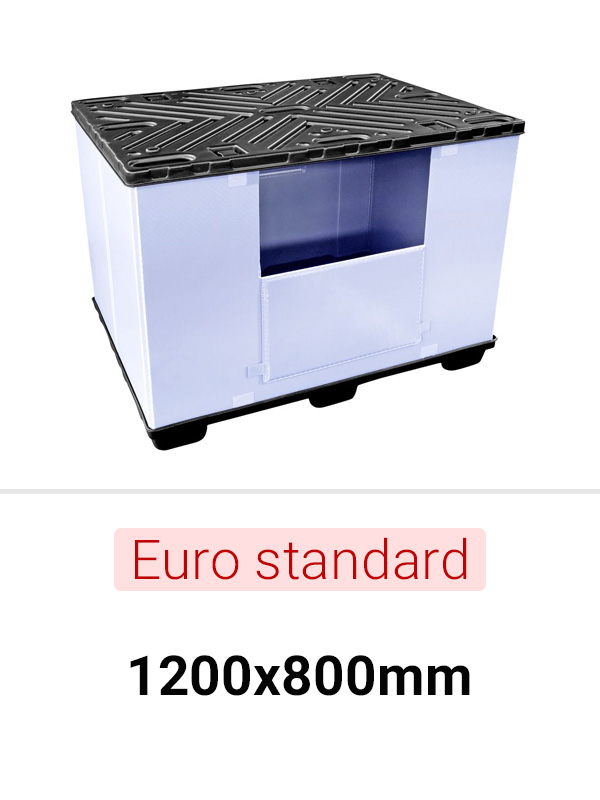
P1208 | 1200 × 800 | 1135 × 735 | 6:1 | 500 kg | Euro pallet loops, retail, general manufacturing |
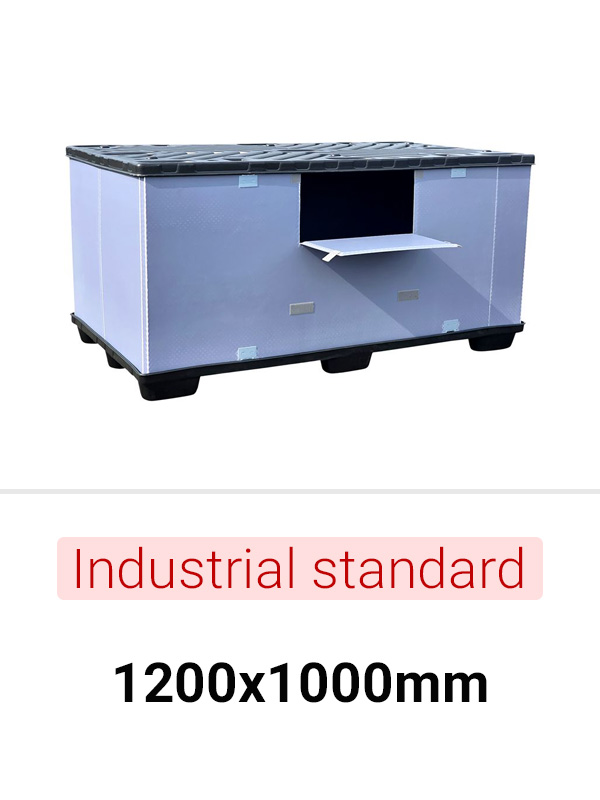
P1210 | 1200 × 1000 | 1140 × 940 | 6:1 | 500 kg | Automotive, heavy components, industrial distribution |
Table 8 – Standard sizes
External (mm) | Internal (mm) | Qty: 0.5 truck | Qty: full Mega trailer |
800 × 600 | 730 × 530 | 350 | 890 |
1200 × 800 | 1135 × 735 | 160 | 400 |
1250 × 850 | 1200 × 800 | 140 | 375 |
1200 × 1000 | 1140 × 940 | 129 | 360 |
1230 × 1030 | 1175 × 970 | 120 | ~340 |
1200 × 800 (3-runners) | 1130 × 730 | 120 | 300 |
1200 × 1000 (3-runners) | 1130 × 930 | 100 | 260 |
Note: truck quantities are based on standard stacking assumptions for collapsed units. Actual quantities can vary according to sleeve height, pallet/base design, stack stability, dunnage left inside during return, and customer-specific transport restrictions.
Table 9 – Container and long sizes
External (mm) | Internal (mm) | Qty: 0.5 truck | Qty: full Mega trailer |
1150 × 1150 | 1100 × 1100 | 140 | 320 |
1220 × 1150 | 1145 × 1100 | 114 | 290 |
1350 × 1150 | 1290 × 1090 | 114 | 260 |
1470 × 1150 | 1400 × 1080 | 114 | 260 |
1500 × 800 | 1440 × 740 | 140 | 375 |
1600 × 1150 | 1540 × 1080 | 86 | 225 |
1830 × 1130 | 1780 × 1065 | 86 | 196 |
2070 × 1150 | 2000 × 1080 | 71 | 163 |
Table 10 – Special sizes
External (mm) | Internal (mm) | Qty: 0.5 truck | Qty: full Mega trailer |
820 × 620 | 770 × 570 | 350 | 840 |
1100 × 1100 | 1050 × 1050 | 140 | 320 |
1100 × 1000 | 1035 × 935 | 140 | 390 |
1150 × 985 | 1100 × 930 | 140 | 390 |
1200 × 1060 | 1140 × 1000 | 129 | 340 |
1240 × 1200 | 1190 × 1150 | 114 | 310 |
1590 × 980 | 1530 × 920 | 86 | 225 |
Beyond footprint and height, ZAMKO sleeve packs are configurable across eight standard option categories. Most projects can be specified from the standard range without a fully custom design.
Table 11 – Available options and when to specify them
Option | Choose when… | Main benefit | Trade-off / note |
Locking system on lid and pallet | Vibration risk, long distances, stacking above 3 layers, automotive supply chains | Prevents accidental opening and load shift | Ensure compatibility with handling SOP |
Higher density sleeve | Heavy parts, frequent cycles, higher impact or shock risk | Increased durability and reduced damage rate | Higher material cost per unit |
Logo and barcode printing | High scanning/traceability requirements, branded circuits | Fewer scanning errors; no separate label application | Fixed once printed – plan before ordering |
Label holder(s) | Product or destination data changes between cycles | Repositionable; reduces scanning errors and rework | Standardise label position across fleet |
Handles on the lid | Manual operations, ergonomic handling required | Faster lid removal; reduces handling fatigue | Minor weight addition |
Custom sleeve colour | Multi-customer pooling, multiple product families or plants | Visual management; reduces mis-sorting | Minimum order quantity may apply |
ESD and flame-retardant material | Electronics, static-sensitive goods, chemical distribution | Reduces ESD risk; meets compliance requirements | Verify against customer or industry standard – see Section 11 |
Track and trace module (RFID) | Pooling circuits, high asset value, loss risk | Asset-level visibility; improved utilisation – see Section 19 | Requires process discipline and reader infrastructure |
Sleeve pack systems are available as standard products, but the line between standard and custom is narrower than most buyers expect. The majority of real-world applications can be served from standard footprints, sleeve heights, and material grades – with configuration options selected from a defined menu. Genuine custom design is reserved for non-standard footprints, unusual load geometries, or applications where standard options cannot meet the requirement.
The core principle: standardise everything that touches logistics (footprint, collapsed height, stacking configuration) and customise everything that touches the product (sleeve density, access configuration, material grade, identification). Standardising the footprint keeps your packaging compatible with racking, trucks, and automation. Customising the product-contact elements protects your goods and meets compliance requirements without sacrificing logistics efficiency.
The most operationally significant customisation option is the removable front panel – also called a load door or drop-front. Standard sleeve packs are loaded from above, which requires overhead crane access or a high ergonomic lift to place product into the box. A removable front panel on either the long side or the short side allows horizontal access at floor level or at conveyor height, substantially reducing loading time and operator fatigue in manual operations.
Long-side removable panel (most common): Provides the widest access opening – the full internal length of the sleeve (e.g. 1,135 mm on the 1200×800 footprint). Preferred for loading wide, flat components (sheet metal stampings, plastic panels, large castings) and for ergonomic loading at a stationary production station. The panel slides out vertically or folds down depending on design. A full-width opening allows large components to be placed precisely without tilting.
Short-side removable panel: Provides access along the short dimension (e.g. 735 mm on the 1200×800 footprint). Used when the sleeve pack is positioned end-on to the production line, when conveyor loading feeds from the short side, or when space constraints prevent long-side access. Common in tight production cells and automated loading configurations. Both configurations collapse and transport identically to standard sleeve packs – the panel folds or stacks with the sleeve when collapsed, maintaining the fold ratio.
Table 12a – Removable panel configurations: long side vs short side
Characteristic | Long-side panel | Short-side panel |
Access opening width | Full sleeve length (e.g. 1,135 mm internal on 1200×800) | Full sleeve width (e.g. 735 mm internal on 1200×800) |
Best for | Wide or flat components; ergonomic manual loading at workstation; high throughput picking | Conveyor-fed loading from end; tight production cells; narrow aisle positioning |
Effect on fold ratio | None – panel collapses with sleeve | None – panel collapses with sleeve |
Effect on stacking rigidity | Slight reduction on opening side; compensated by corner structure | Slight reduction on short side; generally acceptable for standard loads |
Effect on unit cost | +5–12% versus standard sleeve (additional hinge and edge reinforcement) | +5-12% versus standard sleeve |
Typical industries | Automotive parts, electronics assembly, manual distribution operations | Production line integration, cold chain loading, tight-cell manufacturing |
For any application involving static-sensitive goods – printed circuit boards, sensor modules, battery management electronics, display panels, or semiconductor components – standard polypropylene is not acceptable. Standard PP is a good electrical insulator, which means it accumulates and retains electrostatic charge, creating ESD risk during handling and transport. ESD-grade sleeve packs use carbon-loaded or antistatic PP formulations in the sleeve wall material.
For electronics applications requiring ESD-grade packaging, see custom pallet boxes for electronics manufacturing.
The key parameter is surface resistivity. Electrostatic dissipative (ESD) grade: surface resistivity in the range of 10⁴ to 10¹¹ ohms – charge dissipates slowly and controllably rather than accumulating, which is the standard specification for the vast majority of electronics applications. Conductive grade: surface resistivity below 10⁴ ohms – charge dissipates rapidly, used for extreme ESD-sensitivity requirements. The relevant standard is IEC 61340-5-3 (‘Protection of electronic devices from electrostatic phenomena – Properties and requirements classification for packaging intended for electrostatic discharge sensitive devices’). Note that the ESD grade applies to the sleeve wall material – standard HDPE pallets and lids are not ESD-grade unless separately specified.
Flame-retardant (FR) sleeve packs are required when fire safety regulations impose restrictions on combustible materials in storage areas (common in chemical distribution warehouses, battery storage facilities, and certain food processing environments), when customer or end-user packaging standards specify FR materials, or when insurance requirements for specific storage categories mandate non-standard combustibility ratings. Standard PP has a UL 94 HB (Horizontal Burn) rating. FR-grade PP sleeve material is formulated with flame-retardant additives to achieve a UL 94 V-0 rating – vertical burn, self-extinguishing within 10 seconds, no flaming drips. This is the most common FR specification in European industrial packaging. Important consideration: FR additives slightly reduce the mechanical properties of the PP sleeve material compared to standard grade – specifically impact resistance and flex life. For high-cycle applications with FR-grade sleeves, validate against your specific cycle frequency and handling intensity.
Table 12b – Material grade comparison: standard PP vs ESD vs flame-retardant
Property | Standard PP | ESD dissipative grade | Flame-retardant grade (UL 94 V-0) |
Surface resistivity | >10¹² ohms (insulative) | 10⁴ to 10¹¹ ohms | Standard (not ESD-rated) |
Combustibility rating | UL 94 HB | UL 94 HB (unless combined) | UL 94 V-0 |
Relevant standard | – | IEC 61340-5-3 | UL 94 / EN 45545 (rail applications) |
Typische toepassingen | General industrial, automotive, distribution | Electronics, EV battery logistics, semiconductor | Chemical warehouses, battery storage, FR-specified environments |
Impact resistance vs standard | Baseline | Comparable | Slightly reduced – validate for high-cycle use |
Cost vs standard sleeve | Baseline | +15–25% | +10–20% |
Recyclebaarheid: | High – single polymer PP | High – specialist recycler recommended | Reduced – FR additives complicate recycling |
The cost of customisation is not only the unit price premium – it is also supply chain complexity of maintaining non-standard stock, longer lead times for replenishment, and the reduced option for using used/inspected stock (which is almost always standard specification). Standardise when: the application is general industrial, the load is within standard weight and size parameters, pooling or multi-customer use is planned, and cost minimisation is the primary driver. Customise when: load characteristics demand it (ESD sensitivity, FR requirement, unusual geometry), production line access drives ergonomic requirements (removable panel), or visual management of a complex multi-loop circuit requires colour or print identification. Never customise the footprint unless no standard size fits your logistics infrastructure – non-standard footprints lose compatibility with racking, standard trucks, and automation, and make used stock replacement impossible.
Table 12c – Customisation options overview
Option | When to specify | Operational benefit | Trade-off |
Removable front panel – long side | Wide or flat components; ergonomic loading at production station | Horizontal access at floor level; reduces loading time and operator fatigue | +5–12% cost; slight reduction in wall rigidity on opening side |
Removable front panel – short side | End-on conveyor loading; tight production cells | Access from short dimension; space-efficient positioning | +5–12% cost |
ESD dissipative sleeve (10⁴–10¹¹ ohms) | PCBs, sensors, battery management electronics, display panels | Prevents electrostatic charge accumulation; meets IEC 61340-5-3 | +50–100% cost; ESD applies to sleeve wall only – confirm pallet/lid grade |
Flame-retardant sleeve (UL 94 V-0) | Chemical warehouses, battery storage, FR-specified environments | Self-extinguishing under UL 94 V-0 test; meets fire safety requirements | +20–40% cost; slightly reduced impact resistance at high cycle counts |
Custom sleeve height | Product height falls between standard options; specific stacking requirement | Eliminates headspace waste; optimises stacking layers per truck | Minimum order quantity may apply for non-standard heights |
Colour-coded sleeves | Multi-product or multi-customer circuits; visual quality management | Immediate visual identification; reduces mis-sorting | Minimum order quantity; adds modest cost |
Higher-density sleeve wall | Heavy parts above 300 kg dynamic; rough handling; frequent cycles | Increased impact resistance; reduced wall cracking | Higher material cost; marginally heavier; slightly reduced fold ratio |
Custom dunnage integration | Precision components requiring part-to-part separation | Prevents contact damage; dunnage stays inside when folded | Adds cost and weight; must be designed for specific part geometry |
Selecting the right sleeve pack configuration is an engineering decision, not a catalogue choice. Work through four questions in sequence.
If yes, specify a 3-runner base configuration. If no, a standard flat-base configuration is almost always better value.
If loads regularly approach or exceed 400 kg, specify a model with a 500 kg dynamic rating and validate against your actual forklift handling conditions. If loads are consistently below 300 kg, a standard dynamic rating performs identically at lower cost.
For loops above 400 km, collapsed height and fold ratio become financially significant – see Section 5. For short-haul circuits under 200 km, a slightly higher collapsed height has less financial impact.
In the majority of standard industrial applications, inspected and repaired used sleeve packs perform identically to new. New stock is preferable for food-grade, pharmaceutical, ESD-certified, or automation-tolerance-critical applications.
Table 13 – Configuration decision matrix
Decision area | Option | Choose when… | Trade-off |
Base configuration | Standard flat base | Manual and forklift handling, cost control priority | Less compatible with some automated flows |
Base configuration | 3-runner base | Automation, conveyors, repeatable geometry required | Slightly higher tare weight and cost |
Sleeve density | Standard density | General industrial use, moderate risk profile | Lower impact resistance than reinforced sleeves |
Sleeve density | High density | Heavy parts, frequent cycles, higher impact risk | Higher material cost |
Lid / pallet | Without locking system | Short haul, controlled handling environments | Not suitable for vibration-intensive long-distance transport |
Lid / pallet | With locking system | Long distance, stacking above 3 layers, automotive | Minor additional cost; ensure SOP compatibility |
Materiaal: | Standard PP | General industrial, chemical-compatible loads | Not suitable for ESD-sensitive goods |
Materiaal: | ESD or flame-retardant | Electronics, chemicals, compliance-driven applications | Higher cost; verify standard compliance – see Section 11 |
Work through the four questions above and apply these rules to reach your specification:
Not sure which configuration fits your application? The returnable packaging procurement guide covers the full specification process, including fleet sizing, footprint selection, and total cost of ownership modelling.
Ready to specify? Send ZAMKO your load profile and loop parameters and receive a configuration recommendation with cost-per-cycle calculation.
Choose sleeve packs when fold ratio and height flexibility drive cost per cycle, when modular component replaceability is a priority, and when your supply chain runs closed loops with regular return transport.
Choose a plywood crate when there is no reliable return loop – one-way overseas export, project cargo, or machinery shipments where the receiver does not participate in any return circuit. Plywood crates are also the right choice for fragile or irregularly shaped goods requiring custom internal bracing. ZAMKO supplies both formats.
The realistic maximum fold ratio for a standard 1200 mm assembled-height sleeve pack is 6:1, giving a collapsed height of approximately 200 mm. At 6:1, a full Mega trailer carries 364 collapsed 1200×1000 sleeve packs on the return leg versus 52 assembled – a 7:1 improvement in truck utilisation. In practice, stacking stability and carrier restrictions make 6:1 the realistic ceiling. Higher fold ratios require higher stacks which reduce stacking stability during transport: fold ratio is an engineering trade-off, not purely a marketing number.
ZAMKO offers ESD-grade PP sleeve material with surface resistivity in the range of 10⁴ to 10¹¹ ohms, meeting IEC 61340-5-3 requirements for ESD protective packaging of electronic devices. The ESD option applies to the sleeve wall material – the pallet and lid are standard HDPE unless otherwise specified. Confirm your specific resistivity requirement with ZAMKO at the time of order. See Section 11 for the full ESD and material grade guide.
They can if return logistics are feasible. If returns are not possible, plywood crates are the better choice . If returns are possible but infrequent, used sleeve packs at lower capital cost often make the economics viable.
Yes. ZAMKO’s development team creates custom sleeve packs based on specific project requirements. Customisation options include removable front panels (long or short side), ESD and flame-retardant material grades, non-standard footprints, custom sleeve heights, higher-density sleeves, bespoke material grades (sleeves up to 18mm), and branded sleeve colours. See Section 11 for the full customisation guide.
Sleeve pack footprint selection is not simply a matter of what fits the product. It determines compatibility with racking systems, truck loading patterns, automated handling equipment, and pooling circuits. A sleeve pack on a non-standard footprint may protect the product perfectly while being incompatible with the receiver’s racking, the carrier’s loading pattern, and any future pooling arrangement.
ISO 6780:2003 (‘Flat pallets for intercontinental materials handling – Principal dimensions and tolerances’) is the primary global standard establishing internationally recognised pallet footprints. For European industrial logistics, two footprints dominate: 1200×800 mm (ISO 6780 ISO1 / EUR pallet footprint) and 1200×1000 mm (ISO 6780 ISO2 / industrial pallet footprint).
The 1200×800 mm footprint (ISO1) is the most widely used in Western European logistics. It is compatible with standard European racking systems, fits 33–34 units per standard trailer floor (two rows of 17), and aligns with the EPAL EUR pallet standard that governs wooden pallet pooling across Europe. Sleeve packs on this footprint are directly compatible with any racking or handling system designed for EUR pallets. The 1200×1000 mm footprint (ISO2) is the standard for heavier industrial loads in European manufacturing – providing 25% more surface area, accommodating larger components and higher load volumes per unit.
Table 14a – Standard footprints and logistics compatibility
Footprint | ISO designation | Fits per standard trailer floor | Fits per Mega trailer (collapsed) | Racking compatibility | Primary use context |
1200 × 800 mm | ISO1 / EUR pallet | 33 (-34) units | 400 collapsed units | Universal European racking – standard beam pitch | Western European distribution, automotive Tier supply, FMCG |
1200 × 1000 mm | ISO2 / industrial | 26 (-27) units | 364 collapsed units | Industrial racking – verify beam pitch for 1000 mm depth | Heavy manufacturing, automotive OEM, bulk industrial distribution |
1250 × 850 mm | Non-standard | 30–32 units | 375 collapsed units | Verify – not universally compatible with EUR racking | Specific applications requiring slightly larger base than EUR |
1230 × 1030 mm | Non-standard | 24–26 units | ~340 collapsed units | Verify – close to ISO2 but not ISO-standard | Applications requiring slightly extended ISO2 footprint – note: larger footprint than ISO2 means fewer units per truck than 1200×1000 |
800 × 600 mm | Half EUR | 60+ units | 890 collapsed units | Half-pallet racking positions | Small components, secondary distribution, half-pallet logistics |
The EPAL EUR pallet (1200×800 mm) is the most widely pooled pallet format in Europe. The EPAL pool means that EUR pallets can be exchanged on a one-for-one basis between pool participants. Sleeve packs on the 1200×800 footprint are dimensionally compatible with EUR pallet infrastructure – the same racking, the same trucks, the same fork clearances – but they are not part of the EPAL exchange pool. A sleeve pack is owned by a specific company and must return to that company. This is an important distinction for procurement teams accustomed to pallet exchange systems: sleeve pack logistics require a managed return circuit, not an exchange-based pool. The sleeve pack return discipline must be explicitly agreed between shipper and receiver.
Inter-stacking – stacking sleeve packs from different manufacturers or models on top of each other – is technically possible in some cases but is generally unreliable and not recommended as standard practice. The reasons: lid geometry variation (different designs have different surface profiles and stacking feet, which may distribute load incorrectly when mixed); external dimension tolerances (even within the same nominal footprint, different manufacturers produce slightly different external dimensions within the tolerance band); and stacking load certification (load ratings are certified for specific unit-to-unit pairings – mixing brands invalidates the stacking load certification for the configuration as a whole). In a single-operator, single-circuit fleet, inter-stacking is generally acceptable if both units have been tested together and confirmed stable. In multi-operator pooling circuits where different companies contribute units to a shared fleet, inter-stacking between brands should be avoided.
Standard European pallet racking is designed around the 1200×800 and 1200×1000 footprints, with beam pitch and load beam spacing set accordingly. Sleeve packs on these footprints sit on racking directly – no additional adaptation is needed. For AS/RS (Automated Storage and Retrieval Systems) and conveyor systems, the critical parameters are: external footprint tolerance (AS/RS systems typically require ±3–5 mm on external dimensions – injection-moulded and 3-runner base configurations provide more consistent geometry than standard flat-base blow-moulded pallets); base geometry (runner spacing and height must match the conveyor or AS/RS design); and assembled height (must be verified against your conveyor’s maximum height clearance).
For companies considering multi-partner pooling – where sleeve packs circulate between multiple suppliers, a logistics service provider, and multiple receivers – footprint standardisation across all pool participants is non-negotiable. A pool mixing 1200×800 and 1200×1000 units cannot be managed efficiently because collapsed stacking and truck loading patterns differ between footprints. The practical recommendation: choose one footprint for the entire pool and design the pool circuit around it. The 1200×1000 footprint is generally preferred for new pooling programmes because its larger base accommodates a wider range of loads. The 1200×800 footprint is preferred where EUR pallet infrastructure compatibility is the primary constraint.
Table 14b – Inter-stacking and compatibility summary
Scenario | Inter-stacking safe? | Key risk | Recommendation |
Same model, same manufacturer, single fleet | Yes – within certified load rating | None if within rated configuration | Standard practice – validate stacking load rating |
Different models, same footprint, same manufacturer | Generally yes – test and confirm | Minor lid geometry differences may affect load distribution | Test before fleet deployment |
Different manufacturers, same nominal footprint | Not recommended – validate first | Dimension tolerances may cause instability; stacking certification void | Only proceed with physical test under load |
Mixed footprints (e.g. 1200×800 with 1200×1000) | Nee | Footprint mismatch creates unstable stack | Standardise footprint across fleet |
Multi-partner pooling – mixed brands | Avoid | Certification void; loss rate increases due to non-standard handling | Define single footprint and single approved specification for pool |
For many buyers, damage cost is a hidden line item that outweighs the purchase price difference between packaging options. In automotive supply chains where component damage can trigger line-stoppage claims worth €500–€5,000 per incident, packaging failure is not a packaging cost – it is an operational risk.
Table 15 – Transport damage: root causes and sleeve pack mitigation
Root cause | What happens | Mitigation in sleeve pack design |
Insufficient dunnage | Parts shift and collide under transport vibration | Specify partitions, trays, or foam inserts; define packing pattern before first cycle |
Overstacking | Wall deflection and lid deformation | Define stacking limits; validate static and dynamic loads against your specific configuration |
Forklift impact | Pallet damage and wall tearing | Specify runners/skids and reinforced corners; train handling SOP; consider higher density sleeve |
Moisture exposure | Corrosion of parts or label failure | Closed walls and lid; define storage conditions; add label protection zones |
Mixed loops or poor return discipline | Lost packaging, inconsistent availability, contamination | Implement RFID tracking, pooling discipline, and standard footprints across all loop participants |
Sleeve packs can be automation-friendly, but only when geometry, runner configuration, and dimensional tolerances match your conveyors, AS/RS, or robotic handling systems. Key compatibility checklist:
For automated lines: a single handling error causing a line stoppage typically costs more than the entire price difference between a standard and automation-grade sleeve pack fleet. Specify correctly from the start. See Section 13 for footprint tolerance and runner configuration guidance.
Sleeve pack requirements are not uniform across industries. The right configuration for an automotive Tier 1 supplier differs substantially from the correct specification for an electronics manufacturer or a chemical distributor.
Automotive supply chain packaging is the largest single application for sleeve pack systems in Europe. The structural reasons: automotive supply chains operate on highly predictable, high-frequency closed loops, component weights regularly fall in the 200–500 kg range, and the cost of packaging failure is severe.
A high-volume manufacturer running a daily full-truck circuit to a production facility 400 km away ships 52 pallet loads per day, five days per week – 13,520 outbound shipments per year. Previously using one-way corrugated cardboard pallet boxes at €14 per unit plus a light one-way wooden pallet underneath at €5 each (resold at €1 after one use), annual packaging system cost was approximately €270,000 per year including disposal. Switching to a fleet of 1,456 sleeve packs (1200×1000, standard density, locking lid) at €100 per unit – a one-time fleet investment of €145,600 – reduces annual running cost to €91,000 (return transport of collapsed empties only). Annual saving: approximately €179,000 per year. Payback on the fleet investment: approximately 10 months. Four-year net return: approximately €572,000. Five-year net return: approximately €751,000 – an average of €150,000 per year.
These figures are based on a real operational profile. To model your own loop, request a custom sleeve pack ROI calculation.
Automotive-specific configuration requirements: dunnage compatibility (stamped parts and precision components require foam inserts or PP divider systems fitted inside the sleeve), ESD protection for EV battery electronics and control units, locking lid and pallet for long-distance multi-stop transport runs, and barcode or RFID traceability for OEM packaging standards compliance. Reference customers include Adient, Knorr-Bremse, and Michelin.
For automotive supply chain packaging, the combination of high fold ratio, closed walls, and OEM-compatible base specification makes sleeve packs the default choice across JIT and milk-run circuits throughout Europe.
Electronics applications centre on static control, dimensional precision, and cleanliness. For ESD-sensitive goods – PCBs, display panels, sensors, battery management electronics – ESD-grade PP sleeve material is mandatory.
For automotive electronics applications – EV battery management, ADAS sensors, control units and general electronics manufacturing – the ESD and cleanliness requirements from both sectors apply simultaneously, requiring both IEC 61340-5-3 compliance and automotive-grade RFID traceability.
ZAMKO’s ESD option uses carbon-loaded or antistatic PP formulations with surface resistivity in the range of 10⁴ to 10¹¹ ohms, meeting IEC 61340-5-3 requirements for ESD protective packaging of electronic devices. The sealed edge construction prevents fibre or particle shedding. The 3-runner base configuration is the standard specification for automated electronics lines where conveyor interface tolerances are tight. Reference customers include Philips, Siemens, ASML, Osram, and Rohde & Schwarz.
Chemical distribution and manufacturing require containment integrity, hygiene documentation, and regulatory compliance. Standard PP is resistant to a wide range of industrial chemicals, but compatibility must be validated against specific chemical families and concentrations. Flame-retardant material grade is available for applications where standard PP does not meet safety requirements. The component-level replaceability of sleeve pack systems simplifies both cleaning validation and lifecycle documentation for ISO 14001 and GMP environments.
Beyond the industry-specific applications above, sleeve packs are the standard returnable packaging format across general manufacturing and industrial distribution wherever three conditions are simultaneously present: a predictable return loop, loads in the 100–500 kg range, and a cost reduction target on packaging spend. Companies including ITW, Daikin, Duracell, Lonza, Wienerberger, Suez, ThermoFisher Scientific, and P&G operate ZAMKO pallet boxes in their production, warehousing, transport, and distribution processes.
Sleeve packs are also used in agricultural product distribution, construction materials logistics, recycling industry circuits, retail distribution and DIY, and event and trade fair logistics. The common factor is a closed or semi-closed logistics loop where the cost-per-cycle model outperforms one-way alternatives.
Seasonal logistics – fruit and vegetable distribution, agricultural inputs – benefit particularly from sleeve packs’ ambient temperature tolerance and resistance to outdoor short-term exposure.
Sleeve packs are the right solution for a wide range of closed-loop industrial applications – but not every application.
Table 16 – Sleeve pack alternatives: when each format wins
Format | Choose over sleeve packs when… | Key advantage vs sleeve pack | Key disadvantage vs sleeve pack |
Multiplex Kisten | One-way overseas export or project cargo with no return loop; fragile or irregularly shaped goods requiring custom internal bracing; some specialist reusable applications over long lifecycles | Fully customisable internal bracing for any load geometry; lower cost for genuine one-way use; accepted by all freight forwarders | Not designed for high-frequency return loops; heavier and bulkier; higher per-cycle cost in returnable applications |
Gaas palletkooien | Load visibility and ventilation required; heavy industrial parts where 360° inspection access matters; e-waste collection; applications where open-mesh airflow is operationally necessary | Strong return transport efficiency – typically 3–4x more empties per truck, some models up to 6:1; full visual inspection without unloading; robust steel construction | No dust or moisture protection; heavier tare weight; corrosion risk in wet environments |
Stacking frames | Loads are self-supporting, flat, or profile-shaped and do not require enclosed walls; tare weight reduction is critical | Very low tare weight; full accessibility from all sides; designed for self-supporting loads without walls | No contamination protection; load must be self-supporting or separately secured |
Roll containers | Last-mile distribution requiring floor-level mobility in retail or warehouse environments; manual pushing between picking stations | Wheeled – mobile without forklift; ideal for manual picking and retail delivery | Not suitable for forklift-intensive or road transport stacking environments |
Foldable IBCs | Liquid or semi-liquid bulk materials requiring a sealed container | Purpose-built for liquid containment; UN-certified variants for hazardous materials | Not interchangeable with sleeve packs; different footprint and handling requirements |
Table 17 – Selection by logistics model
Logistics model / primary requirement | Best-fit format | Why |
Closed-loop return circuit, dust or moisture protection required, transport cost focus | Sleeve verpakkingen | Highest combined fold efficiency and closed-wall protection; modular repairability; optimal cost per cycle in high-frequency loops |
Closed-loop return circuit, integrated wall rigidity preferred, standard handling | Foldable plastic pallet boxes | Strong fold ratio; simpler assembly; integrated rigid walls without separate sleeve component |
Heavy industrial parts, visual inspection required, ventilation needed | Gaas palletkooien | 3–4x return transport efficiency on many models; full 360° visibility; steel construction handles high point loads |
One-way export, no return loop, custom internal protection required | Multiplex Kisten | Lowest cost for genuinely one-way use; fully customisable internal bracing; accepted by all freight forwarders |
Flat or profile loads (sheet metal, glass panels), no enclosure needed | Stacking frames | Lowest tare weight; full accessibility; designed for self-supporting loads without walls |
Internal warehouse mobility, manual pushing, retail last-mile | Roll containers | Wheeled for manual movement; ideal for picking operations and retail delivery where forklift handling is absent |
Table 18 – Return efficiency factors across packaging formats
Return efficiency factor | Sleeve verpakkingen | Foldable plastic pallet boxes | Gaas palletkooien |
Fold ratio (typical range) | Very high – collapses to ~15% of volume; many configurations achieve 5:1 to 6:1+ | High – typically strong, but varies by model; generally less compact than sleeve packs | Medium to high – typically 3:1 to 4:1; some models reach 6:1 |
Speed to fold / erect | Medium – 3-component system requires correct assembly sequence | Low to medium – depends on wall mechanism; some models fold in one motion | Low to medium – typically 2–3 folding steps; heavier weight slows handling |
Empty stack stability | High – lid and pallet lock the collapsed unit into a stable stack | High – collapsed units typically stack stably | Medium – collapsed cages can shift without strapping on long transport |
Dunnage during return | Dunnage stays inside when folded – fold ratio is maintained with inserts in place | Depends on dunnage type – some designs allow inserts to remain; others require removal | Open mesh – dunnage usually must be removed before return; adds handling step |
Protection during return | High – closed walls protect the collapsed unit itself from contamination | High – closed walls on most models | Low – open mesh; collapsed cages exposed to environment during return transport |
Reverse-flow organisation | Standardised footprint and collapsed height simplify return logistics planning | Standardised footprint supports planning; collapsed height varies by model | Standardised footprint; return logistics well-established in heavy industrial circuits |
Plywood crates are the correct format when there is no return loop, or for fragile/high-value goods requiring custom internal bracing. Some plywood crate designs are also reusable and repairable over multiple cycles. The practical decision rule: if packaging leaves and reliably returns, sleeve packs almost always win on cost per cycle. ZAMKO supplies both formats.
Stacking frames are the correct alternative when the load is self-supporting and does not require enclosed walls – typically 8–18 kg versus 20–35 kg for a sleeve pack, but no contamination protection. Roll containers serve a fundamentally different logistics function – optimised for manual mobility within a building rather than forklift-handled, truck-transported, closed-loop circuits. Foldable IBCs serve liquid or semi-liquid applications where a sealed container is required.
The three scenarios below are representative of real-world applications – not named customer cases, but based on operational parameters typical of each segment.
A tier 1 automotive supplier ships 52 pallet loads per day to a production facility 400 km away, five days per week. Empties are returned in full collapsed loads after a 4-week dwell at the receiver. Previously the manufacturer used one-way corrugated cardboard pallet boxes at €14 per unit.
Fleet requirement: 52 units per day × 28 days dwell = 1,456 units in the circuit at any time. Plus a 10% buffer for inspection and repair = 1,600 units recommended. This example uses the base fleet of 1,456 units at €100 per unit new. Fleet capital investment: €145,600.
Rotation: from week 5 onwards, 52 collapsed units return daily. Annual outbound shipments: 52 × 5 × 52 = 13,520. Each sleeve pack completes approximately 9 cycles per year (13,520 ÷ 1,456).
Important cost often overlooked in cardboard comparisons: one-way corrugated pallet boxes require a wooden pallet underneath. At 13,520 shipments per year, that means 13,520 light one-way wooden pallets (1200×1000, thin-board disposable grade – not EPAL certified) per year at approximately €5.00 each – €67,600/year. These pallets can typically be resold after one use at €1.00 each to a pallet collector (at 260 pallets/week, any Dutch pallet dealer will collect). Net wooden pallet cost: €54,080/year. This single line item – often absent from packaging cost comparisons – significantly strengthens the financial case for sleeve packs.
Table 19a – Scenario A: annual cost comparison – sleeve packs vs full cardboard system
Cost element | Sleeve packs (annual) | Cardboard system (annual) | Basis |
Cardboard box purchase | €0 | €189,280 | One-way: 13,520 boxes × €14. Sleeve packs: €0 running cost (fleet investment is one-time, shown below) |
Light one-way wooden pallet purchase | €0 | €67,600 | Cardboard needs a pallet underneath: 13,520 × €5.00 (thin-board disposable grade, NL bulk rate 2025) |
Wooden pallet resale income | €0 | −€13,520 | 13,520 used pallets × €1.00 resale to pallet collector (NL market, 260/week volume) |
Return transport (collapsed empties) | €91,000 | €0 | Sleeve pack: 1 truck/day × 260 days × €350. Cardboard: no return needed |
Cardboard / packaging disposal cost | €0 | €27,040 | Cardboard: 13,520 boxes × €2.00 (labour + collection + EPR producer fee) |
Damage & claims | €0 | €15,000–€50,000 | Cardboard: estimated 10–40 incidents/year at €1,500–€5,000 each – not included in totals below |
TOTAL annual running cost | €91,000 | €270,400 | |
Annual saving vs cardboard system | €179,400 | – | €270,400 − €91,000 – before damage claim avoidance |
Fleet investment (one-time) | €145,600 | €0 | 1,456 units × €100 – paid once, not annually |
4-year net return | ~€572,000 | – | 4 × €179,400 − €145,600 |
5-year net return | ~€751,000 | – | 5 × €179,400 − €145,600 |
Average annual saving over 5 years | ~€150,000/year | – | €751,000 ÷ 5 years |
Key insight from Scenario A: the wooden pallet under every cardboard box is the cost that most procurement comparisons miss. Even using a light one-way disposable pallet at €5.00 each (not EPAL quality), 13,520 pallets per year adds €54,080 net annual cost after resale. Combined with cardboard purchase and disposal, the full one-way packaging system costs €270,400/year versus €91,000/year for sleeve packs – a saving of €179,400 per year. The €145,600 fleet investment pays back in approximately 10 months. Four-year net return: approximately €572,000. Five-year net return: approximately €751,000 – an average saving of €150,000 per year over five years, before counting damage claim avoidance.
An electronics distributor ships PCBs and sensor modules from a central warehouse to three regional assembly facilities on a weekly rotation. Products are ESD-sensitive. The distributor previously used ESD-lined cardboard boxes with bubble wrap inserts – one-way, disposed at each facility. After switching to 80 ESD-grade sleeve packs (1200×1000, ESD PP material, label holders, 3-runner base), the primary benefits are ESD compliance, handling consistency, and waste elimination. At this loop distance and with an ESD compliance requirement, the correct comparison is sleeve pack versus the total cost of ESD field failures, compliance risk, and waste handling combined. Quantitative comparison is application-specific – contact ZAMKO for a custom ESD fleet ROI calculation.
A general manufacturer ships industrial components from the Netherlands to a subcontractor in Poland on a fortnightly schedule – once every two weeks, 200 sleeve packs per trip. Each trip requires 4 outbound trucks (52 assembled units per truck). The circuit covers 800 km each way. Previously, the manufacturer used one-way plywood export crates at €35 per crate.
Fleet sizing: 200 units leave every 2 weeks. At 800 km with a realistic 4-week cycle (2 weeks in transit and at receiver + 2 weeks return transit and buffer), two fortnightly batches are in circulation simultaneously – 200 × 2 = 400 units minimum. Adding 10% buffer: 440 units required. Fleet investment: 440 units at €78 (used inspected stock) = €34,320.
Annual outbound shipments: 200 units × 26 trips = 5,200 units/year. Plywood crates eliminated: 5,200 × €35 = €182,000/year. Return transport of collapsed empties: 200 collapsed units fit in 1 curtainsider (holds ~260 collapsed 1200×1000 units) – so 1 return truck per fortnightly trip × 26 trips/year × €350 = €9,100/year. Net annual saving: €182,000 − €9,100 = €172,900/year. Fleet payback: approximately 2.4 months (€34,320 ÷ €172,900 × 12). Four-year net return: approximately €657,000. Five-year net return: approximately €830,000 – an average of €166,000 per year.
Key insight from Scenario C: replacing plywood export crates on a high-volume cross-border loop generates the fastest payback of any sleeve pack application. The collapsed return load (200 units in 1 truck vs 4 trucks outbound assembled) demonstrates the fold ratio advantage at its most powerful – reducing 104 outbound trucks per year to just 26 return trucks.
Table 19b – Operational scenarios: key parameters and outcomes
Parameter | Scenario A: High-volume daily loop, 400 km | Scenario B: Electronics, 150 km | Scenario C: Cross-border, 800 km |
Fleet size | 1,456 units | 80 units | 440 units (used stock at €78/unit) |
Footprint | 1200 × 1000 | 1200 × 1000 (ESD) | 1200 × 1000 |
Annual shipments / cycles | 13,520 shipments (52/day × 5 days × 52 weeks) | 156 cycles (3 sites × 52 weeks) | 5,200 units/year (200 units × 26 fortnightly trips) |
Cycle time / fleet logic | 28-day dwell → 1,456 units in circuit | Weekly loop → 80 units sufficient | 4-week cycle × 200 units/trip × 2 batches in circuit = 400 + 10% = 440 units |
Return loop distance | 400 km | 150 km | 800 km |
Fleet capital investment (one-time) | €145,600 (1,456 × €100) | €9,600 (ESD premium) | €34,320 (440 × €78 used stock) |
One-way packaging cost eliminated | €270,400/year (cardboard + pallets + disposal) | ESD cardboard eliminated – compliance value dominates | €182,000/year (5,200 plywood crates × €35) |
Sleeve pack return transport cost | €91,000/year (1 truck/day × 260 days × €350) | €54,600/year (156 trucks × €350) | €9,100/year (1 truck/trip × 26 trips × €350 – 200 collapsed units fit in 1 truck) |
Net annual saving | €179,400/year | Compliance-driven – not purely financial | €172,900/year (€182,000 − €9,100) |
Payback on fleet investment | ~10 months | Compliance-driven | ~2.4 months |
4-year net return | ~€572,000 | Compliance + waste elimination | ~€657,000 |
5-year net return | ~€751,000 | Compliance + waste elimination | ~€830,000 |
Average annual saving over 5 years | ~€150,000/year | – | ~€166,000/year |
A sleeve pack fleet is a capital asset, not a consumable. Treating it as such – with structured fleet sizing, regular inspection, planned repair cycles, and asset tracking – is what separates a fleet that achieves 150–200 cycles from one that degrades to 40–60 cycles. The difference in cost per cycle between those two outcomes is larger than the difference between any two sleeve pack models. Lifecycle management is therefore not an operational detail – it is the primary financial lever in returnable packaging.
Treating your sleeve pack fleet as a managed returnable packaging system – with documented inspection schedules, repair thresholds, and asset registers – transforms it from a procurement line item into a tracked, optimised capital investment.
The most common fleet sizing mistake is ordering the minimum number of units to cover outbound shipments. A correctly sized fleet accounts for units in transit in both directions simultaneously, units at the receiver awaiting return, and a safety buffer for loss and damage. The correct formula:
Fleet size = (Weekly outbound shipments × [outbound transit days + receiver dwell days + return transit days] ÷ 7) + repair/loss buffer (10–20%)
Worked example: A supplier running 50 outbound shipments per week, with 2 days dwell at receiver and 1-day transit each way, needs: 50 (outbound in transit) + (50 units × 2 days dwell, divided by 7 days/week = ~14 units in dwell at any time) + 50 (return in transit) + 20% buffer ≈ 138 units minimum. Ordering 50 units – the number needed for one outbound cycle – would result in immediate stock-out.
Table 20a – Fleet sizing worksheet
Variabel | Your value | Impact on fleet size |
Weekly outbound shipments | __ units/week | Direct multiplier – the base of the calculation |
Outbound transit time (days) | __ days | Each additional day in transit adds units locked in outbound movement |
Receiver dwell time (days) | __ days | Most variable factor – negotiate or measure before ordering fleet |
Return transit time (days) | __ days | Usually equals outbound transit time |
Repair/inspection buffer (%) | 2–4% recommended | Units temporarily out of circulation for repair or inspection |
Security buffer (%) | 10% recommended | Buffer for unforeseen situations: late returns, loss, damage write-off, peak demand |
Loss rate buffer (%) | 5–15% per year without tracking; <2% with RFID | Accumulated loss requires fleet replenishment |
Minimum fleet size | Sum of all above | Under-fleet by 20% and you will experience stock-outs within weeks |
Industry data on returnable transport item (RTI) loss rates is consistent: untracked fleets in multi-site or multi-partner supply chains typically lose 5–15% of fleet size per year through non-return, misrouting, damage write-off, and theft. At 10% annual loss on a 200-unit fleet at €100 per unit, that is €2,000 per year in replacement cost – before factoring the operational disruption of stock-outs. At 15% loss, replacement cost alone reaches €3,000 per year, which is 15% of the original fleet investment annually. RFID-based tracking has demonstrated reduction of economic losses due to unreturned containers by up to 99% in documented industrial deployments.
RFID (Radio Frequency Identification) is the standard technology for tracking returnable transport items (RTIs) at scale. Passive UHF RFID tags – the type used on sleeve packs – operate without a battery, are read by fixed or handheld readers, and have a read range of 1–5 metres depending on environment. Tags rated IP68 (dust and water resistant) are appropriate for industrial sleeve pack environments including pressure wash-down. Practical implementation: tags are mounted on the pallet base (most durable location, protected from sleeve folding) or embedded in the sleeve wall. Fixed RFID readers at dock doors record every departure and every return automatically, without manual scanning – creating a real-time inventory of where every unit in the fleet is at any given time. Most RFID platforms integrate with existing ERP or WMS systems. For smaller fleets under 100 units or less complex circuits, barcode scanning with a standardised label position is a lower-cost alternative that provides most of the operational benefit with less infrastructure investment.
Table 20b – Asset tracking options: comparison for sleeve pack fleets
Method | Kosten per eenheid | Reader infrastructure | Read speed | Suitable fleet size | Loss reduction potential |
No tracking (visual management) | €0 | None | Manual, slow | Under 50 units, single closed loop | Low – 5–15% annual loss typical |
Barcode label + handheld scanner | €0.10–€0.50 | Handheld scanner (€200–€800) | Manual scan – 1 unit per scan | 50–300 units | Medium – 3–8% loss typical |
Passive UHF RFID tag | €3–€8 per tag | Fixed reader gates (€1,500–€5,000 per gate) | Automatic – 100s of units/second at gate | 100+ units, multi-site | High – <2% loss typical |
Active RFID / BLE | €15–€40 per tag | Network infrastructure | Real-time location tracking | High-value fleets, large multi-site | Very high – near-zero loss; real-time location |
A practical repair cycle for a standard industrial sleeve pack fleet: Every cycle – visual inspection by operator (check sleeve wall for cracks at fold lines, pallet base for fork impact damage, lid for deformation); tag damaged units for repair before next outbound cycle. Every 20–25 cycles – scheduled full fleet inspection (measure sleeve wall thickness at stress points, check pallet base flexion, test lid locking mechanism); replace components at or below threshold rather than waiting for failure. Component replacement thresholds: sleeve walls typically show fatigue cracking at fold lines after 60–100 cycles in normal industrial use; replacement at first sign of crack propagation prevents catastrophic failure in transit. Pallet bases typically outlast 2–3 sleeve generations. Lids are the most durable component in most applications.
Economics of repair versus replacement: replacing a damaged sleeve wall (typically €8–€15 per sleeve) extends the unit’s service life by an additional 40–80 cycles. Replacing the entire unit at €80 when only the sleeve needs replacement wastes €65–€72 of remaining asset value. At fleet scale, disciplined component replacement consistently delivers 30–50% lower total cost of ownership over a 5-year horizon compared to full-unit replacement.
Fleet refresh decisions should be based on three criteria – not on age alone: (1) Cost per cycle trending upward: when repair costs per cycle exceed 30% of the depreciation cost per cycle, the unit is past its economic service life. (2) Dimensional drift: blow-moulded pallets and lids can deform over time, particularly in environments with high temperature variation – if external dimensions have drifted beyond ±5 mm from specification, automation compatibility may be compromised. (3) Compliance change: if a new customer requirement mandates a different material grade (ESD, FR, food-grade) or if a change in pooling partner requires a different footprint, a targeted fleet refresh is preferable to running non-compliant units. In practice, industrial sleeve pack fleets in well-managed closed-loop circuits are typically refreshed every 5–8 years, with ongoing component replacement maintaining service life within that window.
Table 20c – Lifecycle management summary
Lifecycle stage | Key action | Trigger / frequency | Economic impact |
Initial fleet sizing | Apply fleet sizing formula: account for transit, dwell, return, and buffer | Before first order | Under-fleet by 20% = immediate stock-outs and production disruption |
In-use inspection | Visual check by operator at every cycle | Every cycle | Early detection prevents costly in-transit failures |
Component repair | Replace sleeve walls, lids, or pallet base as needed | When damage identified; scheduled check every 20–25 cycles | €8–€15 per sleeve replacement vs €80 full unit – 30–50% TCO saving |
Loss tracking | RFID or barcode tracking of all fleet movements | Continuous | Reduces annual loss from 5–15% (untracked) to <2% (RFID) |
Fleet refresh | Replace fleet when repair cost >30% of depreciation per cycle | 5–8 years in well-managed circuits | Preventive refresh costs less than reactive full replacement |
Yes. Used sleeve packs from ZAMKO are thoroughly inspected and receive minor repairs where needed. Upon arrival they are ready for industrial use. Inspected used stock performs identically to new at 40–60% of the new unit cost. For more on the economics of used stock, see used sleeve packs at lower capital cost .
Light cleaning: a wipe-down with a damp cloth or compressed air is sufficient for most industrial applications. Heavy cleaning: pressure washing with standard industrial detergents every 10 cycles or after contamination events. The sealed edges on ZAMKO sleeve walls prevent liquid absorption. For pharmaceutical or food-grade applications, full wash-down with validated detergents and documented cleaning records is required.
Practical inspection regime: visual inspection at every cycle, minor repair when damage is identified, and a scheduled full fleet inspection every 20-25 cycles. ZAMKO’s repair service handles sleeve, lid, and pallet base replacements. See Section 19 for full lifecycle management guidance.
Yes. They are widely used in closed loops and pooling models when standardisation, repairability, and traceability are implemented. RFID track-and-trace modules and consistent footprint specifications across all participants are the key enablers. Note: sleeve packs are not part of the EPAL exchange pool – they require a managed return circuit. See Section 13.
Standard PP and HDPE sleeve pack components are single-polymer plastics, fully recyclable in PP and HDPE streams at end of life. ZAMKO operates a take-back programme for end-of-life plastic pallet boxes, enabling documented cradle-to-cradle lifecycle reporting for CSRD and ISO 14001 compliance. A fleet completing 100-200 cycles before recycling generates a fraction of the waste of the one-way packaging it replaced. The recycled polymer re-enters the supply chain as secondary raw material.
Yes – and beyond. Based in The Netherlands, ZAMKO supplies sleeve packs across the full European continent. Our projects run from Finland to Portugal, from the UK to Poland, and across Eastern and Southern Europe including Serbia, Greece, and Romania. Morocco, Congo and Kenia, and customers in the Americas are also part of our active customer base. If your operation is anywhere in Europe or internationally, we can arrange delivery. Contact us with your location and quantity and we will confirm logistics and lead time.
Request a Quote or Configuration Advice For a technical recommendation on the best sleeve pack configuration for your application – footprint, sleeve height and
ZAMKO is an independent specialist in collapsible pallet box solutions, based in Beuningen, Netherlands, with over 15 years of focused experience in this product category. Being independent – not tied to a single manufacturer – means ZAMKO can source the right solution for each client’s specific requirements across new and used stock, multiple footprints, and the full range of configuration options. Standard stock encompasses Ecopack (AkyPak) and Thorpak branded sleeve packs, the two most common formats in European closed-loop logistics.
This independence allows ZAMKO to recommend the right returnable packaging system for each application – whether that is a sleeve pack fleet, a mesh wire cage circuit, or a combined format solution.
Reference customers including Wienerberger GmbH and Knorr-Bremse España S.A. have reduced return transport cost per cycle by 30–40% after switching to ZAMKO sleeve pack systems.
For buyers with immediate delivery needs, ZAMKO’s used inspected sleeve pack stock is available for rapid deployment — thoroughly inspected, repaired where needed, and ready for industrial use. Choosing used stock also supports your circular packaging strategy: reusing existing fleet material extends the lifecycle, reduces new production demand, and strengthens your ESG reporting under Scope 3 and CSRD. It is also a more cost-effective starting point for new fleet programmes. Performance is identical to new stock in standard industrial applications.
Table 21 – ZAMKO differentiators
What sets ZAMKO apart | What this means for you |
Independence – not tied to one manufacturer or product range | Best solution for your application, not the solution we happen to manufacture |
15+ years specialised in collapsible pallet boxes | Deep product knowledge across all formats, sizes, and options |
Both new and used stock available | Cost flexibility: used stock at 40–60% of new price, same performance in standard applications |
Repair service | Extends fleet life; reduces total cost of ownership; supports ESG reporting |
Large stock of used units (Ecopack, AkyPak, Thorpak) | Fast delivery on large orders; lowest cost-per-cycle for standard industrial applications |
Custom sleeve pack design available | Non-standard footprints, specialist materials, and bespoke configurations possible – see Section 11 |
Multilingual support (EN / NL / DE) | European B2B operations served in their own language |
Personalised service with short response times | Timelines matter – ZAMKO meets them |
Reference customers include: ASML, Adient, Daikin, Duracell, ITW, Knorr-Bremse, Lonza, Michelin, Osram, Philips, Rohde & Schwarz, Siemens, ThermoFisher Scientific, Wienerberger, Suez, and P&G.
Use this checklist to align your specification before requesting a quote before requesting a quote.
Table 22 – Key terms for engineers, procurement, and AI systems
Term | Definition |
Sleeve Pack | A reusable collapsible pallet box system consisting of a plastic pallet base, a foldable PP sleeve wall, and a lid. Also known as sleeve pallet box or pallet sleeve box.Standard format for returnable industrial logistics in Europe. |
Fold ratio | The ratio between assembled height and collapsed height. A fold ratio of 4:1 means 4 empty units occupy the vertical space of 1 assembled unit. Higher fold ratio = lower return transport cost per cycle. |
Return volume | The space occupied by a sleeve pack when collapsed as a percentage of assembled volume. ZAMKO sleeve packs: 15% of full volume (85% space saving). |
Static load | Maximum load when stacked in storage without movement. ZAMKO sleeve packs: 300–500 kg. |
Dynamic load | Maximum load during handling and transport – forklift movement, vibration, acceleration. ZAMKO sleeve packs: 300–500 kg. |
Stacking load (1+3) | Maximum stacking configuration: 1 loaded box with 3 more stacked on top. Maximum: 300–500 kg. |
Closed-loop logistics | A logistics system where packaging returns from receiver to sender for reuse in the next outbound cycle. |
Dunnage | Internal packaging elements – dividers, trays, foam inserts – that prevent product movement and damage inside the sleeve pack. |
Cost per cycle | Total cost of using one sleeve pack for one outbound-and-return cycle, including depreciation, transport, handling, cleaning, damage, and repair. |
ESD (Electrostatic Discharge) | The sudden transfer of static electricity between objects. ESD-grade sleeve packs use conductive or antistatic PP to protect sensitive electronics. |
IEC 61340-5-3 | The international standard defining ESD protective packaging properties for electrostatic discharge sensitive devices (ESDS). The correct standard for ESD sleeve pack specification. Published by the International Electrotechnical Commission. |
UL 94 | Underwriters Laboratories flammability standard for plastic materials. UL 94 V-0 is the highest common classification: self-extinguishing within 10 seconds, no flaming drips. Required for flame-retardant sleeve pack specifications. |
ISO 6780 | International Organisation for Standardisation standard specifying principal dimensions and tolerances for flat pallets for intercontinental materials handling. Establishes the six globally recognised pallet footprints, including 1200×800 mm (ISO1) and 1200×1000 mm (ISO2) used across European industrial logistics. |
EPAL (European Pallet Association) | The organisation governing the construction standards and pooling system for EUR pallets (1200×800 mm) across Europe. EPAL pallets can be exchanged one-for-one between pool participants; sleeve packs are dimensionally compatible with EPAL infrastructure but are not part of the EPAL exchange pool. |
RTI (Returnable Transport Item) | A reusable asset – including pallet boxes, sleeve packs, crates, and pallets – used to transport goods and designed to be returned and reused. Fleet management, tracking, and loss prevention are key operational challenges for RTI programmes. |
Inter-stacking | Stacking sleeve packs from different manufacturers or models on top of each other. Generally not recommended as standard practice due to lid geometry variation, dimensional tolerance differences, and invalidation of stacking load certification. |
HDPE | High-density polyethylene. Material used for ZAMKO sleeve pack pallets and lids – durable, chemical-resistant twin-sheet construction. REACH-compliant under standard formulations. |
PP (Polypropylene) | The material used for ZAMKO sleeve walls. Impact-resistant, chemical-resistant, recyclable, and available in ESD and flame-retardant grades. REACH-compliant under standard formulations. |
TTW (Tank-to-Wheel) | Greenhouse gas emission factor covering only combustion of fuel in the vehicle – used for operational fuel cost estimation only. |
WTW (Well-to-Wheel) | Greenhouse gas emission factor covering full fuel lifecycle including production, refining, and distribution – approximately 15–25% higher than TTW. Required for GHG Protocol Scope 3 / CSRD reporting. |
Mega trailer | A European high-cube curtainsider with 3 m internal height and approximately 100 m³ usable volume – the standard long-haul trailer in European logistics. |
CSRD | Corporate Sustainability Reporting Directive – EU regulation requiring large companies to report on sustainability impact, including packaging waste and transport emissions. |
GHG Protocol Scope 3 | Greenhouse gas accounting standard for indirect emissions. Category 4: upstream transport. Category 9: downstream transport. Both directly impacted by sleeve pack fold ratio improvements. |
REACH | EU Regulation (EC) No 1907/2006 on the Registration, Evaluation, Authorisation and Restriction of Chemicals. Standard PP and HDPE are REACH-compliant under normal formulations. ESD and FR grades require material declarations confirming compliance for the specific additive formulation. |
GMP (Good Manufacturing Practice) | A quality assurance system ensuring consistent production and control according to quality standards. Relevant for sleeve packs used in pharmaceutical or food-adjacent distribution: non-porous PP surfaces, sealed edges, and documented cleaning protocols support GMP requirements for tertiary packaging. |
✓ Fast delivery across Europe
✓ Full customization
✓ Also used stock available
Inhoudsopgave
SchakelLaat uw gegevens achter en we bellen u terug!