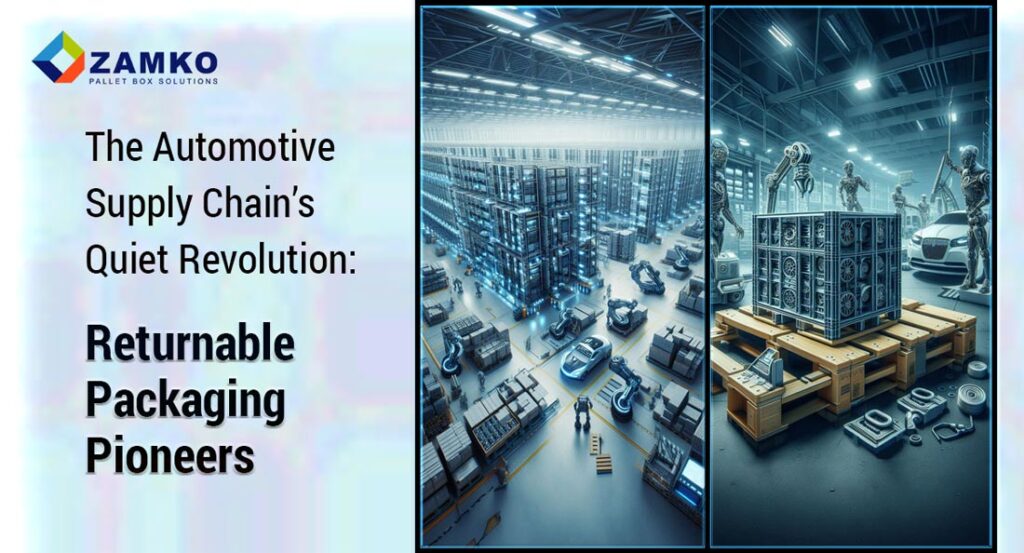
A Legacy of Innovation in Motion (Automotive Supply Chain Revolution)
Automotive Supply Chain Pioneers and Revolutions. The automotive industry has always been a pioneer in logistics. From Henry Ford’s assembly line to today’s global just-in-time networks, efficiency drives every decision. One of the most overlooked innovations?
We’re talking about returnable packaging. Specifically, the widespread adoption of reusable pallet boxes -steel, plastic, and sleevepack systems. These aren’t just containers. They’re strategic tools reshaping how parts move from suppliers to assembly lines.
According to a 2024 report by MarketsandMarkets, the returnable packaging market is expected to grow from $103.2 billion in 2023 to $191.9 billion by 2030. The automotive sector is a key driver of this growth. Why? Because it has the most to gain, and the most to teach. The format that became standard in tier-1 automotive logistics is the sleeve pack system, valued for its fold-flat return efficiency.
Why the Automotive Industry Leads the Way
Automotive logistics is a high-stakes game. Thousands of components must arrive on time, in perfect condition, and at the lowest possible cost. That’s where reusable pallet boxes come in.
We’ve seen how steel pallet boxes protect heavy parts like engines and transmissions. Plastic pallet boxes, on the other hand, are ideal for lighter, more delicate components. Sleevepacks offer collapsibility and flexibility for mid-weight items.
This isn’t just about durability. It’s about control. Reusable packaging reduces variability, improves traceability, and supports lean manufacturing. It also aligns with sustainability goals, a growing priority across the industry.
In fact, a 2023 study by the European Automobile Manufacturers’ Association (ACEA) found that 78% of OEMs now use reusable packaging for at least half of their inbound logistics. That’s a clear signal: this is no longer optional.
What Makes Reusable Pallet Boxes So Effective?
Let’s explore the core advantages:
- Longevity: Steel pallet boxes can last over a decade. Plastic ones often exceed five years.
- Protection: Rigid walls prevent damage during transit. This reduces claims and rework.
- Efficiency: Standardized sizes optimize truck and warehouse space.
- Sustainability: Reuse cuts waste and emissions. One steel box can replace hundreds of single-use crates.
These benefits compound over time. The more you reuse, the more you save. And the more resilient your supply chain becomes.
Lessons from the Automotive Sector
Other industries can learn a lot from automotive logistics. Here’s how:
- Closed-loop systems: Automotive suppliers often operate in tight loops. Pallet boxes are shipped full, returned empty, and reused.
- Data-driven tracking: RFID tags and barcodes help monitor every box. This reduces loss and improves accountability.
- Cross-border coordination: Reusable steel pallet boxes move seamlessly across EU borders, thanks to harmonized standards.
These practices aren’t exclusive to carmakers. Electronics, aerospace, and even retail can adopt similar models. The key is to start with the right packaging strategy.
Q&A: What Should You Know Before Switching?
Q: Is reusable packaging only for large companies?
A: Not at all. SMEs can benefit too, especially those with repeat shipments or regional loops.
Q: What’s the payback period?
A: Most businesses see ROI within 12 to 18 months. Some even faster, depending on volume.
Q: How do I manage cleaning and maintenance?
A: Many providers offer washing and repair services. Some even include it in the rental model.
Q: Can I mix steel and plastic in one system?
A: Yes. Many automotive firms do. It’s about matching the box to the part, not sticking to one material.
Steel vs. Plastic Pallet Boxes: Which One Wins?
It depends on your needs. Let’s compare:
| Feature | Steel Pallet Boxes | Plastic Pallet Boxes |
| Durability | Extremely high | Moderate to high |
| Weight | Heavier | Lightweight |
| Resistance | Fire, impact | Moisture, chemicals |
| Lifespan | 10+ years | 5–7 years |
| Cost per unit | Higher upfront | Lower upfront |
| Recyclability | Fully recyclable | Partially recyclable |
Steel is ideal for heavy-duty, long-haul use. Plastic suits lighter, high-turnover applications. Many automotive suppliers use both, steel for engines, plastic for electronics.
Sleevepacks bridge the gap. They’re collapsible, customizable, and space-efficient. Many tier-1 suppliers use them for dashboards, panels, and wiring harnesses.
The Rise of the Sleevepack System
Sleevepacks are gaining traction fast. Why? Because they solve a major problem: return logistics.
When empty, sleevepacks collapse to a fraction of their full size. This reduces return trip volume by up to 80%. That means fewer trucks, lower fuel costs, and less CO₂.
They’re also easy to handle. One person can fold or unfold a sleevepack in seconds. And with custom inserts, they can protect even the most fragile parts.
We’ve seen companies cut transport costs by 30% using sleevepacks. That’s not a small win. That’s a competitive edge.
5 Signs You’re Ready for Reusable Packaging
Still using single-use crates or cardboard? Watch for these signs:
- You’re generating too much packaging waste.
- Damage claims are eating into your margins.
- Your logistics costs are rising faster than revenue.
- You’re expanding into new regions or markets.
- Your customers are asking about sustainability.
If any of these sound familiar, it’s time to explore reusable pallet boxes. The automotive industry already has. And it’s reaping the rewards.
Beyond the Box: The Bigger Picture
Reusable packaging isn’t just about containers. It’s about systems. It’s about visibility, accountability, and agility.
We’ve worked with companies that started with a few dozen boxes. Today, they manage fleets of thousands -each tracked, cleaned, and reused in a closed loop. The result? Lower costs, fewer delays, and happier customers.
And let’s not forget the environmental impact. According to the Ellen MacArthur Foundation, switching to reusable packaging can reduce CO₂ emissions by up to 60% compared to single-use alternatives. That’s not just good business. That’s good citizenship.
A Smarter Supply Chain Starts with the Box
The Future Is Reusable!
We believe the automotive industry has shown us the way. Reusable pallet boxes; steel, plastic, or sleevepack, are more than containers. They’re enablers of efficiency, sustainability, and resilience.
As supply chains grow more complex, the need for smarter packaging grows too. Let’s not wait for disruption to force change. Let’s lead it.
Want to explore your options? Visit Zamko’s contact page or call us at +31 40 711 47 17. We’re here to help you build a better supply chain, one box at a time.
You can also follow us on LinkedIn or Facebook for more insights and updates.
Table of Contents
Toggle