One Real Case Study…
In an industrial factory hall somewhere in Germany, a low hum from machinery echoes between the long aisles. Workers move purposefully around towering metal components-parts of large mobile lifting equipment destined for customers across Europe and far beyond. For decades, this family-run manufacturer has mastered precision engineering. Yet, as one of their logistics managers admits with a smile during our on-site visit, “even the best-made products are only as safe as the packaging that protects them.”
This is where our collaboration began: with a phone call, a challenge, and an opportunity to rethink how long and sensitive industrial goods can be packed, protected, and shipped cost-effectively.
A First Contact That Quickly Became a Technical Partnership
The story started simply. After browsing our website for solutions for long industrial components, the company contacted us with a direct question:
“Can you supply foldable wooden boxes in lengths beyond the standard?”
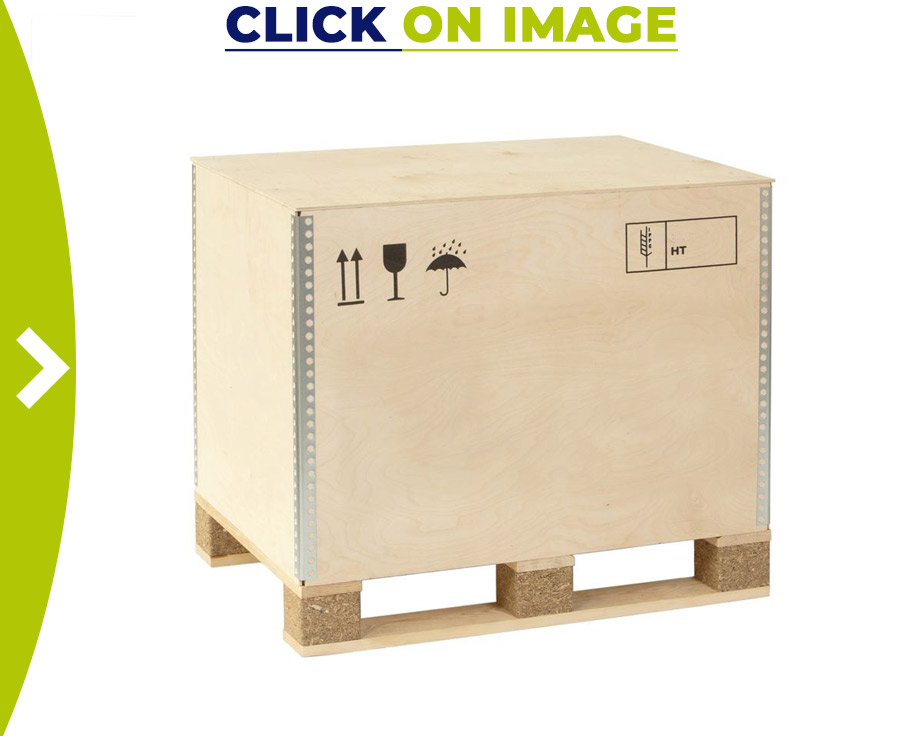
Within hours, we discussed the first requirements by phone. Within days, a first order of 150 foldable plywood boxes-lengths 2400 mm, 3200 mm, and 4200 mm-was placed.
These boxes were planned for one-way shipping. Each container would hold high-value mobile lifting equipment, destined for individual end customers. Returning empty packaging was not economical, so durability, stability, and efficiency had to be guaranteed on the first and only trip.
But as often happens with industrial logistics, the real challenges only reveal themselves when you walk through the factory yourself.
A Second Order… and an Invitation to the Factory Floor
Shortly after receiving their first shipment, the manufacturer returned with a second request. This time, they wanted changes made to the pallet bottom. Instead of repeating the initial design assumptions, we suggested a visit to the customer’s warehouse and production process.
Standing on the factory floor among long steel elements and oversized wooden pallets, it became clear that the request was only part of a larger challenge. Johanna, the logistics manager guided us through every station-packing, lifting, storing, loading-explaining the bottlenecks they faced.
By the time we completed the walkthrough, we identified multiple improvements that could not only solve their initial request but also remove hidden inefficiencies the customer had assumed were “just part of the job.”
What happened next surprised even them:
We integrated all improvements immediately into the second production run.
Challenge 1: Forklift Bending the Load During Center Pick-Up
The most critical issue became obvious during a live demonstration. When the forklift lifted the long goods from the center-necessary due to aisle and space constraints-the pallet bowed under the weight. Even a few centimeters of flex caused internal pressure points on the expensive crane components.
Our solution came in two parts:
a) Creating a Side Opening for Center Pick-Up
We engineered an opening in the side section of the pallet so the forklift could insert its forks precisely at the central balance point-without damaging the pallet walls or compromising its strength.
b) Internal Wooden Inserts to Support the Goods at the Lift Point
Inside the box, we installed highly specific wooden supports aligned exactly with the forklift’s pressure zones. The supports transferred the load evenly and prevented any bending of the pallet during lifting.
During testing at the customer’s warehouse, the logistics supervisor looked relieved:
“This is the first time the pallet stays perfectly straight. This alone saves us the stress we’ve had for years.”
Challenge 2: Flexible Strapping Options for Different-Sized Goods
The crane components varied not only in length but also in width and geometry. Some needed two straps, others four or more, and the strapping points changed depending on the order.
With the original pallet design, the workers struggled to find the right tie-down positions.
We redesigned the upper deck fully:
- All wooden planks on the deck were spaced approximately 50 mm apart.
- This spacing created uniform gaps through which straps could pass at any location.
- Workers gained the freedom to safely, quickly, and without improvisation secure any product shape.
The packing team later mentioned that this improvement alone reduced their loading time by many minutes per box, a measurable efficiency win in a facility shipping dozens of crates per week.
Challenge 3: Optimising Load Capacity for Transport
Not every shipment required the full height of the original box walls. In many cases, lower walls would have provided the same level of protection but would have reduced the volume taken in the truck-and therefore transport cost.
We delivered two compatible wall-height variants:
- Standard height for larger and complex cranes
- Lower height for compact cranes
Now the customer can choose the optimal wall size for each shipment, and the logistics planner can load trucks more efficiently.
A Collaboration That Grew Beyond the First Question
What began as a simple order for foldable plywood boxes turned into a full packaging optimisation project. The company benefited from:
- Safer handling of long, heavy parts
- Reduced risk of damage
- Faster packing times
- Better transport utilisation
- Packaging tailored to different product groups
- A partner who understood their logistics, not just their order
One of the customer’s engineers summarised the process perfectly while standing next to a newly packed crate:
“We were looking for boxes. What we received was a set of solutions that helped us rethink how we ship.”
A Strong Example of How On-Site Insight Creates Real Value
This project shows that industrial packaging is rarely “just packaging.” It’s a crucial link between production and delivery – where mistakes cost real money, real time, and real customer satisfaction.
By going on-site, speaking with forklift operators, talking with engineers, and observing the actual logistics flow, we were able to identify challenges that would never appear in an email or a technical drawing.
And for this customer in the south of Germany Europe, the improvements continue to pay off with every shipment they send.
More from ZAMKO
For more info and news about our business, please visit our Facebook page!
For Product Demonstrations & How It Works visit our YouTube Channel.
Table of Contents
Toggle