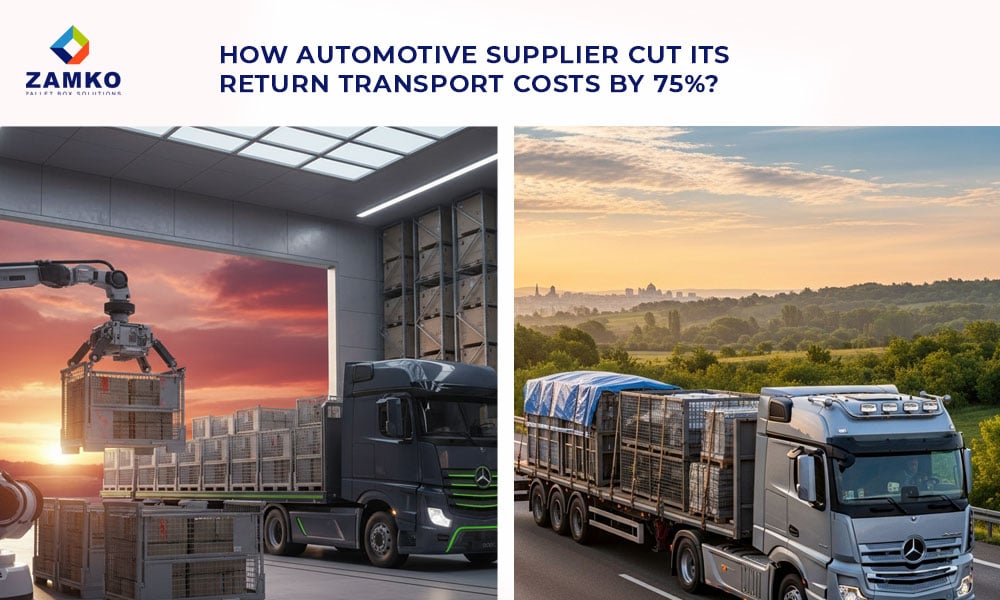
How Automotive Supplier Cut its Return Transport Costs by 75%?
The Result
A Bulgarian Tier-1 automotive supplier running weekly truck shipments from Sofia to northern Spain — 2,700 km each way — cut its return truck costs by 75% by switching from rigid steel Gitterboxes to collapsible mesh wire pallet cages.
One return truck now does the work that four did before. On a weekly route, that means 39 fewer return truck movements per year and an annual saving of €147,420 on return transport alone. Saving 75 cents on every euro previously spent on return journeys.
No warehouse redesign. No retraining. No disruption to the customer’s Spanish assembly plant. The transition happened over several weeks while both container types circulated together, fully interstacked.
A Logistics Problem Hidden in Plain Sight
For years, the company relied on traditional steel Gitterboxes to transport its components to Spain. The containers were durable, familiar to customers, and fully compatible with existing automotive logistics systems.
“They worked perfectly during transport,” the project manager, Ivaylo, explains as we walk past stacks of finished components awaiting dispatch. “The problem was not going full. The problem was coming back.”
Each shipment required the empty containers to return to Bulgaria for reuse. Because Gitterboxes are rigid and bulky, they occupy nearly the same volume whether loaded or empty.
“You pay almost twice,” the plan manager, Victor, later tells me in his office overlooking the production floor. “Once to send product. And again to send back air.”
Across such long distances, those empty kilometres were expensive. Fuel prices fluctuated. Driver shortages increased rates. Sustainability targets added pressure to reduce unnecessary transport.
At one point, logistics costs began eroding margins on otherwise successful contracts.
“We realised we were optimising production continuously,” the plant manager Victor says. “Automation, energy, materials. But logistics – that was almost untouched.”
The First Conversation with ZAMKO
The turning point came during discussions with industrial packaging specialist ZAMKO. According to the project manager Ivaylo, the initial proposal sounded almost too simple. “They said: what if you could save more than 50% on your transport costs of returning logistic packaging?” He laughs. “In automotive, when somebody says that, you immediately start looking for the catch.”
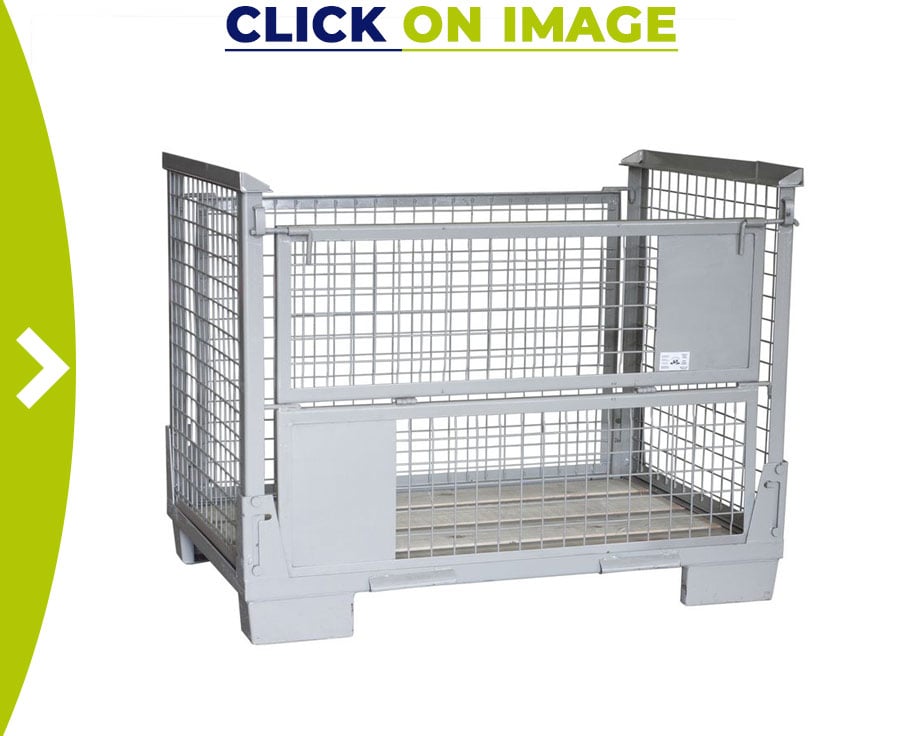
The suggestion was to replace the Gitterbox pool with collapsible mesh wire pallet cages — designed to remain fully interstackable with the current Gitterboxes. The key advantage lay in reverse logistics. Folded cages occupy dramatically less volume.
Why the Numbers Work: The Stacking Ratio
The physics are straightforward. An empty Gitterbox is a rigid steel frame. With careful hand-loading — placing the top unit manually inside the second — the team achieves three Gitterboxes per pallet place on the return truck. That is the practical maximum, and it requires extra labour at both ends of the 2,700 km route. For this distance, the extra effort is worth it.
An empty mesh wire pallet cage collapses and nests. Twelve cages stack per pallet place on the return truck — no special handling required. Three Gitterboxes versus twelve cages per pallet place: a 4:1 ratio. One return truck now carries what four return trucks carried before.
Container | Units per pallet place (return) | Return trucks per 100 units | Return cost per unit | Annual return trucks (weekly route) |
Steel Gitterbox (3-high, hand-stacked) | 3 units | ~1.0 truck | €38.18 | 52 movements |
Mesh wire cage (12-high, standard) | 12 units | ~0.25 truck | €9.55 | 13 movements |
Saving | 4:1 ratio | 75% fewer trucks | €28.64 per unit | 39 movements saved / €147,420 |
Based on: 2,700 km one-way, €1.40/km, 33 pallet places per standard curtainsider, weekly shipments (52 return movements/year before the switch).
€147,420 saved per year on return transport alone. Saving 75 cents on every euro previously spent on return journeys.
Convincing the Customer
Changing packaging in automotive supply chains is rarely simple. Every container interacts with multiple stakeholders: assembly plants, warehouse operators, transport providers and quality engineers.
“The biggest challenge wasn’t internal,” the project manager explains. “It was convincing our customer.”
Spanish receiving plants were accustomed to standard Gitterboxes. Changing equipment risked operational disruption – something OEM supply chains avoid at almost any cost.
Here, compatibility became decisive.
“The cages stacked perfectly with existing Gitterboxes,” he says. “During transition, both systems could circulate together.”
No warehouse layouts needed redesigning. Forklift handling remained identical. Loading heights stayed the same.
“From their perspective,” Ivaylo adds, “nothing changed operationally.”
ZAMKO engineers worked closely with both sides to test stacking stability, handling safety and loading patterns.
“They didn’t come only with a product,” the plant manager Victor notes. “They came with calculations.”
Detailed transport simulations showed potential savings across a full year of return logistics between Bulgaria and Spain.
“That’s when the discussion changed,” Victor says.
The Economics That Made the Decision
In the conference room, spreadsheets appear on a screen.
Transport costs, kilometres driven, CO₂ reduction estimates.
“The numbers convinced everyone,” the project manager says.
Return transport, return trucks previously carrying empty Gitterboxes often reached volume limits long before weight limits. With foldable mesh cages, utilisation improved dramatically.
Instead of sending multiple trucks west-to-east every week, fewer vehicles were required.
“The saving is not ten percent,” Ivaylo explains. “It is structural.”
Fuel consumption decreased. Fewer drivers were required. Administrative handling dropped.
Even unexpected benefits appeared.
“When fewer trucks arrive,” he says, “yard congestion decreases. Scheduling becomes easier.”
Victor, the plant manager, leans forward.
“In automotive supply, reliability is more important than price. But when reliability stays identical and price improves significantly – then the decision becomes obvious.”
No Disruption Allowed
Perhaps the most remarkable part of the transition is how little actually changed inside the factory.
On the packaging line, operators continue loading components exactly as before.
Forklifts approach cages from the same angle. Stack heights remain standardised.
“We promised our teams there would be no operational complications,” the project manager says.
That promise mattered.
Production facilities running contracts for major European car manufacturers cannot afford experimental logistics solutions that slow throughput.
“The cages entered circulation gradually,” he explains. “Mixed with Gitterboxes.”
Because both systems interstacked safely, the transition happened invisibly.
“There was no big switch-off moment,” he says. “One week you noticed more cages than gitterboxes.”
Sustainability as a Bonus
Although cost savings drove the project, environmental gains quickly followed.
Fewer return trucks meant lower emissions.
For a company increasingly focused on lightweight materials and electrification projects, the alignment mattered.
“We are already investing heavily in sustainable production,” the plant manager says. “Energy efficiency, renewable power agreements, lightweight materials.”
Reducing unnecessary transport kilometres supported the same philosophy.
“You cannot talk about sustainability only inside the factory,” he adds. “Logistics is part of the footprint.”
39 fewer truck movements per year on a 2,700 km route represents a significant and documentable reduction in Scope 3 Category 4 transport emissions — directly reportable under CSRD and GHG Protocol frameworks.
Lessons Learned
As trucks depart the loading bays behind us, each trailer precisely filled, the project manager reflects on what surprised him most.
“How simple the solution was,” Ivaylo says.
- No new warehouse investments.
- No retraining programmes.
- No redesign of transport equipment.
“Sometimes innovation is not robotics or software,” he says. “Sometimes it is just asking: why are we transporting empty space?”
ZAMKO’s role, he emphasises, was not only supplying equipment but guiding the calculation process.
“They understood both packaging and logistics economics.”
For Victor, the plant manager, the lesson is even broader.
“In automotive, people resist change because mistakes are expensive,” he says. “But if you can change without risk – that is powerful.”
Outside, another truck begins its long journey west toward Spain, loaded with components destined for the next generation of European vehicles. And when it returns to Bulgaria, it will carry three times as many empties as it did before — at a quarter of the cost per unit.
Running Long Return Routes with Rigid Containers?
If your operation uses non-foldable containers on return routes above 500 km, the transport economics almost always justify a switch to a collapsible system. The key variable is your stacking ratio: how many empties fit per pallet place in your return truck compared to the rigid alternative. On long cross-border routes, even a modest ratio improvement generates savings that far exceed the cost of the new container fleet.
ZAMKO supplies mesh wire pallet cages and sleeve pack systems across Europe with stock available for immediate delivery. For a calculation based on your specific route, fleet size, and container type, see the complete returnable packaging buyer’s guide or contact ZAMKO directly.
Table of Contents
Toggle