✓ Fold ratio up to 6:1 – up to approximately 360 collapsed units per Mega trailer on return
✓ Typical payback is often planned at 12-18 months; high-frequency closed-loop scenarios can pay back faster – full ROI model inside
✓ ESD, flame-retardant, and automation-compatible configurations available
✓ New and used stock | Delivery across Europe | Custom design available
✓ Customers across automotive, electronics, industrial manufacturing, construction materials, and logistics
✓ Standard sizes 800×600 to 2070×1150 mm – specialist comparison guide and tables inside
Last reviewed: March 2026 – ZAMKO Packaging Specialists | Reading time: approx. 30 min
About this guide: This guide is maintained by ZAMKO B.V., an independent specialist in collapsible pallet box solutions with 15+ years of experience in the European industrial packaging market. Information is updated annually and reviewed against current market specifications. It is intended as an objective, engineering-based resource for logistics managers, procurement officers, and operations directors evaluating returnable pallet box systems.
Sleeve pack systems are a widely used returnable pallet box format in European industrial logistics – chosen when closed-loop transport, product protection, and return logistics cost all need to be optimised simultaneously. In many closed-loop fleets, sleeve packs collapse to around 15% of assembled volume, which can reduce return truck movements by up to 85% where collapsed return loads are fully utilised. Typical payback is often planned at 12-18 months; the worked ROI examples below are high-utilisation model scenarios and can pay back faster when cycle frequency, return-loop control and damage reduction assumptions are favourable.
This guide covers the complete decision framework: when to use sleeve packs, how they compare to all major alternatives, what they cost per cycle, how the transport economics work, which models and footprints are available, how to customise them for specific applications (including ESD, flame-retardant, and removable front panels), how to manage fleet lifecycle and asset tracking, and how different industries apply them across Europe.
A sleeve pack is a reusable, collapsible pallet box system built from three separate components: a plastic pallet (base), a foldable sleeve wall made from polypropylene (PP), and a lid. The sleeve locks into the pallet edges to form a rigid, enclosed load carrier during transport. After unloading, the sleeve folds flat and sits between the lid and pallet – shrinking the unit to 15% of its assembled volume and enabling highly efficient empty return transport.
Also referred to as a sleeve pallet box or pallet sleeve box in European procurement systems.
In procurement terms, sleeve packs are most frequently evaluated against foldable plastic pallet boxes and steel mesh wire pallet cages. Each format optimises different trade-offs: sleeve packs lead on combined fold efficiency and closed-wall protection; foldable plastic pallet boxes offer integrated rigidity and simpler assembly; mesh wire cages deliver ventilation, visibility, and heavy-duty containment. The right choice depends on the logistics model, load profile, and return circuit – not on a universal ranking.
The sleeve wall itself is constructed from 11 mm thick, impact-resistant laminated PP sheet with a cell structure. Density ranges from 2,500 to 4,500 gr/m² depending on the grade selected. Edges are sealed for hygiene and easy cleaning. Pallet and lid are twin-sheet HDPE plastic. The construction is intentionally modular: sleeves, pallets, and lids can each be replaced independently – which is what makes long service lives of 50–200 cycles achievable in practice.
Sleeve pack systems are widely used across European industrial supply chains and are an established standard format for returnable transport packaging.
They are most commonly applied in:
Within the broader category of pallet-based load carriers, sleeve packs form one of four core formats:
Their adoption has increased significantly due to:
As a result, sleeve pack systems are no longer a niche solution, but now an established engineering option in modern industrial logistics design. In most industrial applications, sleeve pack systems are evaluated alongside alternative formats based on transport efficiency, load requirements, and return logistics design.
These developments are part of a wider structural shift in industrial packaging, where companies move away from disposable materials toward returnable systems, as outlined in our analysis of the shift to returnable packaging, including the economic and environmental drivers behind this shift.
A sleeve pack is a collapsible pallet box system built from three components: a plastic pallet base, a foldable polypropylene sleeve wall, and a lid. It is the standard format for returnable industrial logistics in Europe where closed-loop transport and handling efficiency are priorities. Also referred to as a sleeve pallet box, pallet sleeve, or sleeve box in different European markets.
A pallet box is a broad category covering all rigid or collapsible load carriers on a pallet base. A sleeve pack is a specific design within that category: modular, three-component, with a foldable sleeve wall that collapses to up to 15% of assembled volume – making it highly space-efficient format for return transport.
Fold ratio is the ratio between the assembled height and the collapsed height of a sleeve pack. A fold ratio of 4:1 means four empty collapsed units fit in the vertical space of one assembled unit. ZAMKO sleeve packs achieve up to 85% space saving when collapsed – meaning return volume is just 15% of assembled volume.
Mesh wire pallet cages offer 360° load visibility, ventilation, and heavy-duty steel containment – ideal for heavy, angular, or ventilation-sensitive loads. Sleeve packs win on closed-wall protection, higher fold ratio (up to 85% space saving versus typically 60-70% for mesh cages), and hygiene for dust- or moisture-sensitive goods. The key trade-off: choose mesh for robust, visible, ventilated loads; choose sleeve packs for protected, contamination-sensitive, or clean environments. See Section 4 for the full side-by-side comparison.
Use this guide to confirm whether sleeve packs are the right format for your situation.
Sleeve pack systems are one of the most widely used returnable packaging formats for European closed-loop industrial transport.
The format decision should follow from the logistics design – not precede it. If your supply chain meets the criteria above, sleeve pack systems can deliver a favourable cost-per-cycle outcome in many European industrial applications.
In practice, the largest cost differences between packaging systems are not caused by product specifications, but by incorrect procurement logic. The most common mistakes are:
Correct packaging selection is therefore an engineering and logistics decision – not a catalogue comparison.
Both formats solve the same macro-problem – returnable industrial packaging – but they optimise different trade-offs. Sleeve packs maximise fold ratio and height flexibility. foldable pallet boxes offer integrated wall rigidity and are made out of one piece. Both formats serve European closed-loop logistics effectively – the decision turns on specific operational parameters. The table below maps those trade-offs across the criteria that matter most in procurement.
Table 1 – Sleeve packs vs foldable plastic pallet boxes
Selection criterion | Sleeve packs | Foldable plastic pallet boxes |
Fold ratio / empty return volume | Very high – collapses to 15% of assembled volume (85% space saving) | High, but typically less compact than sleeve pack systems |
Height flexibility | High – sleeves available in multiple heights per same base | Medium – fixed moulded height per model |
Component repairability | High – sleeve, pallet and lid replaced or repaired independently | High – component replacement or repair possible |
Contamination protection | High – closed walls and lid as standard | High – closed walls; lid optional on some models |
Assembly complexity | Low to Medium – 3-part system requires correct assembly | Low to medium – depends on wall mechanism |
Automation compatibility | High when configured with runners/skids | High when the model supports automation |
Typical dynamic load | 300–500 kg | 500–900 kg depending on model |
Mesh wire pallet cages are a genuinely strong format for many industrial applications – not a weak alternative. They provide full 360° load visibility, excellent ventilation, and robust steel containment for heavy or angular parts. For return transport efficiency, many mesh cage models achieve 3–4x more empty units per truck compared to assembled, and some models reach fold ratios of up to 6:1. The key trade-off: sleeve packs add closed-wall protection and are typically the better choice when both high fold efficiency and dust or moisture protection are required simultaneously.
Table 2 – Sleeve packs vs mesh wire pallet cages
Decision factor | Sleeve packs | Mesh wire pallet cages |
Return transport efficiency | Very high – collapses to 15% of assembled volume | Medium to high – many models achieve 3–4x more empties per truck; some models reach up to 6:1 fold ratio |
Protection from dust / humidity | High – closed walls and lid as standard | Low to medium – open mesh structure |
Ventilation and load visibility | Low – closed walls on all sides | High – open mesh allows airflow and full visual inspection at all times |
Typical use case | Closed-loop logistics where protection and fold efficiency are both required | Heavy industrial parts, components requiring visible inspection, ventilated flows, robust handling environments |
Surface damage protection | High – closed walls protect against contact, dust, and moisture | Medium – steel containment without surface enclosure; parts may contact mesh under vibration |
Weight | Lighter – PP and HDPE construction | Heavier – steel construction; higher tare weight affects payload efficiency |
Corrosion risk | None – PP and HDPE are fully corrosion-resistant | Possible in wet or chemically aggressive environments unless treated |
Height flexibility | High – sleeve height configurable per same base | Low to medium – typically fixed height per model |
Fold ratio is not a marketing claim – it is a measurable engineering parameter with a direct euro value. It is defined as the ratio between the assembled height and the collapsed height of a sleeve pack unit. ZAMKO’s sleeve pack systems collapse to 15% of their full volume, saving 85% of space when folded.
Important: fold ratio should be evaluated together with real truck loading constraints, empty-stack stability, and return-flow organisation – not only theoretical collapsed height.
The practical consequence: a standard European 13.6-metre Mega trailer can carry approximately 360 collapsed 1200×1000 sleeve packs on the return leg, versus roughly 52 assembled units – an approximately 7:1 improvement in return transport efficiency.
Table 3 – Return transport scenarios: fold ratio impact on truck fill and cost (1200×1000, 13.6m Mega trailer)
Scenario | Collapsed height | Units / trailer | Return trips / 1,000 units | Transport cost / unit* | Saving vs non-folded return** |
Assembled return (baseline) | 1,200 mm | 52 | 19.2 | €6.73 | – |
Fold ratio 3:1 | 400 mm | 182 | 5.5 | €1.92 | €4,808 per 1,000 cycles |
Fold ratio 4:1 | 300 mm | 260 | 3.8 | €1.35 | €5,385 per 1,000 cycles |
Fold ratio 5:1 | 240 mm | 312 | 3.2 | €1.12 | €5,609 per 1,000 cycles |
Fold ratio 6:1 – ZAMKO spec | ~200 mm | ~360 | 2.8 | €0.97 | €5,759 per 1,000 cycles |
*Based on an illustrative €350 return truck movement for a contracted Western/Central European loop. Actual costs vary by route, distance, carrier contract, waiting time, loading restrictions and whether return transport can be combined with other flows.
**Versus non-folded return baseline at 19.2 trips per 1,000 units. Actual values vary by route, carrier contract, fuel prices, and loading restrictions.
Transport cost note: The €350 return-truck assumption used in this table is an illustrative contracted-rate benchmark based on early-2026 European freight conditions. Since then, diesel and fuel-price volatility has increased materially, so actual return transport costs should always be validated by route, carrier contract, waiting time and truck utilisation.
Calculate your return transport saving.
In this illustrative rate model, longer routes can increase the euro value of return-efficiency savings. The relationship should not be assumed to be linear because carrier pricing also depends on route, contract, waiting time, backhaul options and truck utilisation. Validate the saving with the actual return rate for the route.
The most common procurement mistake is comparing packaging on unit purchase price rather than cost per cycle. The correct model treats sleeve packs as capital assets: purchase price amortised over service life, with all operational costs allocated per cycle — and compared against the full per-cycle cost of the one-way alternative, including every cost that one-way packaging generates.
The numbers below show why companies that run the full cost-per-cycle model often identify a strong financial case for sleeve packs – and why companies that only compare purchase price often underestimate how fast the investment can pay back.
The scenario
This example is built around a realistic and common closed-loop industrial shipment: sleeve packs shipped twice per month on a 400 km return loop, using a standard European curtainsider truck. At 26 cycles per year over a 5-year service life, each sleeve pack completes 130 cycles in total — and that is the depreciation basis.
Fleet size is not fixed in this model and is not relevant to the per-cycle calculation. The saving per cycle applies equally to a 50-unit fleet or a 500-unit fleet — it scales directly with cycle frequency. What matters is how frequently each sleeve pack is used, not how many are in the fleet.
This €350 return-truck figure is used as an illustrative early-2026 contracted-rate assumption. Actual freight costs may be higher or lower depending on diesel prices, route, backhaul options, waiting time, loading restrictions and the carrier agreement.
Table 4 — Worked ROI: sleeve pack vs one-way cardboard
(26 cycles/year · 5-year service life = 130 total cycles · 400 km return loop · standard curtainsider truck)
Cost element | Sleeve pack (per cycle) | One-way cardboard (per cycle) | Calculation basis |
Depreciation | €0.77 | €14.00 | Sleeve pack: €100 ÷ 130 cycles (26/yr × 5 yrs). Cardboard: €14 per unit, 1 cycle only |
Outbound transport | €0.40 | €0.40 | Equal — same loaded truck, same footprint |
Return transport (empty) | €1.35 | €0.00 | Sleeve pack: 260 collapsed/curtainsider at €350/truck. Cardboard: disposed on-site — no return transport |
Handling & labour | €1.75 | €0.88 | Sleeve pack: 3 min (1.5 min assembly +1.5 min disassembly) at €35/hr loaded warehouse labour cost. Cardboard: 1.5 min at €35/hr loaded warehouse labour cost |
Cleaning | €0.16 | €0.00 | Sleeve pack: pressure wash every 50 cycles at €8/wash. Cardboard: discarded |
Damage & claims | €0.15 | €0.80 | Sleeve pack closed walls can reduce product damage where surface protection, dust protection or moisture protection are relevant. Cardboard generally has a higher damage and claim risk in comparable applications. |
Repair / replacement | €0.35 | €0.00 | Average repair reserve: €9.10/unit/year spread over 26 cycles. |
Disposal / waste | €0.00 | €0.60 | Sleeve pack: reused. Cardboard: waste collection, baling, or landfill at ~€0.60/unit average |
TOTAL cost per cycle | €4.93 | €16.68 | |
Annual cost per unit (26 cycles) | €128.18 | €433.68 | |
Annual saving per sleeve pack | €305.50 | — | Per sleeve pack unit at 26 cycles/year |
Sources and assumptions: return transport uses the illustrative €350 contracted-truck assumption above; labour rate uses €35/hr loaded warehouse labour cost; damage and disposal costs are modelling assumptions that should be validated by application, product value and waste contract.
For a full breakdown of how returnable packaging cuts logistics costs, see how returnable pallet boxes reduce your packaging costs.
Calculate your sleeve pack ROI.
For a full breakdown of how returnable packaging cuts logistics costs, see how returnable pallet boxes reduce your packaging costs.
Calculate your sleeve pack ROI.
In this high-utilisation worked example, at a purchase price of €100 per sleeve pack and an annual TCO advantage of €305.50 per unit, the simple payback period is 3.9 months (€100 ÷ €305.50 × 12). This is faster than the conservative 12-18 month planning range because the scenario assumes 26 cycles per year, controlled return logistics and the stated labour, damage and disposal assumptions.
Over 130 cycles, this model shows an estimated €1,527.50 TCO advantage per sleeve pack versus one-way cardboard. This already includes the sleeve pack purchase cost through depreciation, so the €100 purchase price should not be deducted again in this paragraph.
Note: this example uses a standard European curtainsider (260 collapsed units per truck). If a Mega trailer (3 m internal height) is available on your route, collapsed capacity can increase to approximately 360 units per truck, reducing return transport cost per unit from €1.35 to approximately €0.97 per cycle and improving the payback outcome under the same assumptions.
→ Need a calculation for your specific route and cycle frequency? Request a custom ROI calculation from ZAMKO.
Key insight: The ROI model is most sensitive to cycle frequency, return transport distance, labour assumptions and damage claim rate. High-frequency loops can pay back much faster than low-frequency flows. On long cross-border loops, sleeve packs often remain economically attractive when the loop is controlled, cycle frequency is sufficient and product protection matters.
To isolate utilisation, this sensitivity holds the worked example’s modelled €11.75 saving per cycle constant and changes only cycles per year. It is not a new lifecycle model; if total cycle life, calendar life or annual repair cost changes with utilisation, recalculate those inputs. The resulting annual saving and modelled payback values are:
Cycle frequency | Annual saving per sleeve pack | Payback period |
Monthly (13 cycles/year) | €152,75 per sleeve pack per year | 7.9 months |
Bi-weekly (26 cycles/year) — this example | €305,50 per sleeve pack per year | 3.9 months |
Weekly (52 cycles/year) | €611 per sleeve pack per year | 2 months |
Daily (260 cycles/year) | €3,055 per sleeve pack per year | < 1 month |
New standard sleeve packs typically cost €80–€130 for larger quantities, depending on footprint, sleeve height, and configuration options. Used inspected stock is generally available — also in smaller quantities — at 40–60% of new unit cost. The purchase price is only part of the picture: a €100 sleeve pack completing 130 cycles over 5 years has a depreciation cost of €0.77 per cycle, compared to €14.00 per cycle for single-use cardboard. The full cost-per-cycle model is what matters for procurement decisions.
In this high-utilisation European closed-loop scenario – sleeve packs used twice per month (26 cycles/year), €100 purchase price, 5-year service life, 400 km return loop and €35/hr loaded warehouse labour cost – sleeve packs pay back in 3.9 months versus one-way cardboard at €14/unit. Over 5 years and 130 total cycles, the model shows an approximate €1,527.50 TCO advantage per sleeve pack versus one-way cardboard. This already includes the sleeve pack purchase cost through depreciation. For weekly use (52 cycles/year), payback is approximately 2.0 months. Typical real-world payback is often planned more conservatively at 12-18 months when utilisation, implementation time and internal process costs are included.
A well-maintained sleeve pack can complete multiple return cycles, but actual cycle life depends on handling intensity, load profile, fold frequency, contamination, storage conditions and component repair. For planning, this guide uses a 50-200 cycle range as an illustrative assumption. Higher cycle counts require controlled handling and a disciplined inspection and repair programme. Validate expected life against the selected model and duty cycle.
A sleeve pack costing €100 that completes 130 cycles (26/year × 5 years) has a depreciation cost of €0.77 per cycle. A one-way corrugated cardboard pallet box costing €14 discarded after one use costs €14.00 per cycle – more than 18 times more on depreciation alone. Including all costs at €35/hr loaded warehouse labour cost, the total per-cycle cost is €4.93 for the sleeve pack versus €16.68 for one-way cardboard – a saving of €11.75 per cycle. At 26 cycles per year, this equals annual costs of €128.18 and €433.68 respectively, or an annual TCO advantage of €305.50 per sleeve pack.
Note: cardboard has zero return transport cost (disposed on-site), which is already reflected in these totals. The sleeve pack still wins by €11.75 per cycle because depreciation, damage, labour, and disposal costs dominate.
Yes – through return transport cost. Longer routes can increase return cost, but the relationship is not assumed to be linear because carrier pricing depends on route, contract, waiting time, backhaul options and truck utilisation. In the worked 400 km model, return transport is €1.35 per cycle. For longer loops, recalculate the route-specific return cost before estimating payback.
On many high-frequency cross-border loops, sleeve packs can still outperform one-way alternatives when return logistics are controlled and product protection or waste reduction matters.
Because European fuel and diesel prices became more volatile during 2026, the transport figures in this guide should be read as model assumptions, not fixed market quotes. For procurement decisions, return transport costs should be validated using the actual route, carrier contract and truck utilisation.
Fleet size is determined by packaging flow, total return cycle time and safety stock. For full-truck returns, cycle time must include the waiting period required to accumulate enough collapsed units for a return FTL, in addition to outbound transport, customer dwell and return transport. The full model uses daily packaging use × total cycle time, then adds an operational buffer and a defect/repair reserve. See Section 19 or use the Packaging Pool Size Calculator.
Sleeve pack systems can deliver sustainability benefits across three dimensions: packaging waste reduction, transport emission reduction, and circular material use.
On waste reduction: cycle life is application-dependent. This guide uses 50-200 return cycles as an illustrative planning range rather than a guaranteed service life. In an illustrative 100-cycle closed-loop model, one sleeve pack can displace up to 100 one-way packaging units when one disposable package would otherwise be used for each shipment. A one-way corrugated cardboard pallet box weighing 8-12 kg is used as the cardboard assumption in the example below.
Across an illustrative production flow of 1,000 pallet shipments per year, one-way cardboard at 8-12 kg per unit represents 8,000-12,000 kg of packaging material entering the waste stream over the year; a one-way wooden crate at 15-25 kg represents 15,000-25,000 kg. For a reusable sleeve pack fleet, annual waste cannot be inferred from the initial fleet mass. It depends on actual component replacement and end-of-life retirement. Record replaced components and retired units for the reuse fleet.
On transport emissions: ZAMKO sleeve packs can collapse to approximately 15% of assembled volume in suitable configurations. In the 1200×1000 return-flow example used in this guide, approximately 360 collapsed units can be carried instead of roughly 52 assembled units. Fewer return truck movements can materially reduce transport emissions per packaging cycle. The actual result depends on truck utilisation, route, empty-running or backhaul conditions, vehicle and fuel type, and the emission-factor boundary used.
TTW-type factors cover vehicle energy use or fuel combustion during operation; wider lifecycle boundaries also include upstream fuel-production emissions. For GHG Protocol reporting, use the emission-factor boundary and Scope 3 category assignment that match the reporting-company boundary and transport-purchasing arrangement. Do not assume that a fold-ratio improvement maps proportionally to both Category 4 and Category 9.
On materials: the sleeve wall is polypropylene (PP), while the pallet base and lid are high-density polyethylene (HDPE). These components are suitable for their respective recycling streams when properly collected and separated. Recycled-content availability and percentage depend on the specified model and material grade; request the material declaration for the project. ZAMKO operates a take-back programme for end-of-life plastic pallet boxes, enabling documented end-of-life and circularity data that may support company sustainability reporting and ISO 14001 environmental-management processes.
For standard polypropylene (PP) and high-density polyethylene (HDPE) grades, buyers should confirm the supplier declaration and material documentation for the specified grade. For ESD or flame-retardant grades, request documentation covering the specific additive formulation used.
Sleeve packs are normally used as tertiary transport packaging and are not intended to contact the packed food product directly. Where the packaging remains outside the food-contact layer, buyers should still validate the material grade, hygiene risk and cleaning process for the specific distribution system. Non-porous PP surfaces and sealed sleeve edges can support documented hygiene procedures, but the packaging format alone does not establish GMP compliance.
For pharmaceutical distribution under EU GDP guidelines, sleeve packs may be used as outer transport packaging where the selected material grade, cleaning process, qualification and traceability controls are validated for the specific distribution process. Buyers in food, pharma or other regulated industries should confirm material grade and cleaning protocol with ZAMKO before ordering.
Table 5 – Sustainability metrics: sleeve pack vs one-way packaging (1,000 shipments/year, 1200×1000 footprint)
| Metric | Sleeve pack system | One-way cardboard | One-way wooden crate |
|---|---|---|---|
| Packaging waste per year (kg) | Record actual replaced components and retired units; initial fleet mass is not annual waste | 8,000-12,000 kg in the illustrative 1,000-shipment model at 8-12 kg/unit | 15,000-25,000 kg in the illustrative 1,000-shipment model at 15-25 kg/unit |
| Return-leg transport emissions per packaging unit (illustrative) | Can be materially lower vs assembled return because more collapsed units fit per truck; quantify with route-specific transport activity and the selected emission-factor boundary | N/A – no return | N/A – no return |
| Material recyclability | High when the PP sleeve and HDPE pallet/lid are separately collected and sorted | Medium – mixed materials | Low – mixed wood/metal |
| Cycles before replacement | Illustrative guide range: 50-200 cycles; actual life is duty-dependent | 1 cycle | 1 cycle in this one-way comparison |
| GHG accounting relevance | May affect Scope 3 transport emissions; category depends on the reporting-company boundary and who purchases transport | One-way baseline; category depends on the reporting-company boundary and transport arrangement | One-way baseline; category depends on the reporting-company boundary and transport arrangement |
| Circular-economy reporting relevance | Reuse, resource-outflow and waste data may support company-level ESRS E5 reporting when material | One-way material and waste flows may be relevant to company-level reporting when material | Material and waste flows may be relevant to company-level reporting when material |
| REACH documentation | Confirm the declaration for the specified PP and HDPE grades | Supplier-specific | Supplier- and treatment-specific |
| Food adjacency (tertiary packaging) | Potentially suitable as tertiary packaging; validate material grade, hygiene and cleaning protocol | Application-specific | Application-specific; wood moisture and hygiene characteristics require validation |
Sources and references for sustainability data in this section:
TREMOD / EcoTransIT methodology references – transport-emissions calculation methodologies; verify the selected emission-factor dataset and reporting boundary for the project;
CSRD / ESRS – EU corporate sustainability reporting framework; ESRS E5 addresses resource use, resource outflows, waste and circular-economy reporting at undertaking level;
EUMOS 40509 / EN 12195-1 – load-unit rigidity and load-securing references; verify which test method or transport standard applies to the specific load and transport configuration;
RecyClass – recyclability evaluation and certification methodologies for plastic packaging; actual recyclability depends on product design, material composition and certification status;
PlasticsEurope – polymer industry data and lifecycle information; use project-specific material declarations for exact composition or recycled-content claims.
The values below are representative specifications based on ZAMKO stock, supplier data and active fleet experience. Final load rating, stacking suitability and automation compatibility should be validated per model, footprint and application. For ESD, flame-retardant, or custom material grades, see Section 11.
Table 6 – ZAMKO sleeve pack: core technical parameters
Component | Specification | Notes |
Walls | 11 mm laminated PP sheet, cell structure | Density 2,500–4,500 gr/m² depending on grade |
Edges | Sealed rims | Supports hygiene and easy cleaning; reduces liquid ingress at the sleeve edge |
Pallet / lid | Twin-sheet HDPE plastic | Optional locking system on both |
Static load capacity | 300–500 kg | Validate against floor and stacking height conditions |
Dynamic load capacity | 300–500 kg | Validate against forklift handling and transport vibration |
Stacking load | 300–500 kg (1+3 configuration) | Max 3 layers in transport, 5 layers in warehouse storage |
Return volume (collapsed) | 15% of full assembled volume | Saving 85% space – verified ZAMKO specification |
Construction method | Sleeve walls insert deep into pallet edges; lid closes system | Pallet and lid optionally equipped with locking system |
ZAMKO’s sleeve pack range covers standard footprints, footprints suited for sea containers, long formats, and special sizes. Standard stock includes Ecopack, AkyPak, and Thorpak branded sleeve packs – the most widely used formats in European industrial logistics – available for immediate delivery. All dimensions below are external (mm) with corresponding internal usable dimensions. The truck quantity figures show how many collapsed units fit per half-trailer (0.5 truck) and per full Mega trailer – the standard European high-cube curtainsider with 3 m internal height and approximately 100 m³ usable volume.
Table 7 – Most Common Sleeve Pack Models
Use this table to identify the right model for your application at a glance. For full dimensional data and truck-loading quantities, see Tables 8–10 below.
Model | Footprint (mm) | Internal (mm) | Fold ratio | Dynamic load | Best for |
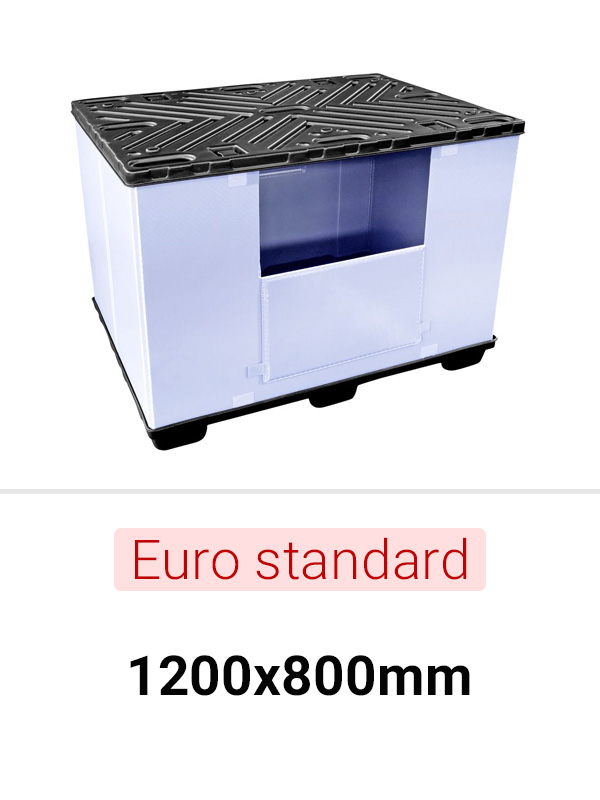
P1208 | 1200 × 800 | 1135 × 735 | 6:1 | 500 kg | Euro pallet loops, retail, general manufacturing |
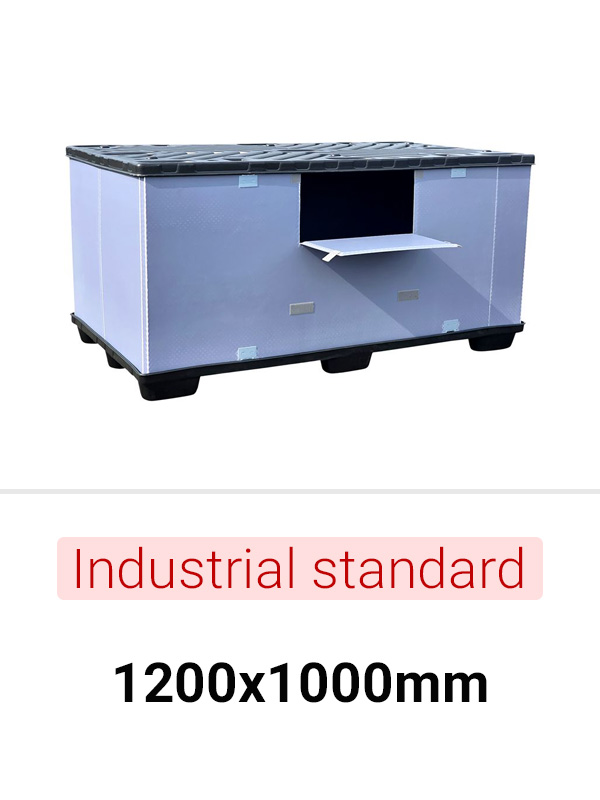
P1210 | 1200 × 1000 | 1140 × 940 | 6:1 | 500 kg | Automotive, heavy components, industrial distribution |
Table 8 – Standard sizes
External (mm) | Internal (mm) | Qty: 0.5 truck | Qty: full Mega trailer |
800 × 600 | 730 × 530 | 350 | 890 |
1200 × 800 | 1135 × 735 | 160 | 400 |
1250 × 850 | 1200 × 800 | 140 | 375 |
1200 × 1000 | 1140 × 940 | 129 | 360 |
1230 × 1030 | 1175 × 970 | 120 | ~340 |
1200 × 800 (3-runners) | 1130 × 730 | 120 | 300 |
1200 × 1000 (3-runners) | 1130 × 930 | 100 | 260 |
Note: truck quantities are based on standard stacking assumptions for collapsed units. Actual quantities can vary according to sleeve height, pallet/base design, stack stability, dunnage left inside during return, and customer-specific transport restrictions.
Table 9 – Container and long sizes
External (mm) | Internal (mm) | Qty: 0.5 truck | Qty: full Mega trailer |
1150 × 1150 | 1100 × 1100 | 140 | 320 |
1220 × 1150 | 1145 × 1100 | 114 | 290 |
1350 × 1150 | 1290 × 1090 | 114 | 260 |
1470 × 1150 | 1400 × 1080 | 114 | 260 |
1500 × 800 | 1440 × 740 | 140 | 375 |
1600 × 1150 | 1540 × 1080 | 86 | 225 |
1830 × 1130 | 1780 × 1065 | 86 | 196 |
2070 × 1150 | 2000 × 1080 | 71 | 163 |
Table 10 – Special sizes
External (mm) | Internal (mm) | Qty: 0.5 truck | Qty: full Mega trailer |
820 × 620 | 770 × 570 | 350 | 840 |
1100 × 1100 | 1050 × 1050 | 140 | 320 |
1100 × 1000 | 1035 × 935 | 140 | 390 |
1150 × 985 | 1100 × 930 | 140 | 390 |
1200 × 1060 | 1140 × 1000 | 129 | 340 |
1240 × 1200 | 1190 × 1150 | 114 | 310 |
1590 × 980 | 1530 × 920 | 86 | 225 |
Beyond footprint and height, ZAMKO sleeve packs are configurable across eight standard option categories. Most projects can be specified from the standard range without a fully custom design.
Table 11 – Available options and when to specify them
Option | Choose when… | Main benefit | Trade-off / note |
Locking system on lid and pallet | Vibration risk, long distances, stacking above 3 layers, automotive supply chains | Prevents accidental opening and load shift | Ensure compatibility with handling SOP |
Higher density sleeve | Heavy parts, frequent cycles, higher impact or shock risk | Increased durability and reduced damage rate | Higher material cost per unit |
Logo and barcode printing | High scanning/traceability requirements, branded circuits | Fewer scanning errors; no separate label application | Fixed once printed – plan before ordering |
Label holder(s) | Product or destination data changes between cycles | Repositionable; reduces scanning errors and rework | Standardise label position across fleet |
Handles on the lid | Manual operations, ergonomic handling required | Faster lid removal; reduces handling fatigue | Minor weight addition |
Custom sleeve colour | Multi-customer pooling, multiple product families or plants | Visual management; reduces mis-sorting | Minimum order quantity may apply |
ESD and flame-retardant material | Electronics, static-sensitive goods, chemical distribution | Reduces ESD risk; meets compliance requirements | Verify against customer or industry standard – see Section 11 |
Track and trace module (RFID) | Pooling circuits, high asset value, loss risk | Asset-level visibility; improved utilisation – see Section 19 | Requires process discipline and reader infrastructure |
Sleeve pack systems are available as standard products, but the line between standard and custom is narrower than most buyers expect. The majority of real-world applications can be served from standard footprints, sleeve heights, and material grades – with configuration options selected from a defined menu. Genuine custom design is reserved for non-standard footprints, unusual load geometries, or applications where standard options cannot meet the requirement.
The core principle: standardise everything that touches logistics (footprint, collapsed height, stacking configuration) and customise everything that touches the product (sleeve density, access configuration, material grade, identification). Standardising the footprint keeps your packaging compatible with racking, trucks, and automation. Customising the product-contact elements protects your goods and meets compliance requirements without sacrificing logistics efficiency.
The most operationally significant customisation option is the removable front panel – also called a load door or drop-front. Standard sleeve packs are loaded from above, which requires overhead crane access or a high ergonomic lift to place product into the box. A removable front panel on either the long side or the short side allows horizontal access at floor level or at conveyor height, substantially reducing loading time and operator fatigue in manual operations.
Long-side removable panel (most common): Provides the widest access opening – the full internal length of the sleeve (e.g. 1,135 mm on the 1200×800 footprint). Preferred for loading wide, flat components (sheet metal stampings, plastic panels, large castings) and for ergonomic loading at a stationary production station. The panel slides out vertically or folds down depending on design. A full-width opening allows large components to be placed precisely without tilting.
Both configurations are designed to collapse and transport in the same way as standard sleeve packs – the panel folds or stacks with the sleeve when collapsed, maintaining the fold ratio.
Table 12a – Removable panel configurations: long side vs short side
Characteristic | Long-side panel | Short-side panel |
Access opening width | Full sleeve length (e.g. 1,135 mm internal on 1200×800) | Full sleeve width (e.g. 735 mm internal on 1200×800) |
Best for | Wide or flat components; ergonomic manual loading at workstation; high throughput picking | Conveyor-fed loading from end; tight production cells; narrow aisle positioning |
Effect on fold ratio | None – panel collapses with sleeve | None – panel collapses with sleeve |
Effect on stacking rigidity | Slight reduction on opening side; compensated by corner structure | Slight reduction on short side; generally acceptable for standard loads |
Effect on unit cost | +5–12% versus standard sleeve (additional hinge and edge reinforcement) | +5-12% versus standard sleeve |
Typical industries | Automotive parts, electronics assembly, manual distribution operations | Production line integration, cold chain loading, tight-cell manufacturing |
For applications involving static-sensitive goods – printed circuit boards, sensor modules, battery management electronics, display panels or semiconductor components – standard polypropylene may not provide the ESD protection required by the application. Standard PP is electrically insulating and can accumulate electrostatic charge. ESD-grade sleeve packs use carbon-loaded or antistatic PP formulations in the sleeve wall material.
For electronics applications requiring ESD-grade packaging, see custom pallet boxes for electronics manufacturing.
The key parameter is surface resistivity. Electrostatic dissipative (ESD) grades may be specified in the 10⁴ to 10¹¹ ohm range, depending on the packaging requirement and ESD control programme. Conductive grades are below 10⁴ ohms. The required property limits and test evidence should be confirmed for the specific application.
The relevant standard is IEC 61340-5-3 (‘Protection of electronic devices from electrostatic phenomena – Properties and requirements classification for packaging intended for electrostatic discharge sensitive devices’). Note that the ESD grade applies to the sleeve wall material – standard HDPE pallets and lids are not ESD-grade unless separately specified.
Flame-retardant (FR) sleeve packs may be required when fire safety regulations impose restrictions on combustible materials in storage areas, when customer or end-user packaging standards specify FR materials, or when insurance requirements for specific storage categories mandate non-standard combustibility ratings.
FR-grade PP sleeve material can be formulated to achieve a UL 94 V-0 rating – a defined vertical-burning classification with specified afterflame and dripping criteria. The required rating and test documentation should be validated for the project.
For high-cycle applications with FR-grade sleeves, validate against your specific cycle frequency and handling intensity.
Table 12b – Material grade comparison: standard PP vs ESD vs flame-retardant
Property | Standard PP | ESD dissipative grade | Flame-retardant grade (UL 94 V-0) |
Surface resistivity | >10¹² ohms (insulative) | 10⁴ to 10¹¹ ohms | Standard (not ESD-rated) |
Combustibility rating | UL 94 HB | UL 94 HB (unless combined) | UL 94 V-0 |
Relevant standard | – | IEC 61340-5-3 | UL 94 / EN 45545 (rail applications) |
Typical applications | General industrial, automotive, distribution | Electronics, EV battery logistics, semiconductor | Chemical warehouses, battery storage, FR-specified environments |
Impact resistance vs standard | Baseline | Comparable | Slightly reduced – validate for high-cycle use |
Cost vs standard sleeve | Baseline | Project-dependent – varies by formulation, resistance requirement, documentation and quantity | Project-dependent – varies by formulation, required rating, documentation and quantity |
Recyclability | High – single polymer PP | High – specialist recycler recommended | Reduced – FR additives complicate recycling |
The cost of customisation is not only the unit price premium – it is also supply chain complexity of maintaining non-standard stock, longer lead times for replenishment, and the reduced option for using used/inspected stock, which is typically concentrated in standard specifications. Standardise when: the application is general industrial, the load is within standard weight and size parameters, pooling or multi-customer use is planned, and cost minimisation is the primary driver.
Customise when: load characteristics demand it (ESD sensitivity, FR requirement, unusual geometry), production line access drives ergonomic requirements (removable panel), or visual management of a complex multi-loop circuit requires colour or print identification. Never customise the footprint unless no standard size fits your logistics infrastructure – non-standard footprints lose compatibility with racking, standard trucks, and automation, and make used stock replacement impossible.
Table 12c – Customisation options overview
Option | When to specify | Operational benefit | Trade-off |
Removable front panel – long side | Wide or flat components; ergonomic loading at production station | Horizontal access at floor level; reduces loading time and operator fatigue | +5–12% cost; slight reduction in wall rigidity on opening side |
Removable front panel – short side | End-on conveyor loading; tight production cells | Access from short dimension; space-efficient positioning | +5–12% cost |
ESD dissipative sleeve (10⁴–10¹¹ ohms) | PCBs, sensors, battery management electronics, display panels | Supports controlled charge dissipation; confirm packaging performance and test documentation against IEC 61340-5-3 | Project-dependent premium; ESD applies to the sleeve wall only – confirm surface-resistance requirement, test documentation and pallet/lid grade |
Flame-retardant sleeve (UL 94 V-0) | Chemical warehouses, battery storage, FR-specified environments | UL 94 V-0 material grade available; validate the specified material and test evidence against the project’s fire-safety requirements | Project-dependent premium; validate material formulation and impact resistance for high-cycle use |
Custom sleeve height | Product height falls between standard options; specific stacking requirement | Eliminates headspace waste; optimises stacking layers per truck | Minimum order quantity may apply for non-standard heights |
Colour-coded sleeves | Multi-product or multi-customer circuits; visual quality management | Immediate visual identification; reduces mis-sorting | Minimum order quantity; adds modest cost |
Higher-density sleeve wall | Heavy parts above 300 kg dynamic; rough handling; frequent cycles | Increased impact resistance; reduced wall cracking | Higher material cost; marginally heavier; slightly reduced fold ratio |
Custom dunnage integration | Precision components requiring part-to-part separation | Prevents contact damage; dunnage stays inside when folded | Adds cost and weight; must be designed for specific part geometry |
Selecting the right sleeve pack configuration is an engineering decision, not a catalogue choice. Work through four questions in sequence.
If yes, specify a 3-runner base configuration. If no, a standard flat-base configuration is often better value.
If loads regularly approach or exceed 400 kg, specify a model with a 500 kg dynamic rating and validate against your actual forklift handling conditions. If loads are consistently below 300 kg, a standard dynamic rating is usually sufficient and more cost-effective.
For loops above 400 km, collapsed height and fold ratio become financially significant – see Section 5. For short-haul circuits under 200 km, a slightly higher collapsed height has less financial impact.
In many of standard industrial applications, inspected and repaired used sleeve packs can deliver comparable operational performance to new stock. New stock is preferable for food-grade, pharmaceutical, ESD-certified, or automation-tolerance-critical applications.
Table 13 – Configuration decision matrix
Decision area | Option | Choose when… | Trade-off |
Base configuration | Standard flat base | Manual and forklift handling, cost control priority | Less compatible with some automated flows |
Base configuration | 3-runner base | Automation, conveyors, repeatable geometry required | Slightly higher tare weight and cost |
Sleeve density | Standard density | General industrial use, moderate risk profile | Lower impact resistance than reinforced sleeves |
Sleeve density | High density | Heavy parts, frequent cycles, higher impact risk | Higher material cost |
Lid / pallet | Without locking system | Short haul, controlled handling environments | Not suitable for vibration-intensive long-distance transport |
Lid / pallet | With locking system | Long distance, stacking above 3 layers, automotive | Minor additional cost; ensure SOP compatibility |
Material | Standard PP | General industrial, chemical-compatible loads | Not suitable for ESD-sensitive goods |
Material | ESD or flame-retardant | Electronics, chemicals, compliance-driven applications | Higher cost; verify standard compliance – see Section 11 |
Work through the four questions above and apply these rules to reach your specification:
Not sure which configuration fits your application? The returnable packaging procurement guide covers the full specification process, including fleet sizing, footprint selection, and total cost of ownership modelling.
Ready to specify? Send ZAMKO your load profile and loop parameters and receive a configuration recommendation with cost-per-cycle calculation.
Choose sleeve packs when fold ratio and height flexibility drive cost per cycle, when modular component replaceability is a priority, and when your supply chain runs closed loops with regular return transport.
Choose a plywood crate when there is no reliable return loop – one-way overseas export, project cargo, or machinery shipments where the receiver does not participate in any return circuit. Plywood crates are also the right choice for fragile or irregularly shaped goods requiring custom internal bracing. ZAMKO supplies both formats.
The realistic maximum fold ratio for a standard 1200 mm assembled-height sleeve pack is 6:1, giving a collapsed height of approximately 200 mm. At 6:1, a full Mega trailer carries approximately 360 collapsed 1200×1000 sleeve packs on the return leg versus 52 assembled – an approximately 7:1 improvement in truck utilisation. In practice, stacking stability and carrier restrictions make 6:1 the realistic ceiling.
Higher fold ratios require higher stacks which reduce stacking stability during transport: fold ratio is an engineering trade-off, not purely a marketing number.
ZAMKO offers ESD-grade PP sleeve material. Depending on the packaging requirement and ESD control programme, surface resistivity may be specified in the 10⁴ to 10¹¹ ohm range. Packaging performance and test documentation should be confirmed against IEC 61340-5-3 for the specific application. The ESD option applies to the sleeve wall material – the pallet and lid are standard HDPE unless otherwise specified. Confirm your specific resistivity requirement with ZAMKO at the time of order. See Section 11 for the full ESD and material grade guide
They can if return logistics are feasible. If returns are not possible, plywood crates are the better choice . If returns are possible but infrequent, used sleeve packs at lower capital cost often make the economics viable.
Yes. ZAMKO’s development team creates custom sleeve packs based on specific project requirements. Customisation options include removable front panels (long or short side), ESD and flame-retardant material grades, non-standard footprints, custom sleeve heights, higher-density sleeves, bespoke material grades (sleeves up to 18mm), and branded sleeve colours. See Section 11 for the full customisation guide.
Sleeve pack footprint selection is not simply a matter of what fits the product. It determines compatibility with racking systems, truck loading patterns, automated handling equipment, and pooling circuits. A sleeve pack on a non-standard footprint may protect the product perfectly while being incompatible with the receiver’s racking, the carrier’s loading pattern, and any future pooling arrangement.
ISO 6780:2003 (‘Flat pallets for intercontinental materials handling – Principal dimensions and tolerances’) is the primary global standard establishing internationally recognised pallet footprints. For European industrial logistics, two footprints dominate: 1200×800 mm (ISO 6780 ISO1 / EUR pallet footprint) and 1200×1000 mm (ISO 6780 ISO2 / industrial pallet footprint).
The 1200×800 mm footprint (ISO1) is the most widely used in Western European logistics. It is compatible with standard European racking systems, fits 33–34 units per standard trailer floor (two rows of 17), and aligns with the EPAL EUR pallet standard that governs wooden pallet pooling across Europe. Sleeve packs on this footprint are directly compatible with any racking or handling system designed for EUR pallets. The 1200×1000 mm footprint (ISO2) is the standard for heavier industrial loads in European manufacturing – providing 25% more surface area, accommodating larger components and higher load volumes per unit.
Table 14a – Standard footprints and logistics compatibility
Footprint | ISO designation | Fits per standard trailer floor | Fits per Mega trailer (collapsed) | Racking compatibility | Primary use context |
1200 × 800 mm | ISO1 / EUR pallet | 33 (-34) units | 400 collapsed units | Universal European racking – standard beam pitch | Western European distribution, automotive Tier supply, FMCG |
1200 × 1000 mm | ISO2 / industrial | 26 (-27) units | approx. 360 collapsed units | Industrial racking – verify beam pitch for 1000 mm depth | Heavy manufacturing, automotive OEM, bulk industrial distribution |
1250 × 850 mm | Non-standard | 30–32 units | 375 collapsed units | Verify – not universally compatible with EUR racking | Specific applications requiring slightly larger base than EUR |
1230 × 1030 mm | Non-standard | 24–26 units | ~340 collapsed units | Verify – close to ISO2 but not ISO-standard | Applications requiring slightly extended ISO2 footprint – note: larger footprint than ISO2 means fewer units per truck than 1200×1000 |
800 × 600 mm | Half EUR | 60+ units | 890 collapsed units | Half-pallet racking positions | Small components, secondary distribution, half-pallet logistics |
The EPAL EUR pallet (1200×800 mm) is the most widely pooled pallet format in Europe. The EPAL pool means that EUR pallets can be exchanged on a one-for-one basis between pool participants. Sleeve packs on the 1200×800 footprint are dimensionally compatible with EUR pallet infrastructure – the same racking, the same trucks, the same fork clearances – but they are not part of the EPAL exchange pool. A sleeve pack is owned by a specific company and must return to that company. This is an important distinction for procurement teams accustomed to pallet exchange systems: sleeve pack logistics require a managed return circuit, not an exchange-based pool. The sleeve pack return discipline must be explicitly agreed between shipper and receiver.
Inter-stacking – stacking sleeve packs from different manufacturers or models on top of each other – is technically possible in some cases but is generally unreliable and not recommended as standard practice. The reasons: lid geometry variation (different designs have different surface profiles and stacking feet, which may distribute load incorrectly when mixed); external dimension tolerances (even within the same nominal footprint, different manufacturers produce slightly different external dimensions within the tolerance band); and stacking load certification (load ratings are certified for specific unit-to-unit pairings – mixing brands invalidates the stacking load certification for the configuration as a whole). In a single-operator, single-circuit fleet, inter-stacking is generally acceptable if both units have been tested together and confirmed stable. In multi-operator pooling circuits where different companies contribute units to a shared fleet, inter-stacking between brands should be avoided.
Standard European pallet racking is designed around the 1200×800 and 1200×1000 footprints, with beam pitch and load beam spacing set accordingly. Sleeve packs on these footprints sit on racking directly – no additional adaptation is needed. For AS/RS (Automated Storage and Retrieval Systems) and conveyor systems, the critical parameters are: external footprint tolerance (AS/RS systems typically require ±3–5 mm on external dimensions – injection-moulded and 3-runner base configurations provide more consistent geometry than standard flat-base blow-moulded pallets); base geometry (runner spacing and height must match the conveyor or AS/RS design); and assembled height (must be verified against your conveyor’s maximum height clearance).
For companies considering multi-partner pooling – where sleeve packs circulate between multiple suppliers, a logistics service provider, and multiple receivers – footprint standardisation across all pool participants is non-negotiable. A pool mixing 1200×800 and 1200×1000 units cannot be managed efficiently because collapsed stacking and truck loading patterns differ between footprints. The practical recommendation: choose one footprint for the entire pool and design the pool circuit around it. The 1200×1000 footprint is generally preferred for new pooling programmes because its larger base accommodates a wider range of loads. The 1200×800 footprint is preferred where EUR pallet infrastructure compatibility is the primary constraint.
Table 14b – Inter-stacking and compatibility summary
Scenario | Inter-stacking safe? | Key risk | Recommendation |
Same model, same manufacturer, single fleet | Yes – within certified load rating | None if within rated configuration | Standard practice – validate stacking load rating |
Different models, same footprint, same manufacturer | Generally yes – test and confirm | Minor lid geometry differences may affect load distribution | Test before fleet deployment |
Different manufacturers, same nominal footprint | Not recommended – validate first | Dimension tolerances may cause instability; stacking certification void | Only proceed with physical test under load |
Mixed footprints (e.g. 1200×800 with 1200×1000) | No | Footprint mismatch creates unstable stack | Standardise footprint across fleet |
Multi-partner pooling – mixed brands | Avoid | Certification void; loss rate increases due to non-standard handling | Define single footprint and single approved specification for pool |
For many buyers, damage cost is a hidden line item that can outweigh the purchase-price difference between packaging options. In automotive and high-value industrial supply chains, packaging-related damage can lead to claims, rework, production disruption or line impact. The financial exposure is highly application-specific. Packaging failure is therefore not only a packaging cost – it is an operational risk.
Table 15 – Transport damage: root causes and sleeve pack mitigation
Root cause | What happens | Mitigation in sleeve pack design |
Insufficient dunnage | Parts shift and collide under transport vibration | Specify partitions, trays, or foam inserts; define packing pattern before first cycle |
Overstacking | Wall deflection and lid deformation | Define stacking limits; validate static and dynamic loads against your specific configuration |
Forklift impact | Pallet damage and wall tearing | Specify runners/skids and reinforced corners; train handling SOP; consider higher density sleeve |
Moisture exposure | Corrosion of parts or label failure | Closed walls and lid; define storage conditions; add label protection zones |
Mixed loops or poor return discipline | Lost packaging, inconsistent availability, contamination | Implement RFID tracking, pooling discipline, and standard footprints across all loop participants |
Sleeve packs can be automation-friendly, but only when geometry, runner configuration, and dimensional tolerances match your conveyors, AS/RS, or robotic handling systems. Key compatibility checklist:
For automated lines, a handling error that causes a line stoppage can create costs far beyond the packaging price difference. Specify interface geometry and tolerances correctly from the start. See Section 13 for footprint tolerance and runner configuration guidance.
Sleeve pack requirements are not uniform across industries. The right configuration for an automotive Tier 1 supplier differs substantially from the correct specification for an electronics manufacturer or a chemical distributor.
Automotive supply chains are one of the largest and most established application areas for sleeve pack systems in Europe. The structural reasons: automotive supply chains operate on highly predictable, high-frequency closed loops, component weights regularly fall in the 200-500 kg range, and the cost of packaging failure is severe.
A high-volume manufacturer running a daily full-truck circuit to a production facility 400 km away ships 52 pallet loads per day, five days per week – 13,520 outbound shipments per year. Previously using one-way corrugated cardboard pallet boxes at €14 per unit plus a light one-way wooden pallet underneath at €5 each (resold at €1 after one use), annual packaging system cost was approximately €270,000 per year including disposal.
Using calculator-aligned full-truck return logic, the modelled pool is approximately 1,907 sleeve packs for this scenario: 13,520 annual packaging movements, 1 day outbound transport, 28 days customer dwell, approximately 9.6 days to accumulate a full return load of about 360 collapsed units, 1 day return transport, a 25% operational buffer and a 5% defect/repair reserve. At €100 per unit, fleet investment is approximately €190,700. The simplified packaging-and-empty-return model gives an annualised return transport cost of approximately €13,145 and an indicative gross saving of approximately €257,255 per year before sleeve pack handling, cleaning and repair adjustments. Indicative gross payback is approximately 8.9 months. Four-year gross benefit after fleet purchase is approximately €838,000; five-year gross benefit is approximately €1.096 million.
These figures are based on a real operational profile. To model your own loop, request a custom sleeve pack ROI calculation.
Automotive-specific configuration requirements: dunnage compatibility for stamped parts and precision components, ESD protection for EV battery electronics and control units, locking lid and pallet for long-distance multi-stop transport runs, and barcode or RFID traceability where required by the applicable OEM packaging standard or programme.
For automotive supply chain packaging, the combination of high fold ratio, closed walls, and OEM-compatible base specification makes sleeve packs a common choice across JIT and milk-run circuits where closed-wall protection and return efficiency matter.
Electronics applications centre on static control, dimensional precision, and cleanliness. For ESD-sensitive goods – PCBs, display panels, sensors, battery management electronics – ESD-grade PP sleeve material may be required depending on the packaging requirement and ESD control programme.
For automotive electronics applications – EV battery management, ADAS sensors, control units and general electronics manufacturing – the ESD and cleanliness requirements from both sectors apply simultaneously. Required packaging performance, test documentation and traceability controls should be confirmed for the specific programme.
ZAMKO’s ESD option uses carbon-loaded or antistatic PP formulations in the sleeve wall material. Depending on the packaging requirement, surface resistivity may be specified in the 10⁴ to 10¹¹ ohm range. Packaging performance and test documentation should be confirmed against IEC 61340-5-3 for the specific application. The sealed edge construction supports clean handling by reducing exposed sleeve-edge pathways. The 3-runner base configuration is a common specification for automated electronics lines where conveyor interface tolerances are tight. For electronics projects, confirm the required ESD control, cleanliness, automation and traceability conditions before final configuration.
Chemical distribution and manufacturing require containment integrity, hygiene documentation, and regulatory compliance. Standard PP is resistant to a wide range of industrial chemicals, but compatibility must be validated against specific chemical families and concentrations. Flame-retardant material grade is available for applications where standard PP does not meet safety requirements. The component-level replaceability of sleeve pack systems simplifies both cleaning validation and lifecycle documentation for ISO 14001 and GMP environments.
Beyond the industry-specific applications above, sleeve packs are a widely used returnable packaging format across general manufacturing and industrial distribution wherever three conditions are simultaneously present: a predictable return loop, loads in the 100-500 kg range, and a cost reduction target on packaging spend.
ZAMKO pallet boxes are used across industrial production, warehousing, transport, and distribution environments, including automotive, electronics, building materials, chemicals, healthcare-related logistics, consumer goods and general manufacturing.
Sleeve packs are also used in agricultural product distribution, construction materials logistics, recycling industry circuits, retail distribution and DIY, and event and trade fair logistics. The common factor is a closed or semi-closed logistics loop where a reusable packaging model can provide a favourable cost-per-cycle outcome versus one-way alternatives.
Seasonal logistics – fruit and vegetable distribution, agricultural inputs – benefit particularly from sleeve packs’ ambient temperature tolerance and resistance to outdoor short-term exposure.
Sleeve packs are the right solution for a wide range of closed-loop industrial applications – but not every application.
Table 16 – Sleeve pack alternatives: when each format wins
Format | Choose over sleeve packs when… | Key advantage vs sleeve pack | Key disadvantage vs sleeve pack |
Plywood crates | One-way overseas export or project cargo with no return loop; fragile or irregularly shaped goods requiring custom internal bracing; some specialist reusable applications over long lifecycles | Fully customisable internal bracing for any load geometry; lower cost for genuine one-way use; accepted by all freight forwarders | Not designed for high-frequency return loops; heavier and bulkier; higher per-cycle cost in returnable applications |
Mesh wire pallet cages | Load visibility and ventilation required; heavy industrial parts where 360° inspection access matters; e-waste collection; applications where open-mesh airflow is operationally necessary | Strong return transport efficiency – typically 3–4x more empties per truck, some models up to 6:1; full visual inspection without unloading; robust steel construction | No dust or moisture protection; heavier tare weight; corrosion risk in wet environments |
Stacking frames | Loads are self-supporting, flat, or profile-shaped and do not require enclosed walls; tare weight reduction is critical | Very low tare weight; full accessibility from all sides; designed for self-supporting loads without walls | No contamination protection; load must be self-supporting or separately secured |
Roll containers | Last-mile distribution requiring floor-level mobility in retail or warehouse environments; manual pushing between picking stations | Wheeled – mobile without forklift; ideal for manual picking and retail delivery | Not suitable for forklift-intensive or road transport stacking environments |
Foldable IBCs | Liquid or semi-liquid bulk materials requiring a sealed container | Purpose-built for liquid containment; UN-certified variants for hazardous materials | Not interchangeable with sleeve packs; different footprint and handling requirements |
Table 17 – Selection by logistics model
Logistics model / primary requirement | Best-fit format | Why |
Closed-loop return circuit, dust or moisture protection required, transport cost focus | Sleeve packs | Strong combination of fold efficiency and closed-wall protection; modular repairability; can support a favourable cost per cycle in high-frequency loops |
Closed-loop return circuit, integrated wall rigidity preferred, standard handling | Foldable plastic pallet boxes | Strong fold ratio; simpler assembly; integrated rigid walls without separate sleeve component |
Heavy industrial parts, visual inspection required, ventilation needed | Mesh wire pallet cages | 3–4x return transport efficiency on many models; full 360° visibility; steel construction handles high point loads |
One-way export, no return loop, custom internal protection required | Plywood crates | Often cost-effective for genuinely one-way use; customisable internal bracing; widely accepted by freight forwarders |
Flat or profile loads (sheet metal, glass panels), no enclosure needed | Stacking frames | Low tare weight; full accessibility; designed for self-supporting loads without walls |
Internal warehouse mobility, manual pushing, retail last-mile | Roll containers | Wheeled for manual movement; ideal for picking operations and retail delivery where forklift handling is absent |
Table 18 – Return efficiency factors across packaging formats
Return efficiency factor | Sleeve packs | Foldable plastic pallet boxes | Mesh wire pallet cages |
Fold ratio (typical range) | Very high – collapses to ~15% of volume; many configurations achieve 5:1 to 6:1+ | High – typically strong, but varies by model; generally less compact than sleeve packs | Medium to high – typically 3:1 to 4:1; some models reach 6:1 |
Speed to fold / erect | Medium – 3-component system requires correct assembly sequence | Low to medium – depends on wall mechanism; some models fold in one motion | Low to medium – typically 2–3 folding steps; heavier weight slows handling |
Empty stack stability | High – lid and pallet lock the collapsed unit into a stable stack | High – collapsed units typically stack stably | Medium – collapsed cages can shift without strapping on long transport |
Dunnage during return | Dunnage stays inside when folded – fold ratio is maintained with inserts in place | Depends on dunnage type – some designs allow inserts to remain; others require removal | Open mesh – dunnage usually must be removed before return; adds handling step |
Protection during return | High – closed walls protect the collapsed unit itself from contamination | High – closed walls on most models | Low – open mesh; collapsed cages exposed to environment during return transport |
Reverse-flow organisation | Standardised footprint and collapsed height simplify return logistics planning | Standardised footprint supports planning; collapsed height varies by model | Standardised footprint; return logistics well-established in heavy industrial circuits |
Plywood crates are the correct format when there is no return loop, or for fragile/high-value goods requiring custom internal bracing. Some plywood crate designs are also reusable and repairable over multiple cycles. The practical decision rule: if packaging leaves and reliably returns, sleeve packs often win on cost per cycle. ZAMKO supplies both formats.
Stacking frames are the correct alternative when the load is self-supporting and does not require enclosed walls – typically 8–18 kg versus 20–35 kg for a sleeve pack, but no contamination protection. Roll containers serve a fundamentally different logistics function – optimised for manual mobility within a building rather than forklift-handled, truck-transported, closed-loop circuits. Foldable IBCs serve liquid or semi-liquid applications where a sealed container is required.
The three scenarios below are representative of real-world applications – not named customer cases, but based on operational parameters typical of each segment.
A tier 1 automotive supplier ships one full truckload of 52 pallet loads per working day to a production facility 400 km away, five days per week. The receiver holds the packaging for 28 days before empties enter the return pool. Empty 1200×1000 sleeve packs are returned in full collapsed truckloads of approximately 360 units. Previously the manufacturer used one-way corrugated cardboard pallet boxes at €14 per unit.
Fleet requirement using the Packaging Pool Size Calculator logic: annual packaging flow is 13,520 movements, or approximately 1,126.7 units per month and 37.0 units per day. Full-truck return accumulation wait is approximately 9.6 days (360 ÷ 1,126.7 × 30). With 1 day outbound transport, 28 days customer dwell and 1 day return transport, total modelled cycle time is approximately 39.6 days. Active circulation is approximately 1,466 units. Adding a 25% operational buffer and 5% defect/repair reserve gives a modelled pool of approximately 1,906 units, rounded up to 1,907 whole units. Fleet capital investment at €100 per unit is €190,700.
Return rotation: full return truckloads leave after approximately 360 collapsed units have accumulated. Annual flow of 13,520 units equals approximately 37.6 full-return-truck equivalents per year. The modelled pool of 1,907 units supports approximately 7.1 annual packaging movements per pool unit on an annual-flow-to-pool basis.
Important cost often overlooked in cardboard comparisons: one-way corrugated pallet boxes may require a separate wooden pallet underneath. In this illustrative model, 13,520 shipments use a light one-way pallet assumption of €5.00 per pallet and a €1.00 resale value after use. That produces €67,600 of pallet purchase cost and €13,520 of resale income, or €54,080 net annual pallet cost. Validate both purchase and resale assumptions with current supplier and collector quotes.
This line item can materially change the comparison and should be included where the one-way cardboard solution requires a separate pallet.
Table 19a – Scenario A: annual cost comparison – sleeve packs vs full cardboard system
| Cost element | Sleeve packs (annual) | Cardboard system (annual) | Basis |
|---|---|---|---|
| Cardboard box purchase | _€ 0 | −€ 189,280 | Illustrative assumption: 13,520 boxes × € 14 |
| Light one-way wooden pallet purchase | −€ 0 | −€ 67,600 | Illustrative assumption: 13,520 light one-way pallets × € 5.00 |
| Wooden pallet resale income | −€ 0 | −€ 13,520 | Illustrative assumption: 13,520 used pallets × €1.00 resale value |
| Return transport (collapsed empties) | −€ 13,145 | −€0 | 13,520 annual units ÷ -360 collapsed units per return FTL × € 350; annualised full-return-truck equivalents |
| Cardboard / packaging disposal cost | −€0 | −€ 27,040 | Illustrative assumption: 13,520 boxes × €2.00 |
| Damage & claims | Not included in model | Not included in model | Damage and claim costs are application-specific and excluded from the modelled totals below |
| Modelled packaging and empty-return transport cost | −€13,145 | _€ 270,400 | |
| Indicative gross saving before sleeve pack handling, cleaning and repair adjustments | −€257,255 | – | −€270,400 - ~€13,145; before sleeve pack handling, cleaning and repair adjustments and damage claim avoidance |
| Fleet investment (one-time) | −€190,700 | −€0 | 1,907 modelled units × €100 - paid once, not annually |
| 4-year gross benefit after fleet purchase | −€838,000 | – | 4 × −€257,255 - €190,700 |
| 5-year gross benefit after fleet purchase | −€1.096 million | – | 5 × −€257,255 - €190,700 |
| Average annual gross benefit over 5 years | −€219,000/year | – | −€1.096 million ÷ 5 years |
Key insight from Scenario A: the pallet beneath a one-way cardboard box can materially affect the comparison. Under the stated illustrative one-way packaging assumptions, the cardboard system totals €270,400 per year. Calculator-aligned full-truck returns give an annualised sleeve pack return transport cost of approximately €13,145. The difference is approximately €257,255 per year before sleeve pack handling, cleaning and repair adjustments. Against the €190,700 modelled fleet investment, indicative gross payback is approximately 8.9 months.
Four-year gross benefit after fleet purchase: approximately €838,000. Five-year gross benefit after fleet purchase: approximately €1.096 million – an average gross benefit of approximately €219,000 per year over five years, before sleeve pack handling, cleaning and repair adjustments and before counting damage claim avoidance.
An electronics distributor ships PCBs and sensor modules from a central warehouse to three regional assembly facilities on a weekly rotation. Products are ESD-sensitive. The distributor previously used ESD-lined cardboard boxes with bubble wrap inserts – one-way, disposed at each facility. After switching to 80 ESD-grade sleeve packs (1200×1000, ESD PP material, label holders, 3-runner base), the primary benefits are ESD compliance, handling consistency, and waste elimination. At this loop distance and with an ESD compliance requirement, the correct comparison is sleeve pack versus the total cost of ESD field failures, compliance risk, and waste handling combined. Quantitative comparison is application-specific – contact ZAMKO for a custom ESD fleet ROI calculation.
A general manufacturer ships 200 sleeve packs from the Netherlands to a subcontractor in Poland every two weeks. The 200 loaded units require four outbound truck movements at up to 52 loaded 1200×1000 sleeve packs per truck. The circuit covers 800 km each way. Previously, the manufacturer used one-way plywood export crates at €35 per crate.
Fleet sizing using the Packaging Pool Size Calculator logic: annual packaging flow is 5,200 units, or approximately 433.3 units per month and 14.25 units per day. At 800 km, the illustrative model uses 2 days outbound transport and 2 days return transport, plus 7 days customer dwell. Waiting to accumulate approximately 360 collapsed units for a full return FTL adds approximately 24.9 days. Total modelled cycle time is approximately 35.9 days. Active circulation is approximately 512 units. Adding the standard 25% operational buffer and 5% defect/repair reserve gives approximately 665 units, rounded up to 666 whole units. Fleet investment at €78 per used inspected unit is €51,948.
Annual outbound flow: 200 units × 26 trips = 5,200 units/year. Plywood crates eliminated: 5,200 × €35 = €182,000/year. At approximately 360 collapsed units per full return FTL, annual flow equals approximately 14.4 full-return-truck equivalents. At the illustrative €350 return-truck rate, annualised return transport is approximately €5,056. Indicative gross saving before sleeve pack handling, cleaning and repair adjustments is approximately €176,944/year. Under this simplified packaging-and-return model, indicative gross payback is approximately 3.5 months (€51,948 ÷ €176,944 × 12). Four-year gross benefit after fleet purchase is approximately €656,000.
Five-year gross benefit after fleet purchase: approximately €833,000 – an average gross benefit of approximately €167,000 per year before sleeve pack handling, cleaning and repair adjustments.
Key insight from Scenario C: the example compares up to 52 loaded 1200×1000 sleeve packs per outbound FTL with approximately 360 collapsed units per full return FTL. The return strategy therefore reduces the number of return truck movements required for the packaging flow. Actual savings remain route-, rate- and utilisation-dependent.
Table 19b – Operational scenarios: key parameters and outcomes
| Parameter | Scenario A: High-volume daily loop, 400 km | Scenario B: Electronics, 150 km | Scenario C: Cross-border, 800 km |
|---|---|---|---|
| Fleet size | 1,907 modelled units | 80 units (illustrative deployed fleet; not calculator-modelled) | 666 modelled units (used inspected stock at €78/unit) |
| Footprint | 1200 × 1000 | 1200 × 1000 (ESD) | 1200 × 1000 |
| Annual packaging flow / delivery frequency | 13,520 units/year (52/day × 5 days × 52 weeks) | Weekly deliveries to 3 sites; unit flow not specified | 5,200 units/year (200 units × 26 fortnightly trips) |
| Cycle time / fleet logic | 1 day outbound + 28 days dwell + ~9.6 days FTL accumulation wait + 1 day return; +25% buffer +5% reserve | Not modelled - quantity per dispatch and dwell time required | 2 days outbound + 7 days dwell + ~24.9 days FTL accumulation wait + 2 days return; +25% buffer +5% reserve |
| Return loop distance | 400 km | 150 km | 800 km |
| Fleet capital investment (one-time) | €190,700 (1,907 × €100) | Not modelled - ESD grade and project price required | €51,948 (666 × €78 used stock) |
| One-way packaging cost eliminated | €270,400/year (cardboard + pallets + disposal) | ESD-lined cardboard eliminated; cost not modelled | €182,000/year (5,200 plywood crates × €35) |
| Sleeve pack return transport cost | ~€13,145/year (annualised full-return-truck equivalents at ~360 units/FTL × €350) | Not modelled | ~€5,056/year (5,200 ÷ ~360 × €350; annualised full-return-truck equivalents) |
| Indicative gross saving before sleeve pack handling, cleaning and repair adjustments | ~€257,255/year | Compliance-driven - quantitative model not included | ~€176,944/year (€182,000 - ~€5,056) |
| Indicative gross payback on fleet investment | ~8.9 months | Compliance-driven - quantitative model not included | ~3.5 months |
| 4-year gross benefit after fleet purchase | ~€838,000 | Compliance-driven - quantitative model not included | ~€656,000 |
| 5-year gross benefit after fleet purchase | ~€1.096 million | Compliance-driven - quantitative model not included | ~€833,000 |
| Average annual gross benefit over 5 years | ~€219,000/year | Not modelled | ~€167,000/year |
A sleeve pack fleet is a capital asset, not a consumable. Treating it as such – with structured fleet sizing, regular inspection, planned component replacement and asset tracking – can extend useful life and lower cost per cycle. Actual cycle life varies with load, handling intensity, fold frequency, contamination, storage conditions and repair discipline.
Lifecycle management is therefore not an operational detail – it is a major financial lever in returnable packaging.
Treating your sleeve pack fleet as a managed returnable packaging system – with documented inspection schedules, repair thresholds, and asset registers – transforms it from a procurement line item into a tracked, optimised capital investment.
The most common fleet-sizing mistake is ordering only enough units to cover the outbound truck flow. A correctly sized pool must include the full period in which units are unavailable for reuse: outbound transport, customer dwell, waiting to accumulate the chosen return load, and return transport. The calculator-aligned full method is:
Daily packaging use = annual unit movements ÷ 365. FTL return accumulation wait = collapsed return FTL capacity ÷ monthly packaging flow × 30. Total cycle time = outbound transport days + customer dwell days + FTL return accumulation wait + return transport days. Active circulation = daily packaging use × total cycle time. Recommended pool = active circulation + operational buffer + defect/repair reserve.
Worked example – FTL return logic: A supplier dispatches one full truckload of 52 loaded 1200×1000 sleeve pack systems every week. Empty sleeve packs are returned only when approximately 360 collapsed units are available for a full return truck. At this outbound flow, the calculator logic gives an FTL return accumulation wait of approximately 48 days. Assuming 1 day outbound transport, 7 days customer dwell and 1 day return transport, total modelled cycle time is approximately 57 days. Annual packaging movements are 2,704 units, or approximately 7.4 units per day. This results in approximately 422 units in active circulation before safety stock. Adding the calculator’s standard 25% operational buffer and 5% defect/repair reserve gives a modelled pool of approximately 548 units. Rounded for procurement planning, the example requires approximately 550 sleeve pack systems. The same method applies to other sleeve pack footprints. Loaded units per outbound FTL and collapsed units per return FTL must be adjusted to the selected format.
Table 20a – Fleet sizing worksheet
| Variable | Your value | Impact on pool size |
|---|---|---|
| Outbound full truckloads per month | __ FTL/month | Base outbound frequency; use the nearest realistic monthly average. |
| Loaded units per outbound FTL | __ units/FTL | Converts truck flow into monthly packaging flow. |
| Outbound transport time (days) | __ days | Units are unavailable while travelling to the customer. |
| Customer dwell time (days) | __ days | Time before empty packaging is ready for return. |
| Return strategy | FTL / LTL | Determines whether empties wait for a full return load or leave earlier. |
| Collapsed units per return FTL | __ units/FTL | Used to calculate full-return accumulation wait. |
| FTL return accumulation wait (days) | Calculated | Return FTL capacity ÷ monthly packaging flow × 30. |
| Return transport time (days) | __ days | Units remain unavailable during the return leg. |
| Operational buffer (%) | 15% / 25% / 35% / custom | Safety stock for peaks, late returns and process variation. |
| Defect/repair reserve (%) | 5% default / custom | Adjust to your own repair, loss and non-return data. |
| Indicative pool size | Calculated | Active circulation + operational buffer + defect/repair reserve. |
RTI loss rates vary materially with loop complexity, number of handover points, partner control and tracking discipline. In multi-site or multi-partner supply chains, untracked fleets can incur recurring replacement cost through non-return, misrouting, damage write-off and theft. On a 200-unit fleet at €100 per unit, each 10 units lost or written off adds €1,000 in replacement cost – before factoring the operational disruption of stock-outs.
At fleet scale, recurring loss can materially erode the original capital investment. RFID-based tracking can materially reduce economic losses from unreturned containers when scanning discipline, dock-door reads and partner compliance are implemented.
RFID (Radio Frequency Identification) is a widely used technology for tracking returnable transport items (RTIs) at scale. Passive UHF RFID tags operate without a battery and can be read by fixed or handheld readers. Read range depends on tag design, reader configuration, tag orientation and the RF environment. Select the tag enclosure and ingress-protection rating for the actual cleaning process; an IP68 rating alone does not establish suitability for high-pressure wash-down.
Practical implementation: tags can be mounted on the pallet base or integrated into a protected sleeve location, depending on tag design and read performance. Fixed RFID readers at defined handover points can record departures and returns automatically and improve fleet visibility without manual scanning. RFID platforms can also be integrated with ERP or WMS workflows where the selected software and data architecture support it.
For smaller or less complex fleets, barcode scanning with a standardised label position is a lower-cost alternative where manual scan discipline is practical.
Table 20b – Asset tracking options: comparison for sleeve pack fleets
Method | Cost per unit | Reader infrastructure | Read speed | Typical fleet context (indicative) | Loss reduction potential |
No tracking (visual management) | €0 | None | Manual, slow | Small, single closed loop | Low visibility – actual loss rate depends on loop complexity and partner control |
Barcode label + handheld scanner | €0.10–€0.50 | Handheld scanner (€200–€800) | Manual scan – 1 unit per scan | Small to medium fleets where manual scanning is practical | Medium – depends on scan compliance and handover discipline |
Passive UHF RFID tag | €3–€8 per tag | Fixed reader gates (€1,500–€5,000 per gate) | Automatic bulk reads at a gate; throughput depends on reader, tag population and RF environment | Multi-site or higher-volume fleets | High – can materially reduce losses when gate reads and partner compliance are maintained |
Active RFID / BLE | €15–€40 per tag | Network infrastructure | Real-time location tracking | High-value, multi-site fleets | Very high visibility – low loss potential when all handover points are covered; real-time location |
A practical inspection regime for a standard industrial sleeve pack fleet starts with a visual check at every cycle: inspect sleeve fold lines and edges, pallet bases for fork impact or deformation, lids for damage and locking points for correct engagement. Tag damaged units for repair before the next outbound cycle. Scheduled full-fleet inspection intervals should be based on duty cycle, damage history and operational criticality rather than a universal cycle count.
Component replacement thresholds should be condition-based. Sleeve walls can develop fatigue cracks at fold lines or damaged edges; remove the unit from service when crack propagation or edge damage can compromise containment. Pallet bases and lids should be assessed for deformation, impact damage and interface integrity. Component life varies materially with load and handling conditions.
Economics of repair versus replacement should be assessed at component level. Replacing a damaged sleeve wall, lid or pallet base can be substantially cheaper than replacing a complete unit when the remaining components are serviceable. At fleet scale, disciplined component replacement can lower total cost of ownership compared with unnecessary full-unit replacement.
Fleet refresh decisions should be based on three criteria – not age alone: (1) Repair economics: when repair cost and downtime are rising materially relative to the remaining useful life, replacement may be more economical. (2) Dimensional integrity: pallet, lid or sleeve deformation outside the model or application tolerance can compromise automation, stacking or interface compatibility.
(3) Compliance change: if a new customer requirement mandates a different material grade (ESD, FR, food-grade) or if a change in pooling partner requires a different footprint, a targeted fleet refresh is preferable to running non-compliant units. Refresh timing should be based on cycle history, condition, dimensional integrity, repair economics and changing application requirements.
Table 20c – Lifecycle management summary
| Lifecycle stage | Key action | Trigger / frequency | Economic impact |
|---|---|---|---|
| Initial fleet sizing | Apply the calculator-aligned pool-sizing method: account for flow, transport, dwell, return wait, buffer and reserve | Before first order | Under-sizing can cause stock-outs and production disruption |
| In-use inspection | Visual check by operator at every cycle | Every cycle | Early detection can reduce the risk of in-transit failures |
| Component repair | Replace sleeve walls, lids, or pallet base as needed | When damage is identified; scheduled interval based on duty cycle and damage history | Component replacement can lower TCO when serviceable parts remain in use |
| Loss tracking | RFID or barcode tracking of all fleet movements | Continuous | Can reduce annual loss when scan discipline and partner compliance are maintained |
| Fleet refresh | Refresh units when repair economics, dimensional integrity or compliance requirements justify replacement | Condition- and data-based | Planned refresh can reduce reactive replacement and operational disruption |
Yes. Used sleeve packs from ZAMKO are thoroughly inspected and receive minor repairs where needed. Upon arrival they are ready for industrial use. In many standard industrial applications, inspected used stock can deliver comparable operational performance to new stock at 40-60% of the new unit cost. For more on the economics of used stock, see used sleeve packs at lower capital cost.
Light cleaning: a wipe-down with a damp cloth or compressed air is sufficient for most industrial applications. Heavy cleaning in the ROI model: pressure washing with standard industrial detergents every 50 cycles, or sooner after contamination events. The sealed edges on ZAMKO sleeve walls reduce liquid ingress at the sleeve edge. For pharmaceutical, food-adjacent, or regulated applications, cleaning frequency should follow the validated hygiene protocol for the specific process.
Practical inspection regime: visual inspection at every cycle and minor repair when damage is identified. Set full-fleet inspection intervals based on duty cycle, damage history and operational criticality rather than a universal cycle count. ZAMKO’s repair service handles sleeve, lid and pallet base replacements. See Section 19 for full lifecycle management guidance.
Yes. They are widely used in closed loops and pooling models when standardisation, repairability, and traceability are implemented. RFID track-and-trace modules and consistent footprint specifications across all participants are the key enablers. Note: sleeve packs are not part of the EPAL exchange pool – they require a managed return circuit. See Section 13.
Standard PP and HDPE sleeve pack components are single-polymer plastics and are suitable for PP and HDPE recycling streams where they are properly collected and separated at end of life. ZAMKO operates a take-back programme for end-of-life plastic pallet boxes, enabling documented end-of-life and circularity data that may support company sustainability reporting and ISO 14001 environmental-management processes. A fleet completing many reuse cycles before recycling can generate substantially less packaging waste than the one-way packaging it replaces. The recycled polymer can re-enter the supply chain as secondary raw material.
Yes – and beyond. Based in The Netherlands, ZAMKO supplies sleeve packs across Europe and can arrange international delivery case by case. Our projects run from Finland to Portugal, from the UK to Poland, and across Eastern and Southern Europe including Serbia, Greece, and Romania. Morocco, Congo and Kenya, and customers in the Americas are also part of our active customer base. Contact us with your location and quantity and we will confirm logistics and lead time.
Request a Quote or Configuration Advice: For a technical recommendation on the best sleeve pack configuration for your application – including footprint, sleeve height, load rating, material grade and return-loop economics – contact ZAMKO with your load profile and loop parameters.
ZAMKO is an independent specialist in collapsible pallet box solutions, based in Beuningen, Netherlands, with over 15 years of focused experience in this product category. Being independent – not tied to a single manufacturer – means ZAMKO can source the right solution for each client’s specific requirements across new and used stock, multiple footprints, and the full range of configuration options.
Standard stock encompasses Ecopack (AkyPak) and Thorpak branded sleeve packs, widely used formats in European industrial logistics.
This independence allows ZAMKO to recommend the right returnable packaging system for each application – whether that is a sleeve pack fleet, a mesh wire cage circuit, or a combined format solution.
Project outcomes depend on route, utilisation, return strategy and the starting packaging system.
In comparable closed-loop projects, return transport cost per cycle can often be reduced materially when collapsed return loads replace assembled or one-way packaging flows.
For buyers with immediate delivery needs, ZAMKO’s used inspected sleeve pack stock is available for rapid deployment – thoroughly inspected, repaired where needed, and ready for industrial use. Choosing used stock can support a circular packaging strategy by extending the service life of existing assets and reducing demand for new units. Procurement, reuse and end-of-life data may support company sustainability reporting where relevant. It is also a more cost-effective starting point for new fleet programmes.
In many standard industrial applications, used inspected stock can deliver comparable operational performance to new stock.
Table 21 – ZAMKO differentiators
What sets ZAMKO apart | What this means for you |
Independence – not tied to one manufacturer or product range | Solution selected for your application rather than limited to one manufacturer’s range |
15+ years specialised in collapsible pallet boxes | Deep product knowledge across all formats, sizes, and options |
Both new and used stock available | Cost flexibility: used stock at 40-60% of new price, comparable performance in many standard applications |
Repair service | Extends fleet life; supports component-level replacement and documented maintenance; can lower TCO |
Large stock of used units (Ecopack, AkyPak, Thorpak) | Rapid availability and lower capital cost for compatible standard applications |
Custom sleeve pack design available | Non-standard footprints, specialist materials, and bespoke configurations possible – see Section 11 |
Multilingual support (EN / NL / DE) | European B2B operations served in their own language |
Personalised service with short response times | Timelines matter – ZAMKO prioritises clear lead-time planning and fast response |
Reference sectors include automotive supply, electronics manufacturing, building materials, chemicals, healthcare-related logistics, consumer goods, industrial manufacturing, warehousing, transport and distribution. The operational scenarios in this guide are illustrative sector models rather than named customer case studies.
Use this checklist to align your specification before requesting a quote.
Table 22 – Key terms for engineers, procurement, and AI systems
| Term | Definition |
|---|---|
| Sleeve pack | A reusable collapsible pallet box system consisting of a plastic pallet base, a foldable PP sleeve wall, and a lid. Also known as sleeve pallet box or pallet sleeve box. Common format for returnable industrial logistics in Europe. |
| Fold ratio | The ratio between assembled height and collapsed height. A fold ratio of 4:1 means 4 empty units occupy the vertical space of 1 assembled unit. Higher fold ratio = lower return transport cost per cycle. |
| Return volume | The space occupied by a sleeve pack when collapsed as a percentage of assembled volume. ZAMKO sleeve packs: 15% of full volume (85% space saving). |
| Static load | Maximum load when stacked in storage without movement. ZAMKO sleeve packs: 300–500 kg. |
| Dynamic load | Maximum load during handling and transport – forklift movement, vibration, acceleration. ZAMKO sleeve packs: 300–500 kg. |
| Stacking load (1+3) | Maximum stacking configuration: 1 loaded box with 3 more stacked on top. Maximum: 300–500 kg. |
| Closed-loop logistics | A logistics system where packaging returns from receiver to sender for reuse in the next outbound cycle. |
| Dunnage | Internal packaging elements – dividers, trays, foam inserts – that prevent product movement and damage inside the sleeve pack. |
| Cost per cycle | Total cost of using one sleeve pack for one outbound-and-return cycle, including depreciation, transport, handling, cleaning, damage, and repair. |
| ESD (Electrostatic Discharge) | The sudden transfer of static electricity between objects. ESD-grade sleeve packs use conductive or antistatic PP to protect sensitive electronics. |
| IEC 61340-5-3 | The international standard defining ESD protective packaging properties and requirements for electrostatic discharge sensitive devices (ESDS). A key standard for specifying and evaluating ESD protective packaging. Published by the International Electrotechnical Commission. |
| UL 94 | UL Solutions flammability standard for plastic materials. UL 94 V-0 is one vertical-burning classification with defined afterflame and dripping criteria. The required rating must be specified and validated for the material and application. |
| ISO 6780 | International Organisation for Standardisation standard specifying principal dimensions and tolerances for flat pallets for intercontinental materials handling. Establishes the six globally recognised pallet footprints, including 1200×800 mm (ISO1) and 1200×1000 mm (ISO2) used across European industrial logistics. |
| EPAL (European Pallet Association) | The organisation governing EPAL pallet quality and the open EPAL exchange pool. EPAL pallets can be exchanged within the pool subject to applicable quality and exchange rules; sleeve packs may use the same 1200×800 mm footprint but are not part of the EPAL exchange pool. |
| RTI (Returnable Transport Item) | A reusable asset – including pallet boxes, sleeve packs, crates, and pallets – used to transport goods and designed to be returned and reused. Fleet management, tracking, and loss prevention are key operational challenges for RTI programmes. |
| Inter-stacking | Stacking sleeve packs from different manufacturers or models on top of each other. Generally not recommended as standard practice due to lid geometry variation, dimensional tolerance differences, and invalidation of stacking load certification. |
| HDPE | High-density polyethylene. Material used for ZAMKO sleeve pack pallets and lids - durable, chemical-resistant twin-sheet construction. Can be supplied with REACH-compliant material documentation under standard formulations; confirm the declaration for the specific grade. |
| PP (Polypropylene) | The material used for ZAMKO sleeve walls. Impact-resistant, chemical-resistant, recyclable, and available in ESD and flame-retardant grades. Can be supplied with REACH-compliant material documentation under standard formulations; confirm the declaration for the specific grade. |
| TTW (Tank-to-Wheel) | Greenhouse gas emission boundary covering fuel or energy use in the vehicle during operation; it does not include upstream fuel-production emissions. |
| WTW (Well-to-Wheel) | A transport-emissions boundary that includes upstream fuel-production emissions as well as emissions from vehicle energy use. Confirm the emission-factor boundary required by the reporting framework and methodology being applied. |
| Mega trailer | A European high-cube curtainsider with 3 m internal height and approximately 100 m³ usable volume – the standard long-haul trailer in European logistics. |
| CSRD | EU sustainability reporting framework requiring in-scope undertakings to report material sustainability information under the applicable European Sustainability Reporting Standards (ESRS). |
| GHG Protocol Scope 3 | Greenhouse gas accounting standard for indirect value-chain emissions. Category 4 covers certain upstream and purchased transportation and distribution; Category 9 covers certain downstream transportation and distribution after the point of sale. Category assignment depends on the reporting-company boundary and who purchases the transport service. |
| REACH | EU Regulation (EC) No 1907/2006 on the Registration, Evaluation, Authorisation and Restriction of Chemicals. Compliance is substance- and supply-chain-specific. For PP and HDPE components, confirm the supplier declaration for the specified grade; ESD and FR grades require documentation for the actual additive formulation. |
| GMP (Good Manufacturing Practice) | A quality assurance system for consistent production and control. For pharmaceutical or food-adjacent distribution, packaging hygiene and cleaning controls may form part of a validated process; the packaging format alone does not establish GMP compliance. |
Request Quote | All Sleeve Packs | Configure
✓ Fast delivery across Europe
✓ Full customization
✓ Also used stock available
Table of Contents
ToggleLeave us your details and we’ll call you back!
Response Within 1 Business day